.jpg)
RAF Cranwell
Above the main doors of the Officers Mess at RAF Cranwell, carved into the lintel, are two Latin words: Altium Altrix. Nurture the highest. The motto was chosen for an institution that did not exist anywhere else in the world when it was founded - a dedicated academy for training the officers of an air force. The Royal Air Force itself had only existed for eighteen months when its college opened here on 1 November 1919. There was no curriculum to copy. Britain was inventing the idea of an air force from the start, and Cranwell was inventing the idea of the officer who would lead it. Every flight commander, station commander, air marshal, and Chief of the Air Staff in RAF history since has begun their commissioned service on the flat Lincolnshire ground around this house.
From Naval Air Station to Air Academy
The story begins not with the Royal Air Force but with the Royal Navy. In November 1915 the Admiralty requisitioned 2,500 acres of farmland from the estate of the Marquess of Bristol, on the open Lincolnshire plain near Sleaford, and turned it into a training base for the Royal Naval Air Service. The flat terrain and the East Midlands skies, often clear in the morning before the haze closed in, were as good for flight training as anywhere in Britain. Three years later the RNAS and the Royal Flying Corps were amalgamated into a single Royal Air Force - the first independent air service in the world. The naval training establishment became RAF Cranwell. And on 1 November 1919 the RAF College Cranwell opened its doors to the first cohort of officer cadets, a year and a half before the United States would commission its own first generation of dedicated military pilots in any comparable structure.
What an Air Officer Has to Know
What do you teach a person who is going to command in three dimensions? The RAF had to work out the answer in real time. The Modular Initial Officer Training Course runs twenty-four weeks now: leadership, physical training, military theory, fieldcraft, and the conceptual material - aerodynamics, navigation, air law, weapons - that an air officer specifically needs. After Cranwell, new officers are dispersed to branch-specific Phase Two training: pilots to flying schools, engineers to engineering courses, intelligence officers to intelligence schools. The college is the RAF's equivalent of Sandhurst for the Army or Dartmouth for the Navy. Cranwell also runs the Officer and Aircrew Selection Centre, where every applicant - whether for officer service or as non-commissioned aircrew - is put through several days of psychological assessment, group exercises, leadership tasks, and aptitude tests. Roughly one applicant in seven gets through.
The Roar of Training
Stand on the grass outside the officers' mess on any weekday morning and you will hear them - small turboprop trainers in the circuit, climbing and descending in the standard patterns that have not really changed since wood-and-fabric biplanes were doing the same thing on the same airfield a hundred years ago. No. 57 Squadron flies Grob Prefects, the elementary fixed-wing trainer for new pilots from both the RAF and the Fleet Air Arm. No. 45 Squadron flies five Embraer Phenom 100s for the multi-engine and rear-seat training stream. Much of the actual flying happens at nearby RAF Barkston Heath, a satellite field a few miles south. Cranwell also hosts the Central Flying School, which trains all of the RAF's qualified flying instructors - the people who teach the next generation how to teach the generation after that. The Headquarters Air Cadets runs from here too: the volunteer adult instructors who lead the squadrons of teenage cadets in every county get their training right here.
Past, Present, Coming Years
The buildings tell their own history. The Sykes Building opened in 2018, named after Air-Vice Marshal Sir Frederick Hugh Sykes, a Great War pilot and politician. It supports the UK Military Flying Training System. The RAF Centre of Aviation Medicine is moving here from RAF Henlow by 2026, bringing hypobaric chambers that simulate high-altitude oxygen failure, helmet-testing rigs, and a cockpit-simulation suite. The Recruit Training Squadron, which takes every new non-commissioned recruit through basic training, is planned to move from RAF Halton to Cranwell, though the timescale has shifted and the move is not expected before 2030. The base is growing, becoming more central, becoming more of what it has always been - the place where the Royal Air Force makes its people. The motto holds. Altium Altrix. Nurture the highest. Whoever is sitting in the cockpit of a British fast jet over the Baltic tonight, or running the airbridge over the Black Sea, or commanding an air operation that has not yet been announced - they came through here. Every single one of them.
From the Air
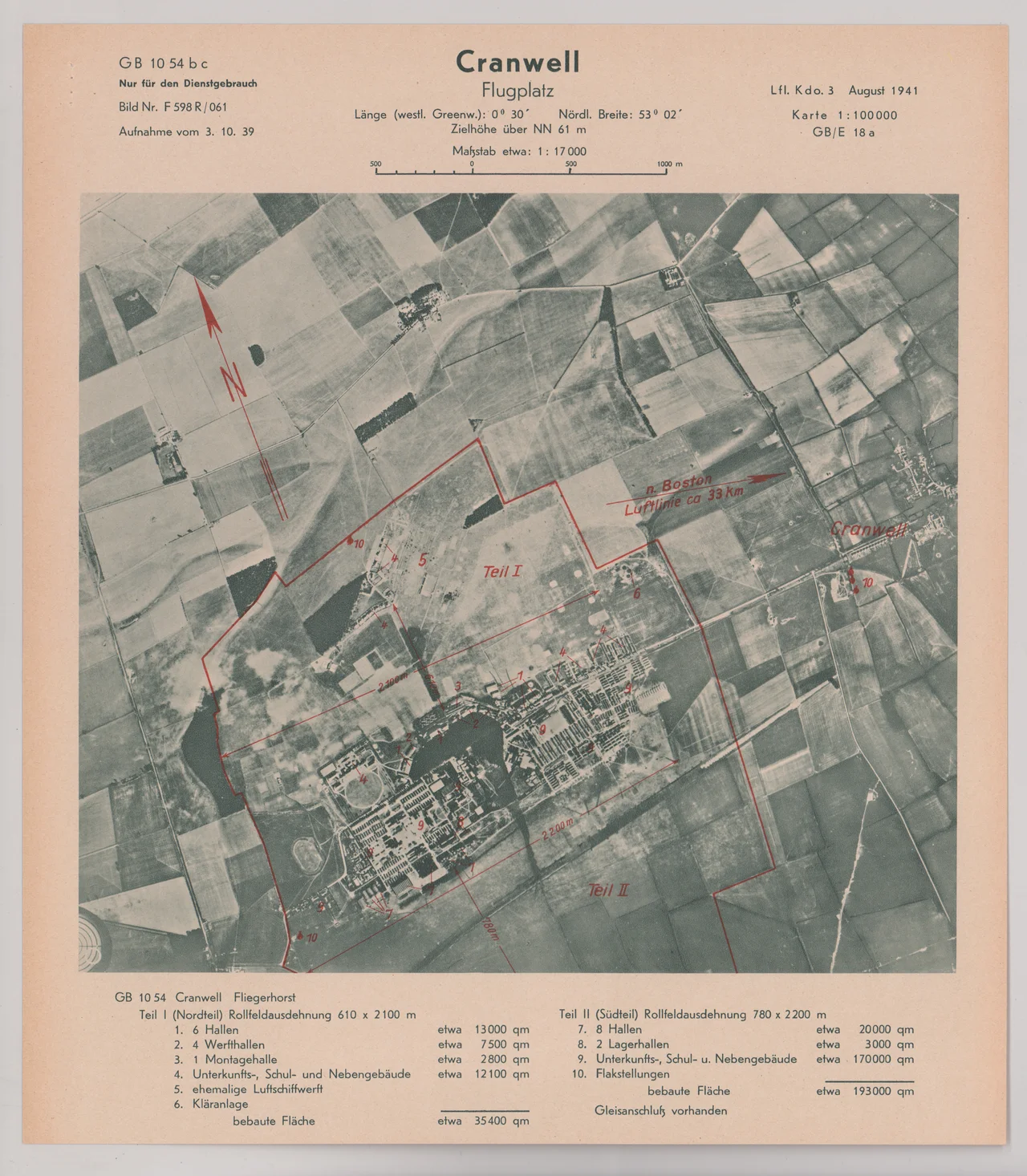
RAF Cranwell sits at 53.03N, 0.48W (ICAO: EGYD), on the flat Lincolnshire plain about five miles north-west of Sleaford. The base is clearly visible from the air: long parallel runways, the iconic colonnaded College Hall facing the airfield, and extensive technical sites. Active military airspace; check current NOTAMs and consult the UK Military AIP before any flight in the vicinity. Nearby airfields include RAF Barkston Heath (a Cranwell satellite, immediately south-east) and East Midlands (EGNX) about 40 miles west. Best viewed at 4,000-5,000 feet on a clear morning when training circuits are most active.
Nearby Stories
- RAF Scampton 5.4 km away
- Battle of Losecoat Field 5.4 km away
- Battle of Mapperley Hills 5.9 km away
- Worksop Priory 6.2 km away
- 2022 Leicester Unrest 11 km away
- Alford Windmill 12 km away
- Murder of Una Crown 13 km away
- Batemans Brewery 19 km away