
Worksop Priory
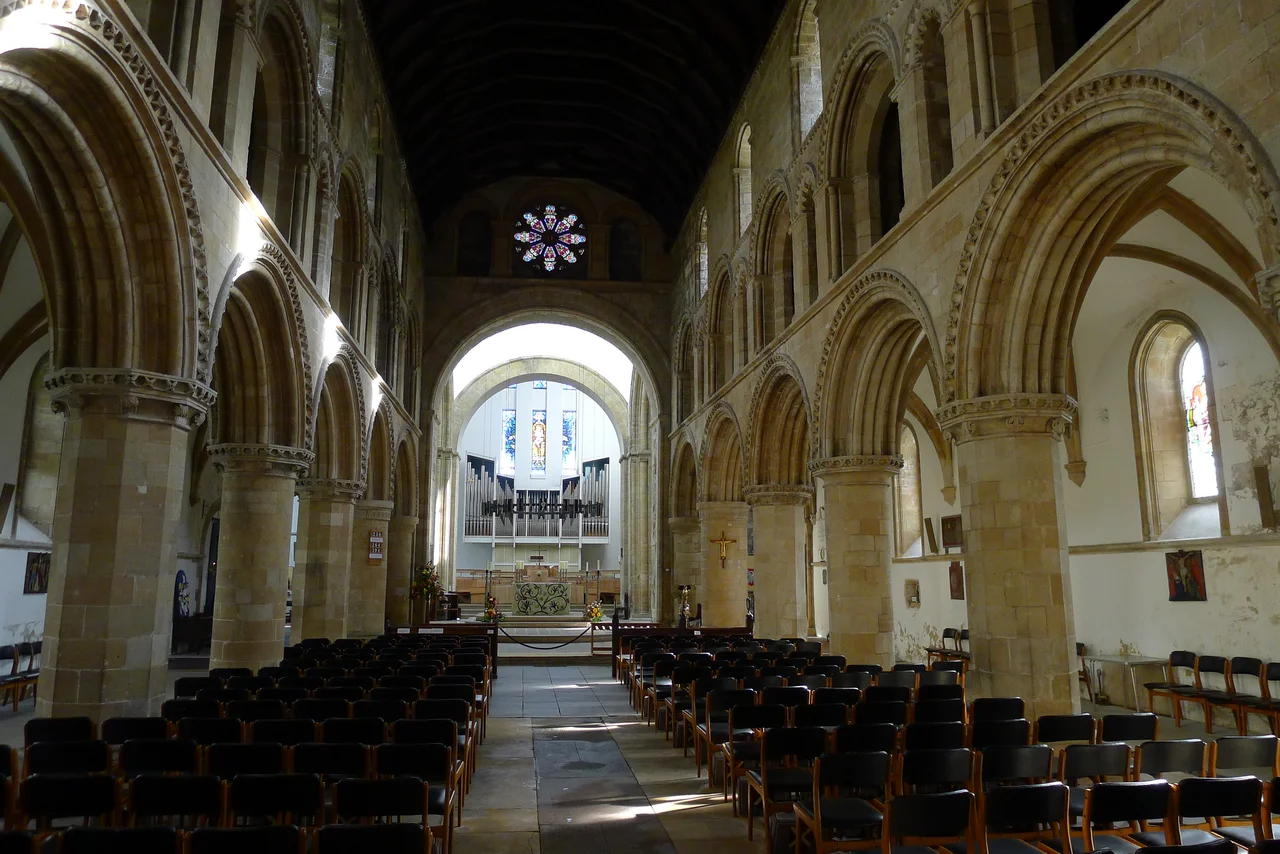
When Henry VIII's commissioners dissolved Worksop Priory in November 1539, they did the usual thing. They pensioned off the prior and his fifteen monks, took the lead from the roof, and sold the buildings as a quarry for their stone. What is unusual is what they did not do. They did not pull down the nave. The townspeople were granted that long, twin-towered western half of the priory church for their parish use, and so today, more than nine hundred years after the first stone was laid, you can still walk in under the same arches the Augustinian canons walked under in 1180.
A Norman Priory on the River Ryton
William de Lovetot endowed the priory in 1103, granting land and money for an Augustinian house on the bank of the River Ryton in what is now central Worksop. The Augustinians were canons rather than enclosed monks - priests who lived in community but also served parishes - and the choice shaped the building's eventual destiny. In 1187 a Canon Philip of Lincoln Cathedral gave the priory an extraordinary gift: an illuminated bestiary, a manuscript catalogue of real and mythological beasts that is today one of the treasures of the Morgan Library in New York. In the 14th century the prior, John de Tickhill, presided over the production of another illuminated manuscript, the Tickhill Psalter, now held by the New York Public Library. Two of medieval England's finest illuminated books were made or kept here, in a small Nottinghamshire town.
Crusaders and a Carved Face
The priory's medieval history is studded with names that show how completely the local gentry were tied into the wider Christian world. In the 13th century two lords of Worksop, Gerard de Furnival II and his son Thomas, died on crusade - Gerard on the Fifth Crusade in 1219, Thomas on the Barons' Crusade of 1241. A rhyming history on display in the priory in the late 15th century claimed Thomas's brother had brought his body home for burial, though earlier records suggest the story was a flourish rather than a fact. In 2017, during renovation work, conservators uncovered a small carved face hidden in one of the priory walls. The block has been dated to around 980 - more than a century before William de Lovetot - but the wall containing it was finished only around 1260. Someone in the 13th century, plastering up the new church, had found an old decorated stone and quietly included it, perhaps under a layer of limewash that no one was meant to see for seven hundred years.
The Glove
At the dissolution the property passed to Francis Talbot, 5th Earl of Shrewsbury, on one condition: the Earl, and whoever held the manor of Worksop after him, would attend every coronation of an English (and later British) sovereign to provide a glove for the monarch's right hand and to support the arm holding the sceptre. The condition has been honoured at every coronation since. The eastern parts of the church fell into disrepair after the monks left, but the nave survived as the parish church, and successive generations restored what they could. R. Nicholson of Lincoln re-roofed the nave and straightened pillars in the 1840s. The 14th-century gatehouse, used for years as a school, was restored in 1912. The Lady Chapel was rebuilt and rededicated in 1922. The south transept was reopened in 1929, the north built in 1932, and in 1935 the blocking walls between nave and transepts came down so that the church could finally read as one continuous space.
Music in a Stone Box
Step inside today and what strikes you is the sound. The nave's high stone vault and bare walls make a generous acoustic. The 1974 organ by Peter Collins, designed on classical 17th- and 18th-century principles in a painted mahogany case, throws its 1,634 pipes' sound forward through the building. The reed pipes were made by Giesecke of Germany, the flues by Stinkens of Holland, the cymbelstern by Laukhuff. The turret clock dates from 1753, restored in 1972 and automated in 2013. John Talbot, 3rd Earl of Shrewsbury, rests in the Lady Chapel, alongside the priory's founder William de Lovetot. Outside, on the west front, the two great Norman towers still bracket the door the canons used. They are nine centuries old, and they still hold up the same stones.
From the Air
Located at 53.30°N, 1.12°W in the centre of Worksop, on the south bank of the River Ryton. Nearest airports: Doncaster Sheffield (EGCN) 13 nm NW, East Midlands (EGNX) 31 nm S. From 3,000 ft the twin western towers and long nave stand out clearly against the surrounding rooflines of the market town. The Chesterfield Canal runs east-west just north of the church. Approach via the A60 from Mansfield or Doncaster.
Nearby Stories
- Flixborough Disaster 0.8 km away
- Peveril Castle 1.7 km away
- Newstead Abbey 2.6 km away
- Huddersfield Town Hall 3.8 km away
- Ackworth School 7.9 km away
- RAF Scampton 11 km away
- RAF Cranwell 16 km away
- Croxden Abbey 18 km away