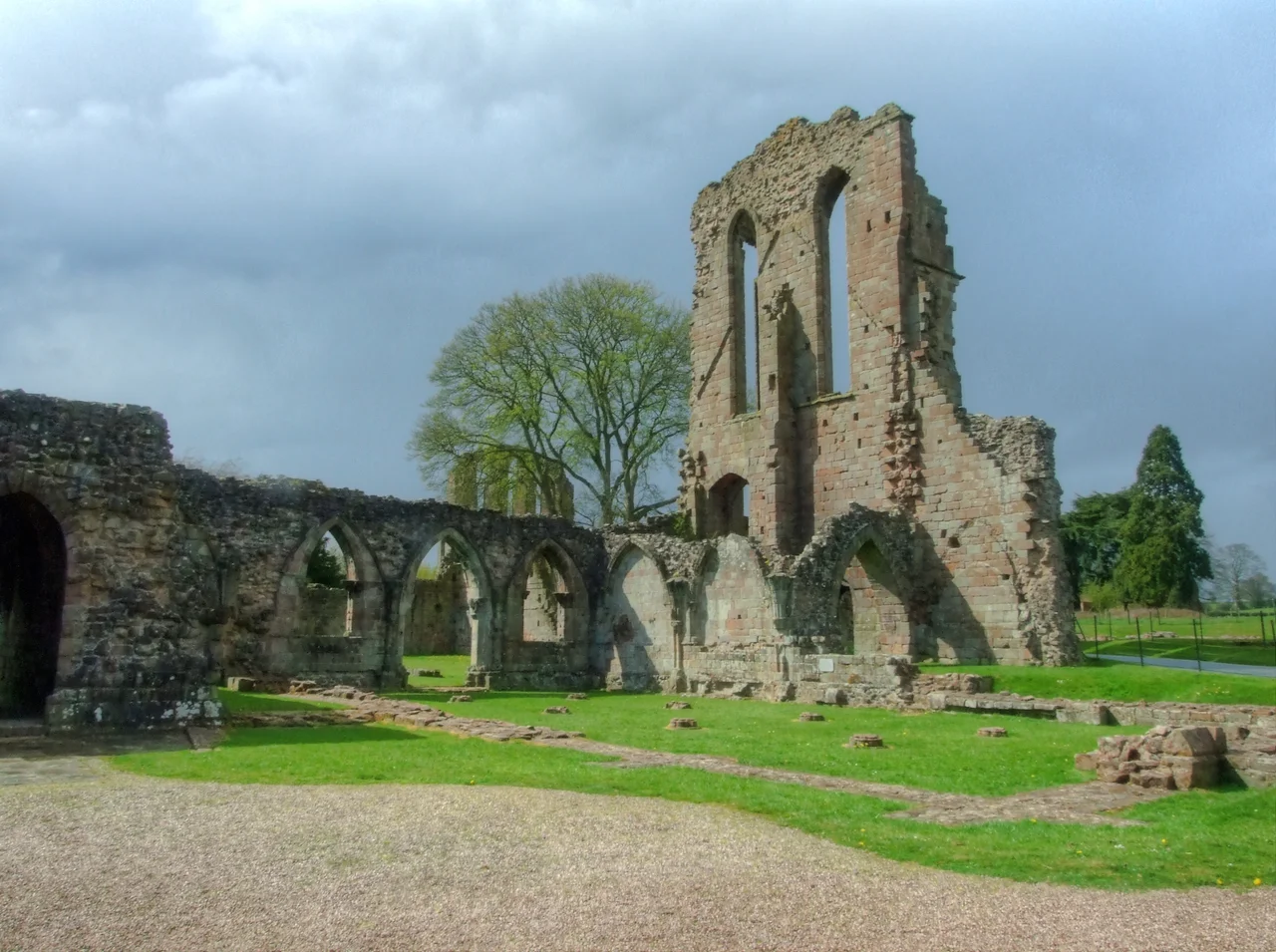

Croxden Abbey
In 1176, twelve monks left the abbey of Aunay-sur-Odon in Normandy and travelled to a valley in Staffordshire to start over. Their patron was Bertram III de Verdun, lord of Alton, who endowed them with land on the condition that they pray forever for his parents and his foster-father Richard de Humez, for himself, for his wife Rohais, and for his successors. The Cistercians were exactly the right order for such a remote site: they preferred wild places, ran their own farms, and built austerely beautiful churches in stone. The abbey they raised here became wealthier than anyone had reason to predict, supplying more wool to Italian merchants than any other religious house in the county. The west wall of their church still stands, its two doorways and lancet windows almost complete after eight and a half centuries.
Wool and Florence
Croxden's prosperity came from sheep. The Staffordshire hills were good grazing, and the Cistercian system, run by lay brothers under the rule of the choir monks, was perfectly adapted to large-scale farming. By 1315 the abbey was the leading wool exporter among Staffordshire's religious houses, selling fleeces directly to Florentine merchant houses that recorded transactions with Croxden well into the 1420s. King John, recognising the abbey early in his reign, awarded the monks an annuity of £5 from the Exchequer of Ireland in 1200, exchanged six years later for land in Adeney, Shropshire. Abbot William of Over had enough surplus cash to buy a townhouse in London for £20, a sum that would have built a modest church. None of this was unusual in the medieval economy. The Cistercian network reached Italian banking houses and English royal courts as a single, integrated commercial system. Croxden was simply doing what such abbeys did, in a quiet valley most travellers never visited.
Sixteen Weeks of Resistance
Late in the 1310s the abbey came into dispute with the de Furnivall family, into whose hands the manor of Alton and patronage of Croxden had passed. The disagreement concerned de Furnivall's use of abbey lands and property. The monks, with no army and no political weight, did what cloistered men sometimes did when the law failed them: they barricaded themselves inside the abbey and refused to come out. The siege lasted sixteen weeks. Without the help of other local landowners, they would have lost everything. In July 1319 they finally received an assize of novel disseisin, the medieval legal remedy for forcible dispossession, and their property rights were restored. The monks paid £100 for a royal licence to continue. The picture is striking: a community of cloistered scholars under siege for nearly four months, surviving on stored grain and the discipline of monastic routine, eventually winning their case in the king's courts.
The Dissolution
Croxden survived for another two centuries after the de Furnivall dispute, but the larger forces gathering against English monasticism were unstoppable. The abbey was surrendered in 1538, two years into Henry VIII's dissolution programme. The last abbot received an annual pension of £26 13s 4d. The monks were dispersed. The lead was stripped from the roof, the bells melted down, the buildings quarried for stone or sold to local landowners. One unusual remnant of the abbey's life travelled an extraordinary distance: the Uttoxeter Casket, a small wooden Anglo-Saxon reliquary that probably stood on a Croxden altar holding some relic, found its way eventually to the Cleveland Museum of Art in Ohio. It is the kind of object that travelled by accident, surviving when most of the abbey's treasures did not.
What the Years Spared
The mid-13th-century chapel continued as the parish church of Croxden until 1886, when a new building was put up to the north. The site passed in 1936 to the Ministry of Public Building and Works, which carried out the excavations of 1968 that revealed the foundations of the lost buildings to the south of the church: sacristy, chapter house, kitchen, dormitory. The west wall of the abbey church, with its twin doorways and lancet windows, is the most complete surviving fragment. The architecture was, by Cistercian standards, more elaborate than usual, modelled on the mother house at Aunay-sur-Odon. Buried beneath the stones lie Bertram de Verdun, his wife Rohais, their grandson Theobald de Verdun, and Theobald's first wife Matilda Mortimer, daughter of Edmund Mortimer, 2nd Baron Mortimer. Their bones remain even as the church above them has weathered to roofless stone.
From the Air
Located at 52.95N, 1.90W, in a small valley a few miles north of Uttoxeter and east of Alton. From the air the ruins are visible as pale stone fragments in a green field, the surviving west wall of the church standing as the most distinct feature. The village of Croxden lies immediately east. Alton Towers theme park (built around the ruined Alton Castle) lies just 2 nm north. East Midlands Airport (EGNX) is 22 nm east-southeast, Birmingham (EGBB) 30 nm south. A pass at 1,500 to 2,000 feet on a clear afternoon shows the abbey footprint clearly against the surrounding pasture.
Nearby Stories
- Lion Salt Works 2.7 km away
- RAF Hednesford 3.5 km away
- Eastwood, Nottinghamshire 7 km away
- Nantwich 8.5 km away
- Killamarsh murders 8.9 km away
- Coalbrookdale 11 km away
- Market Bosworth 12 km away
- Peveril Castle 14 km away