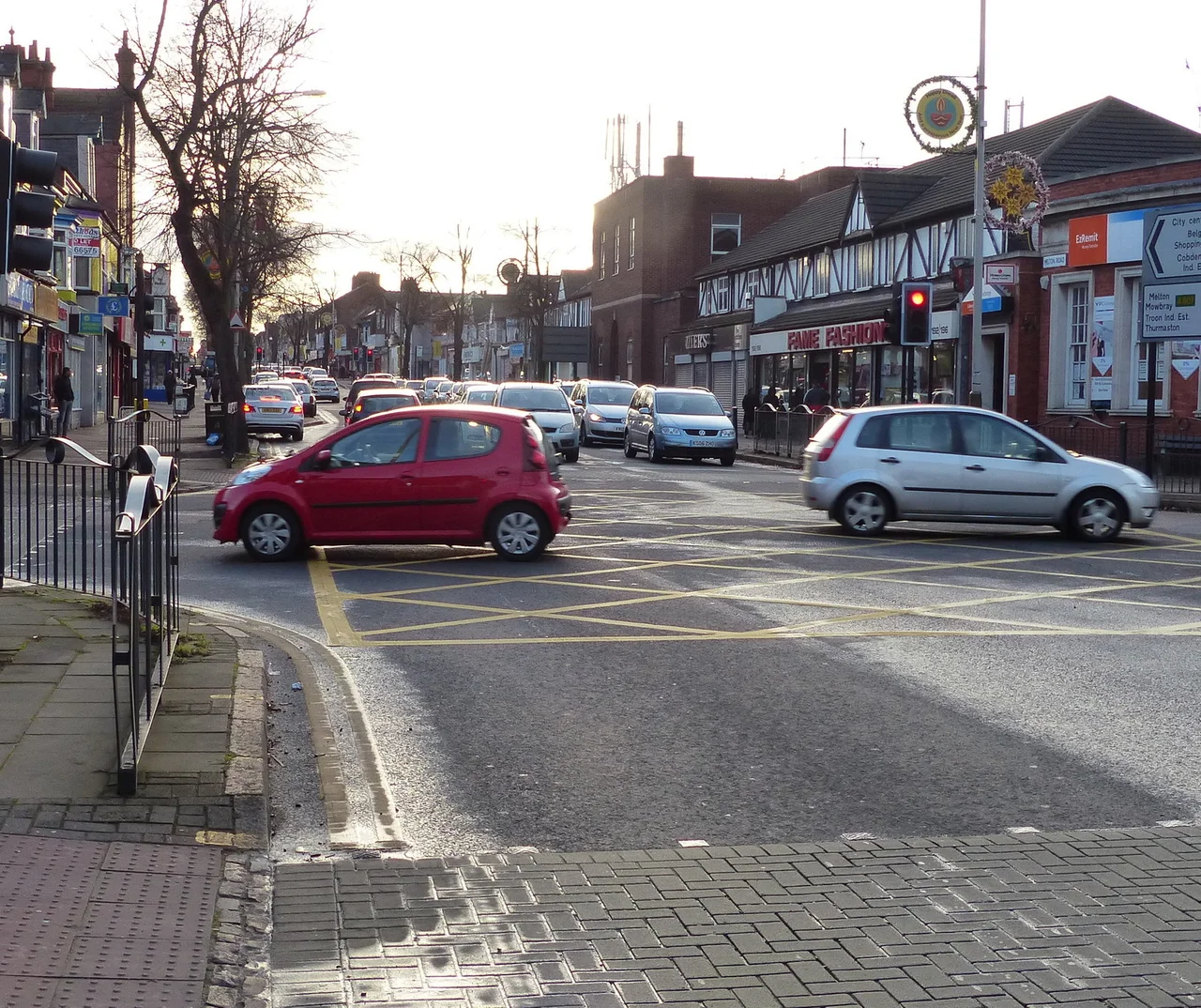

2022 Leicester Unrest
Leicester is the city British politicians often hold up when they want to talk about multiculturalism that works. Roughly one in three residents are Muslim, one in four are Hindu, and the White British population is a minority - one of only a handful of English cities where that is true. For decades the coexistence had been ordinary enough to be unremarkable: Diwali lights along the Golden Mile in Belgrave each autumn, Eid prayers filling the parks each spring, neighbours of every faith waiting for the same bus. Then, over a few weeks in late summer 2022, that ordinariness cracked. What began with a cricket match in Belgrave ended with police in riot gear, broken shop windows, families afraid to leave their homes, and a city looking at itself with a question it had not seriously asked in years.
How a City Was Built
Leicester's South Asian story is layered. The first wave arrived from the Indian subcontinent in the 1960s. A larger one followed in the early 1970s, when South Asians expelled from Kenya and Uganda - many of them East African Indian Hindus from established merchant families - settled in what had been a working-class Belgrave area and slowly transformed it. By 2021 the city's census recorded 33% of residents as Muslim and 25% as Hindu, with each community concentrated in particular postcodes: Muslims predominantly in eastern LE5 around Spinney Hills and North Evington, Hindus predominantly in northern LE4 around Belgrave. More recently, a smaller wave of Hindu families from Daman and Diu - Portuguese-passport holders making use of pre-Brexit EU rights - had settled into the eastern, mostly Muslim postcodes. Scholars and community leaders later described tensions that had been quietly accumulating for years, layered onto disputes about geopolitics in India, party politics in Britain, and the slow drift of online discourse from grievance to grievance.
A Cricket Match and What Followed
On 28 August 2022, India beat Pakistan in the Asia Cup. India fans poured onto Belgrave Road waving flags, honking horns, dancing to dhols - a celebration that, on any other evening, would have been a familiar Leicester scene. At the corner of Shaftesbury Avenue and Melton Road, someone in the crowd stamped on an Indian flag. The flag-stamper, video evidence later showed, was a Sikh man. The fans believed he was Pakistani. A brawl followed; a viral clip followed the brawl; and over the next ten days the city saw a sequence of confrontations - eggs thrown at a Hindu home celebrating Ganesh Chaturthi, marches and counter-marches, slogans shouted on both sides. Most of Leicester's Hindus and Muslims watched what was happening with horror, not enthusiasm. The Sky News story most often remembered from that period featured a Muslim activist who had personally stepped in to shield a Hindu man from a mob - a small, real moment of the city most residents actually live in.
The Weekend Things Broke
The weekend of 17 to 19 September was supposed to belong to the funeral of Queen Elizabeth II. Instead, Leicestershire Police recalled officers from London to manage a Hindu peace march that was followed by an unplanned procession of young men toward Highfields, met by a counter-gathering, with both sides shouting religious slogans into the night air. Sixteen police officers and a police dog were injured. Misinformation moved faster than any of it: a false claim about a Hindu attempted kidnapping of a Muslim girl, repeatedly denied by Leicester Police, kept spreading; a false rumour that Hindus had attacked a mosque kept spreading; a false claim that buses of RSS members were being shipped in from London kept spreading. Mayor Sir Peter Soulsby described the unrest as 'fanned by some very distorted social media' and 'a lot of people who came in from outside.' Rutgers University's Network Contagion Research Institute later documented how online swarming had preceded the violence on the ground. An Islamist preacher named Mohammed Hijab travelled up from London with cameras; he would later lose a defamation suit related to those days when a judge found that the article he had sued over was 'substantially true.'
What a City Owes Itself
By November 2022, Leicestershire Police had reviewed more than 6,000 hours of body-camera and CCTV footage; 73 people had been detained, and 32 were eventually convicted of offences ranging from affray to threats to kill. Civic and religious leaders on both sides urged calm in the days that followed - Pradip Gajjar at the ISKCON Leicester Hindu Temple described himself as 'saddened and heartbroken'; Labour MP Jonathan Ashworth condemned the violence; Leicester East MP Claudia Webbe warned the tensions could spread further. A government-commissioned independent review, headed by former Labour MP Lord Ian Austin, was announced in May 2023 with a panel that included Hilary Pilkington of the University of Manchester and Shaaz Mahboob of NHS England. The review's reception was contested before it even began. What is not contested is that the overwhelming majority of Leicester's Hindus and Muslims - the people whose shops were boarded up, whose children were kept indoors, whose city's reputation as a model of multicultural cohesion was suddenly being debated on cable news in two hemispheres - did not participate in any of it and never wanted to.
From the Air
Leicester's eastern and northern neighbourhoods centre on 52.645°N, 1.109°W. From altitude, Belgrave Road and Melton Road - together known as the Golden Mile - run northeast from the city centre as a clear arterial corridor. The eastern LE5 area extends toward the A47 ring road. East Midlands Airport (EGNX) lies approximately 15nm to the northwest. The Belgrave area's South Asian commercial district is visible from low altitude by its density of retail frontage along the Golden Mile.
Nearby Stories
- National Shell Filling Factory, Chilwell 1 km away
- Staffordshire Regiment Museum 2 km away
- Rutland Water 3.3 km away
- Grantham 4.4 km away
- Wellingborough 9.9 km away
- Croxden Abbey 11 km away
- Bordesley Abbey 14 km away
- Electric Railway Museum 17 km away