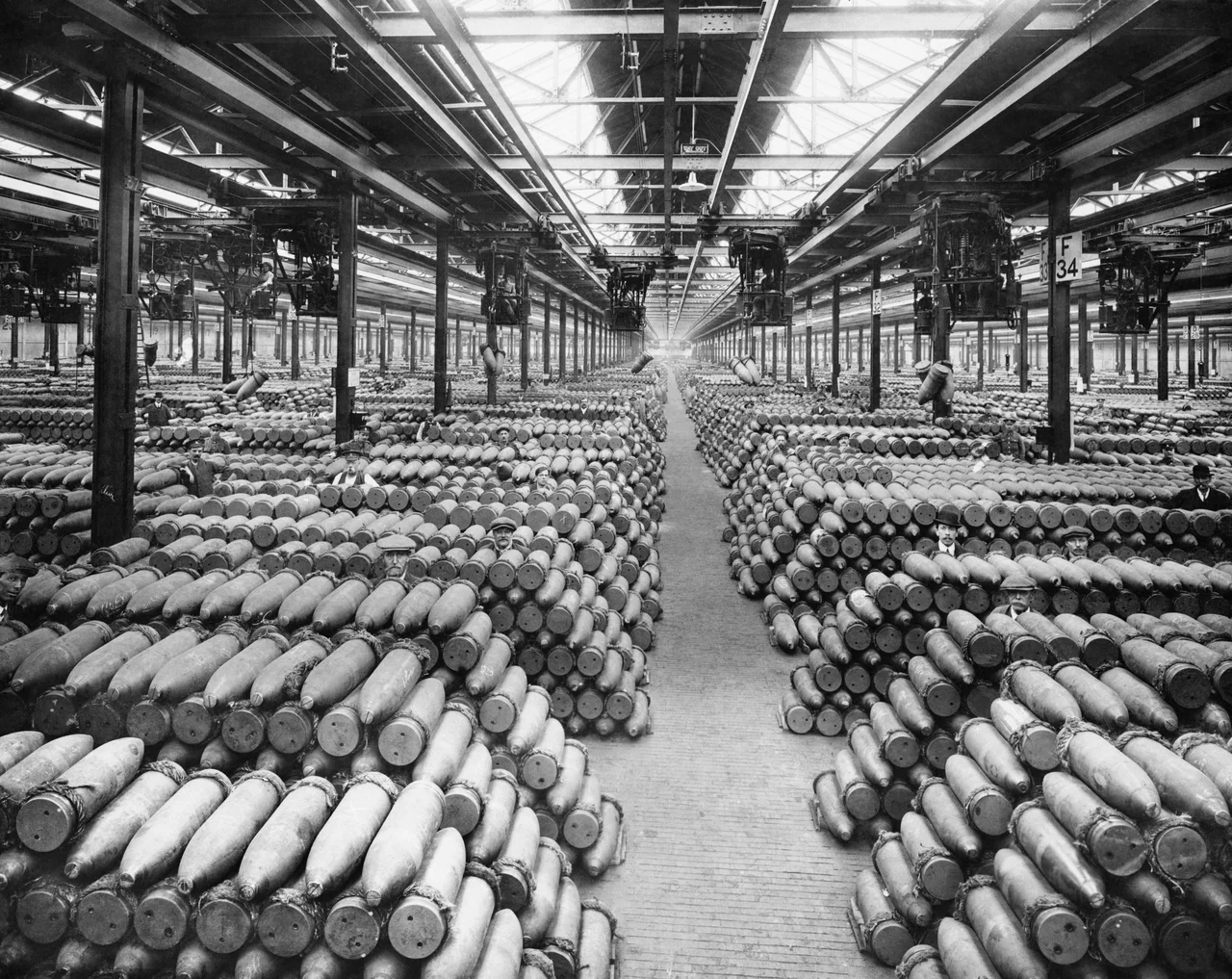

National Shell Filling Factory, Chilwell
Their skin turned yellow. Working with TNT all day did that — the chemical absorbed through the lungs and the pores, jaundiced the liver, and the colour came out across the face and arms first. Munitions factories across Britain in 1916 and 1917 acquired a new vocabulary for the women they were hiring by the thousands: munitionettes when the language was polite, canaries when it was not. The biggest of the high-explosive plants was at Chilwell, in Nottinghamshire, on the road between Nottingham and Ashby de la Zouch. Over three years it filled more than nineteen million shells — slightly more than half of every high-explosive shell Britain fired during the First World War. The women who did the filling were the ones who turned colour.
The Shell Crisis of 1915
The factory existed because in the spring of 1915 the British army on the Western Front had run out of ammunition. The political scandal that followed brought down the Liberal government, brought David Lloyd George into a new Ministry of Munitions, and produced the Munitions of War Act 1915, which gave the state the power to build National Filling Factories at speed. National Filling Factory No. 6 at Chilwell turned its first sod on 13 September 1915 and filled its first shell on 8 January 1916. The first explosive was lyddite — picric acid — but the raw materials had to be imported, so the factory switched quickly to amatol: one part TNT, four parts ammonium nitrate, mixed on site. Lord Chetwynd, who managed the works, introduced production methods that pushed weekly output to one hundred and thirty thousand shells by the summer of 1916.
The Canary Girls
The labour force was overwhelmingly female. Britain's men were at the front, and the work — repetitive, dangerous, requiring careful hands — fell to women drawn in from Beeston, Stapleford, Long Eaton, and the surrounding villages. They handled TNT directly. The chemical stained their skin yellow, sometimes a deep mustard, sometimes green. The nickname canary girls was bitter and accurate. Toxic jaundice from prolonged TNT exposure was not just a cosmetic problem; it could shut down the liver. One hundred and six women across all British munitions factories died of it during the war. The pay was good by the standards women had previously known — substantially better than domestic service — and the work gave a generation of working-class women their first experience of wages they could call their own. None of that absolved the chemistry. The bodies kept absorbing what they were paid to handle.
The Evening of 1 July 1918
On the evening of 1 July 1918, eight tons of TNT detonated in the Mixing House and the TNT Mill. The blast was heard twenty miles away. One hundred and thirty-four people were killed — every worker in the Mixing House and the TNT Mill, and others in surrounding buildings, including twenty-five women that the formal count identifies, though the casualty pattern almost certainly included more. Only thirty-two bodies could be positively identified. The other hundred and two went into a mass grave at St Mary's Church, Attenborough. Two hundred and fifty more were injured. The factory returned to work the next morning. Within a month, weekly production reached an all-time high. Winston Churchill, then Minister of Munitions, sent a telegram praising those who had died at their stations on the field of duty and the decision the survivors had taken to carry on without a break.
The Cause Never Confirmed
Scotland Yard investigated. Lord Chetwynd is alleged to have told them he was sure it was sabotage and to have named the man he suspected. The Home Office committee published its report on 7 August. Neither inquiry could identify a cause with confidence. The likeliest explanation, as later historians have weighed it, is that the workforce was being pushed too hard, that TNT becomes unstable in warm weather, and that 1 July 1918 was an unseasonably hot day. The wartime press was given a sanitised version. Sixty feared dead in a Midlands factory explosion was all the public was told. The real number, more than twice that, was kept quiet for morale reasons. The site eventually acquired an unofficial nickname — the V.C. Factory — after Buckingham Palace floated the idea, never formalised, of recognising the workers with a collective Victoria Cross.
What the Site Became
At the end of the war in 1919, the factory site became a Royal Army Ordnance Corps depot. It is still inside military hands today, as Chetwynd Barracks. The pyramidal memorial that workmen built in 1919 to the dead became a Grade II listed building in 1988 and stands inside the barracks perimeter, on or near the seat of the explosion. The mass grave at Attenborough Church was re-dedicated on 1 July 2018 — exactly one hundred years after the blast — with a new monument by Royal Engineers based at Chetwynd: a Corten steel Celtic cross with a superimposed stainless-steel sword. It echoes a wooden cross that originally marked the grave before vandalism took it down. The book that gathers the memories of the women who worked there is, fittingly, titled The Canary Girls of Chilwell. It was published in 2008, by which point most of the people the title describes were already gone.
From the Air
52.912 N, 1.245 W, on the western edge of Chilwell inside the modern Chetwynd Barracks compound. View from 1,500 to 3,500 ft AGL; the barracks footprint is unmistakable but ground access is restricted. The mass grave at St Mary's Church, Attenborough, lies 1 nm SW across the Trent floodplain. East Midlands (EGNX) is 5 nm SW; Nottingham/Tollerton (EGBN) is 8 nm E.
Nearby Stories
- Rutland Railway Museum 2.4 km away
- Welbeck Abbey 5 km away
- Lichfield rail crash 6 km away
- Peveril Castle 8.8 km away
- Grantham Rail Accident 11 km away
- Croxden Abbey 11 km away
- RAF Scampton 11 km away
- Leicester Abbey 11 km away