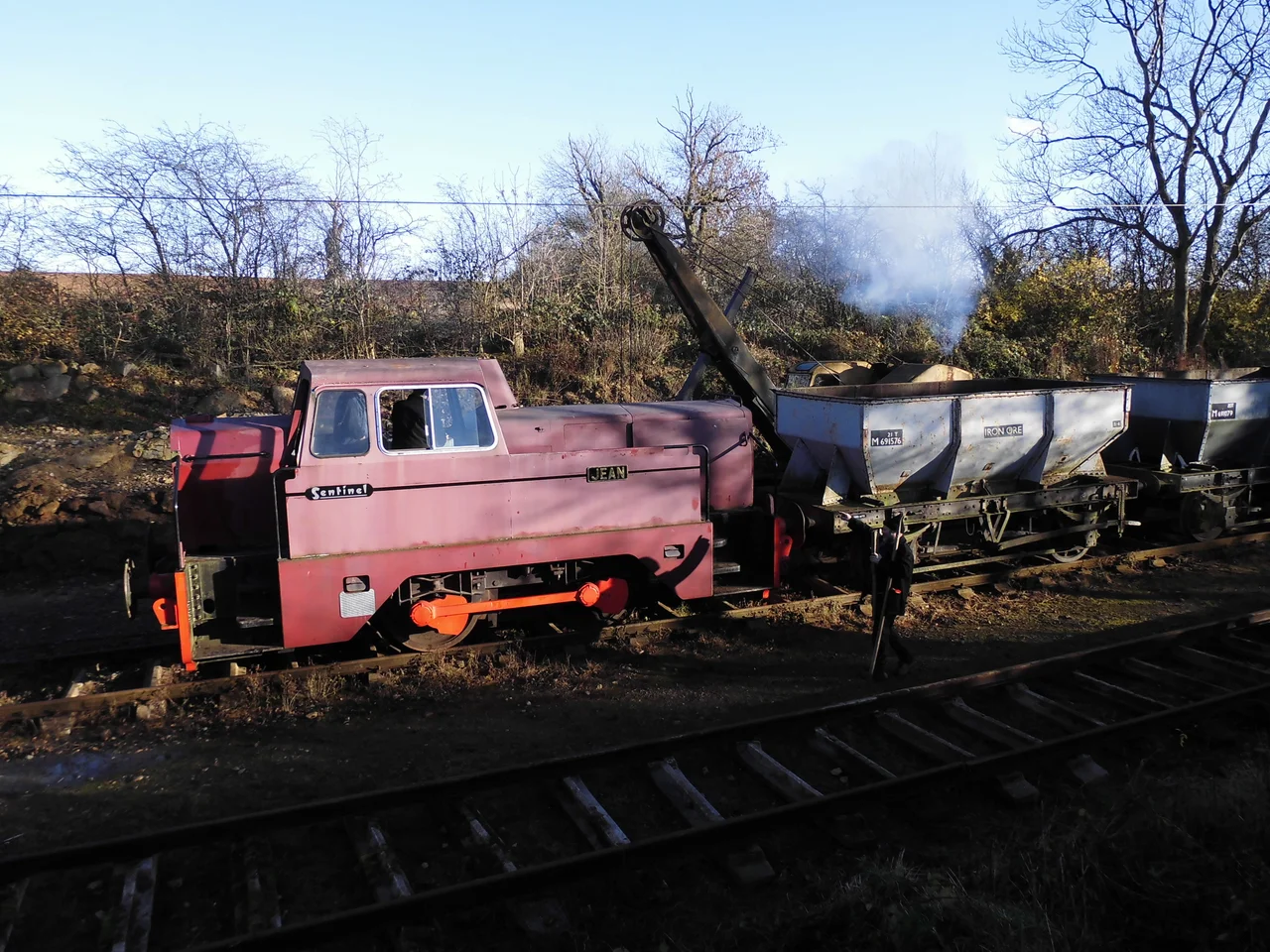

Rutland Railway Museum
A locomotive called SINGAPORE sits in a Rutland field, pockmarked with bullet damage from Japanese aircraft strafing the Royal Navy Dockyard in 1942. It has no obvious business being here, in a quiet corner of England's smallest county. But Hawthorn Leslie works number 3865 is now an honorary member of the Far East Prisoners of War organisation and a registered war memorial, and the volunteers who tend it are the same people who tend the rest of this museum: an open-air shrine to the industrial railways that once cut through Rutland's red ironstone, hauling the raw material of Britain's twentieth century.
Where the Iron Came From
Drive northeast from Oakham toward the village of Ashwell and the landscape looks innocent enough: rolling pasture, hedgerows, sheep. You would never guess that this ground was once stripped open by walking draglines the size of houses. Rutland sat on a band of ironstone, and from the late nineteenth century into the 1970s, private quarry railways laced the county to feed the steelworks at Corby and Scunthorpe. The Cottesmore Iron Ore Mines Sidings, where the museum now stands, were exchange sidings: small private engines hauled wagons in from the quarries, and British Rail picked them up to send south. The concrete tipping dock built for those Cottesmore wagons still stands. So does the locomotive shed, brought here from Woolsthorpe quarries on the Lincolnshire-Leicestershire border and reassembled timber by timber.
Living Ironstone
The museum trades as Rocks by Rail: The Living Ironstone Museum, and the second half of that name is the important part. This is not a place where exhibits sit behind ropes. Restored brake vans carry passengers along three-quarters of a mile of track. A 22-ton Ruston-Bucyrus face shovel performs quarry demonstrations, biting into a mocked-up first cut. The cab of Sundew, a Ransomes and Rapier walking dragline whose entire body once strode across Rutland fields on the way from Exton to Corby, sits where you can climb inside and grip the levers. Sundew's twenty-mile walk in the 1970s was broadcast on the children's programme Blue Peter; the photographs of the giant machine stepping across a public road are some of the strangest images of late industrial Britain.
Engines With Names
The locomotive roster reads like a roll call of country pubs and shipyards. STAMFORD, built by Avonside in 1927 for the Pilton quarries. BELVOIR, Andrew Barclay, 1954, ex-Woolsthorpe. UPPINGHAM, Peckett and Sons, 1912, ex-James Pain ironstone. CRANFORD No. 2, ELIZABETH, RHOS, KETTON No. 1. These small engines were named because they were known personally. A driver and fireman might work the same locomotive for decades. When the quarries closed in the 1960s and early 1970s and the engines became surplus, they were often the last working survivors of their type. The museum's collection is, in many cases, the only example of its wagon class still in existence. A few of the hopper wagons displayed here are literally the last of their breed.
The Locomotive From Singapore
The story of SINGAPORE deserves a section to itself. Built by Hawthorn Leslie of Newcastle in 1936, the locomotive was exported to the Royal Navy Dockyard at Singapore, where it worked shunting duties through the late 1930s and into the war. When the Japanese captured Singapore in February 1942, the engine was caught in air raids and acquired the marks it still carries: small dents and tears from machine-gun fire and shrapnel. After the war it returned to Britain, worked at Chatham Dockyard, and eventually came to Rutland. The volunteers are raising funds to restore it to working order. The damage will not be repaired. It is part of what the locomotive is now: a working machine that was once also a target.
Why It Matters
Heritage railways tend to celebrate the romance of express passenger trains, the streamlined glamour of the LNER A4s and the Great Western Castles. Industrial railways are scruffier, less photogenic, more honest about what railways were actually for. They moved coal, stone, iron, sugar beet, cement. The men who ran them did dirty work for ordinary pay. Rutland's quarries shaped a county; the steelworks at Corby that they fed shaped a town. When the work stopped, both places had to figure out what came next. The Cottesmore Iron Ore Mines Sidings became a museum because someone wanted to remember. On open days, with a small saddle-tank engine simmering in the yard and a brake van full of children, that remembering is a generous, noisy act.
From the Air
Located at 52.71 degrees north, 0.69 degrees west, just northeast of Oakham in Rutland. The site sits in low rolling countryside on the former Midland Railway branch line to Ashwell Signal Box. Best viewed at low altitude in clear weather; look for the locomotive shed and short demonstration track. Nearest major airfield is RAF Wittering (EGXT), 10 nautical miles east-southeast, just south of Stamford on the A1. Cambridge City Airport (EGSC) lies about 45 nautical miles southeast. Watch for active military traffic around Wittering and the Kendrew Barracks (former RAF Cottesmore) circuit a few miles north.
Nearby Stories
- 2022 Leicester Unrest 3.7 km away
- Trent Bridge 6 km away
- Ancaster, Lincolnshire 6.7 km away
- Murder of Una Crown 9.9 km away
- Wellingborough 15 km away
- RAF Witchford 16 km away
- Batemans Brewery 26 km away
- Canons Ashby House 27 km away