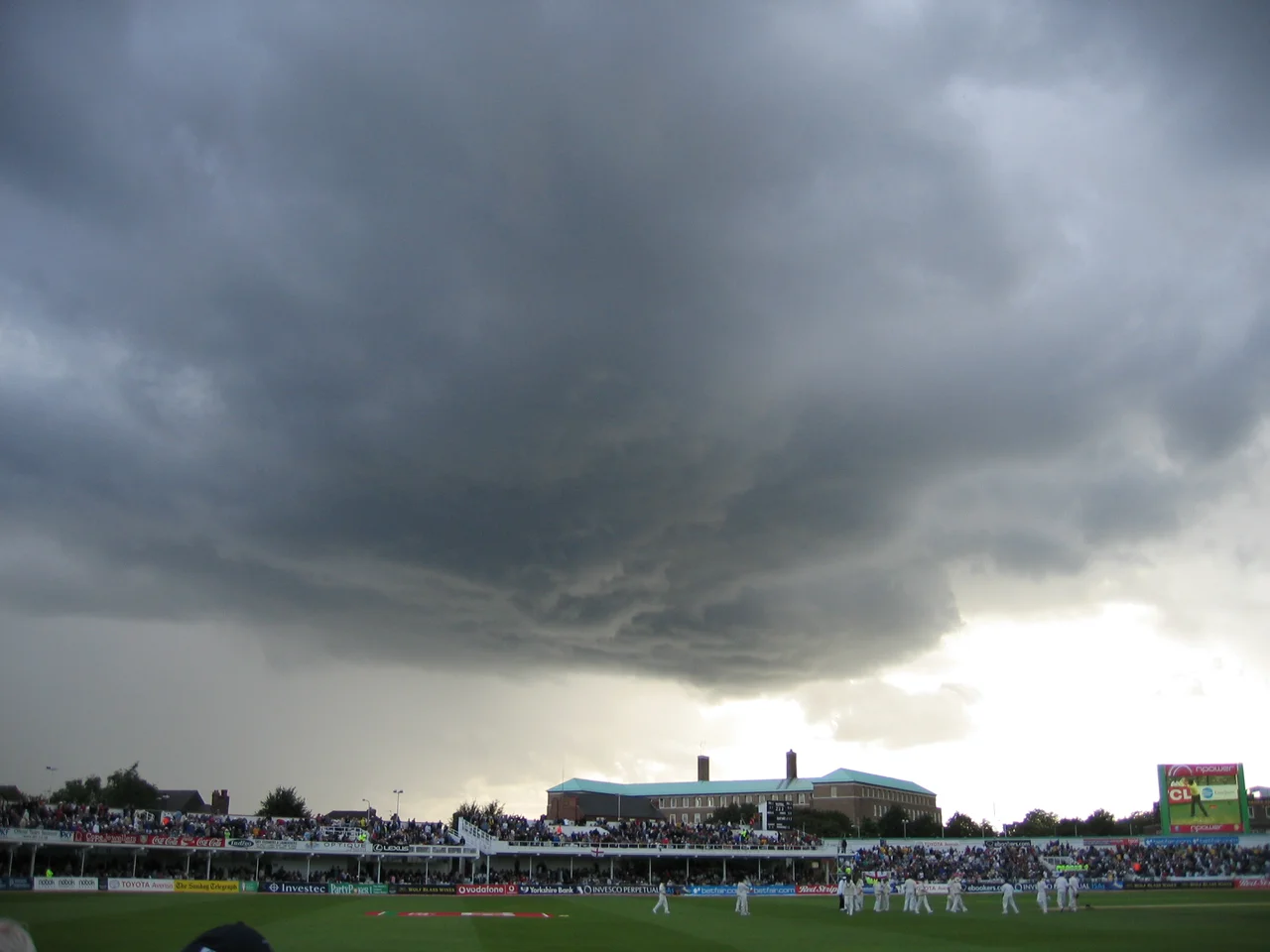

Trent Bridge
The first recorded match was held on a patch of ground behind the Trent Bridge Inn in 1838. William Clarke, husband of the inn's proprietress, formally opened the ground three years later. From that pub yard - barely a hundred yards from the river that gave it a name - has grown one of cricket's most celebrated stages: a Test ground that has hosted England against Australia since 1899, a pavilion older than most countries' cricket boards, and a quirk of architecture that means the building faces the wicket not square-on but at an angle, like a friend leaning in to listen.
Behind the Pub
Trent Bridge sits in West Bridgford, just across the River Trent from Nottingham proper, a stone's throw from Meadow Lane and the City Ground - the home stadiums of Notts County and Nottingham Forest respectively, the latter Brian Clough's old empire. The cricket ground predates almost every English football club, dating to the 1830s. William Clarke ran the Trent Bridge Inn with his wife and saw the value of staging matches on the meadow beside it. The ground was formally opened in 1841, and the first Test was played here in 1899 between England and Australia. For most of its life, Trent Bridge has done double duty: Notts County Football Club played their important matches here from the 1860s, settling in permanently from 1883 until cricket season clashes finally forced them out to Meadow Lane in 1910. The ground also staged an international football match in February 1897, England beating Ireland 6-0.
The Pavilion at an Angle
The pavilion's architectural foundations were laid in 1889, and it has retained those original proportions ever since. The famous detail - immediately recognisable to anyone who watches Test cricket on television - is that it does not face the pitch square on. The pavilion looks across the wicket at an angle, an asymmetry that lends every camera shot a slightly off-axis composition and makes Trent Bridge instantly identifiable. The grounds expanded in 1998 with the £7.2 million Radcliffe Road Cricket Centre, and again in 2002 with the £1.9 million Fox Road Stand, whose modernistic aircraft-wing roof won architectural awards (despite an unhappy quarrel with neighbours about lost sunlight). A further redevelopment from 2007 replaced the Parr Stand and West Wing with what was then called the New Stand, opened on 5 June 2008 by Prince Philip and now known as the Smith Cooper Stand. Capacity sits at 17,500 - small by modern stadium standards, intimate by cricket ones.
The Records They Keep
Trent Bridge holds two of cricket's strangest records, both involving England's One Day International batting. In August 2016, England made 444 for 3 against Pakistan - then the highest ODI total in history. Two summers later, on the same square against Australia, they bettered it: 481 for 6. Test cricket's records here run longer and stranger. In 2013 Australia's number 11 Ashton Agar batted at this ground for 98 - the highest Test score ever recorded by a number 11. Denis Compton scored 278 against Pakistan in 1954, the ground's highest individual Test score. James Anderson has taken 73 Test wickets at Trent Bridge, the most of any bowler. Shane Warne took 29, the most by a non-Englishman. The bowling end at the Pavilion was renamed the Stuart Broad End in July 2024, in honour of the Nottinghamshire bowler who, on this ground, took the Australian wickets that defined a career.
Light and Weather
The 2005 Ashes Test here became part of cricket folklore - Freddie Flintoff reaching his century in front of the Fox Road Stand, fans in the William Clarke Stand celebrating as England crept the last four runs to victory. New floodlights went up in 2008. The 2009 ICC World Twenty20 brought a semi-final between South Africa and Pakistan to the ground, and from 2021 Trent Bridge has hosted One-Day Cup matches alongside Test and County Championship cricket. From the air or the bank of the Trent, the ground reads as a pale green oval surrounded by red-brick stands, with the river curling east-west beside it and the floodlight pylons standing taller than the trees. It is, by general acclaim, one of the most beautiful cricket grounds in the world - and it grew up in a pub yard.
From the Air
Trent Bridge sits at 52.937 N, 1.132 W on the south bank of the River Trent in West Bridgford, immediately across the river from Nottingham city centre. From the air the ground is unmistakable - a pale green oval ringed by stands and floodlight pylons, with the City Ground (Nottingham Forest) and Meadow Lane (Notts County) football stadiums clustered within half a mile, all three venues forming a tight triangle of British sporting history. Recommended viewing altitude is 1,500-2,500 ft AGL. East Midlands Airport (EGNX) lies 11 nm south-west and Nottingham/Tollerton (EGBN) 3 nm south-east. The River Trent itself is the easiest navigation reference - follow the river upstream from its junction with the Soar and Trent Bridge is the first major sports complex you reach.
Nearby Stories
- Rutland Railway Museum 2.4 km away
- Welbeck Abbey 5 km away
- Lichfield rail crash 6 km away
- Peveril Castle 8.8 km away
- Grantham Rail Accident 11 km away
- Croxden Abbey 11 km away
- RAF Scampton 11 km away
- Leicester Abbey 11 km away