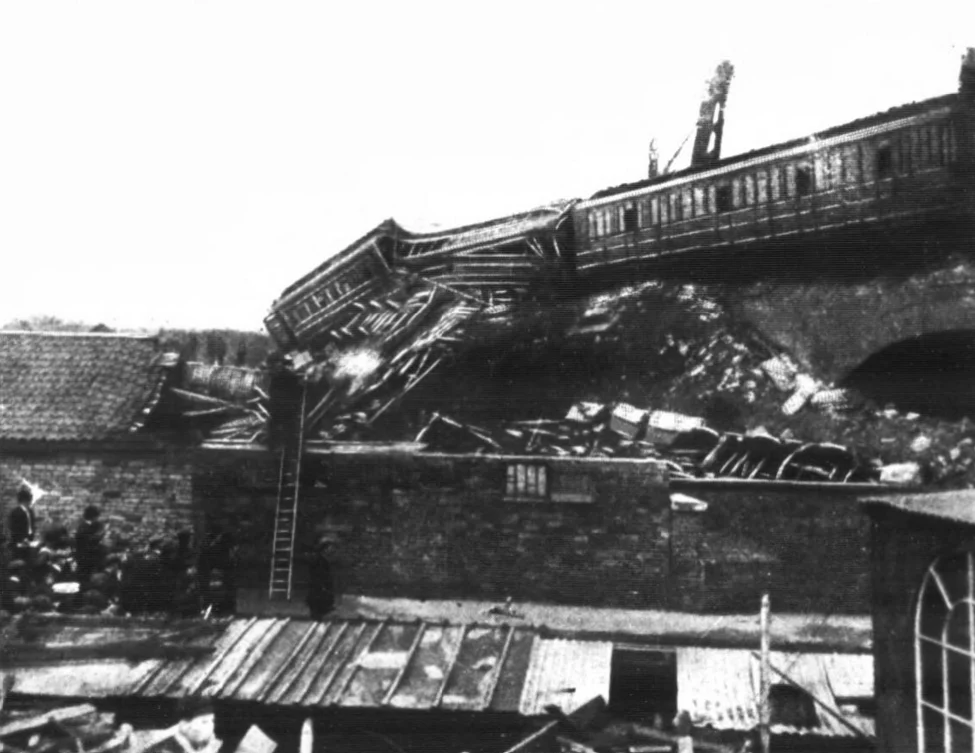

Grantham Rail Accident
At a quarter past eleven on the night of 19 September 1906, the postal sorters at Grantham heard a sound that should not have existed. The Anglo-Scottish Mail was not booked to stop, no, that is wrong - it was booked to stop. It was the booking that made the next thirty seconds impossible. Ivatt Atlantic No. 276 came roaring out of the southern darkness at well over forty miles an hour, headlights blazing, whistle silent, regulator open. The points at the platform end were set against her, locked for a freight movement, with a fifteen-mile-an-hour speed limit. The locomotive hit them, jumped the rails, and detonated in the North Yard in a single white flash that lit the town. Fourteen people died. The Board of Trade inquiry took testimony for weeks and concluded, with formal Edwardian restraint, that the cause must forever remain a mystery.
The Train That Would Not Stop
The Mail had a job to do. From London King's Cross it carried sleeping passengers north and post-office sorters who worked the run through the night, separating letters into pigeonholes as the train threaded the East Coast Main Line. Grantham was a scheduled stop, a place where mail bags came on and off the train and where the engine took water. Driver Fleetwood and apprentice fireman Talbot were on the footplate. They had crested Stoke Bank, the long climb south of Grantham where, three decades later, Mallard would set a world record running the same gradient downhill. From the summit a competent driver shut off steam and let the train coast in. Fleetwood was a competent driver. Signalman Day at Grantham South watched the locomotive approach and noted, with the precision of a man trained to notice small wrong things, that both men were standing at their lookouts but not actually doing anything. The whistle that should have sounded did not sound. The brakes that should have come on did not come on.
Fourteen Lives
Among the dead were passengers in the sleeping car who never woke, mail sorters at their pigeonholes, and the two men on the footplate who alone could have answered the questions everyone wanted to ask. The list of theories the inquiry considered reads like a coroner's catalogue of human possibility: sudden illness, micro-sleep, a fight on the footplate, a stroke, intoxication, a missed brake hose at Peterborough. Fleetwood, the inquiry learned, had reported sick three times that year for thirty days in August and September alone. He claimed sciatica but had seen no doctor. Talbot was a premium apprentice, a gentleman engineer in training, with months of footplate experience rather than years. If Fleetwood had collapsed at the controls, would Talbot have known the road well enough to recognise the danger and act? The men who had to answer that question were dead in the wreckage they could not explain.
The Marie Celeste of the Railways
Lieutenant Colonel P. G. von Donop conducted the inquiry with the patience of a man who knew his report would be read for a hundred years. He took evidence from Fleetwood's mother-in-law, who said her son-in-law was no drunk. He took evidence from the apprentice's friends, who said Talbot had once feared Fleetwood drank too much but later said Fleetwood was sober. He examined the regulator, found one-third open but bent in the impact. He examined the blower valve, found it open, which it would not have been if steam was running. The physical evidence said steam had been shut off before the derailment. The witness evidence said no whistle had been sounded. The behaviour said something had gone wrong with the men, not the machine. The railway historian L. T. C. Rolt would later call it the railway equivalent of the Marie Celeste - a ship, or a train, that simply did not behave as ships or trains behave, with no crew left to explain why.
The Year of Three Wrecks
Grantham was not alone. Salisbury had derailed three months earlier, also at night, also at speed, also at a junction the driver should have known. Shrewsbury would follow in 1907. Three trains in sixteen months, three sets of footplate crew killed, three inquiries that recorded driver error and could not say why an experienced driver would error. The Edwardian railways were the fastest things human beings had ever made, and the men driving them were being asked to stay alert at the regulator for hours at a stretch, on overnight runs, often without proper sleep, without medical oversight, without the safety overlay that later generations would take for granted. Grantham did not solve those problems. But it raised the questions, and after Grantham the Great Northern stopped putting gentleman apprentices on the footplate as firemen. The fourteen people who died are buried in Lincolnshire and beyond. The train ran through Grantham. The reason did not.
From the Air
Grantham station sits at 52.91N, 0.65W, on the East Coast Main Line between London King's Cross and Edinburgh Waverley. The town lies in a shallow valley of the River Witham, with the Lincoln Edge rising to the east. Nearby airports include RAF Cranwell (EGYD) about 15 miles north-east and Nottingham East Midlands (EGNX) roughly 30 miles west. Best viewed at 3,000-5,000 feet on a clear day; the station's platform layout and the curve at the north end where the accident occurred remain visible from the air.
Nearby Stories
- Deene Park 6.3 km away
- RAF Waddington 9.6 km away
- Gotham, Nottinghamshire 11 km away
- Mansfield Railway Station 12 km away
- Batemans Brewery 16 km away
- Ouse Washes 19 km away
- Wisbech 20 km away
- Nuneaton Rail Crash 28 km away