
Nuneaton Rail Crash
Just before two in the morning on 6 June 1975, the 23:30 sleeper from London Euston to Glasgow approached Nuneaton at one hundred miles per hour. Ahead lay a temporary stretch of track, a quiet patchwork of work-in-progress where engineers had pulled out the old points and laid down twenty-mile-an-hour rails through tight curves. Lineside warning boards should have been glowing in the dark. They were not. Two gas canisters, wrongly plumbed, had failed in the night, and the warning lights had quietly gone out somewhere between the last train through and this one. The driver saw nothing unusual. Four times the speed limit, the coaches met the curve.
A Town Pulled Apart by Rails
Nuneaton sits where the West Coast Main Line cuts across Warwickshire on its long run from London to Glasgow, and the station had always been a busy junction. In January 1975, British Rail began a year-long remodelling scheme: ripping out the points and crossovers at the eastern end of the station, replacing them temporarily with plain track that could only take twenty miles per hour. The new alignment would not be installed for months. In the meantime, every train on the down fast line had to throw away most of its speed and creep through a curve that, in a normal world, would not exist at all. Engineers calculated the geometry generously - they believed the rails could actually handle forty - but for the safety margin, the limit stayed at twenty, and the signs that warned drivers were lit by two forty-two-pound canisters of gas, expected to last about ten days each.
The Lights That Went Out
The automatic changeover valve, the small piece of plumbing that would have switched the supply from one canister to the next when the first ran dry, had never been put into service. Whether anyone realised this is unclear. What is clear is that on the night of 5 June, the first canister emptied, and nothing took its place. The illuminated speed-restriction boards stood dark beside the line. There were no other warnings, no track-mounted magnets, no audible alarm in the cab. If the lights failed, train crews had no way to know whether they were facing a twenty-mile-per-hour curve or a hundred-mile-per-hour straight. Ten days earlier, an InterCity in daylight had entered the same restriction at forty - its driver had misread the weekly notice - and only quick, heavy braking had kept it on the rails. That train was lucky. The night sleeper would not be.
Four Times the Limit
The derailment happened at 01:55. The locomotive struck the temporary curve at roughly four times the posted speed, and the carriages behind it had no chance of holding the line. Four people died as the coaches fell and crushed: two passengers and two sleeping car attendants whose job was to watch over the people in their bunks. Two more passengers died later at Manor Hospital in Nuneaton. Of the thirty-eight injured, ten stayed in hospital for weeks. The train carried fewer than a hundred passengers that night - a quiet weeknight run - and investigators noted later that a fully booked sleeper would have produced a much higher toll. Among the survivors was Fred Peart, Minister for Agriculture, who stumbled barefoot from the wreckage and walked toward the hospital alongside other wounded passengers. Six lives ended in those few seconds of impact, and the families left behind carried losses that no inquiry could explain away.
What the Inquiry Changed
The official report, published in September 1976, found driver error - but it placed that finding alongside a long catalogue of failures behind the lights. The canisters had been set up wrong. The automatic changeover had been bypassed. The system depended on one fragile signal to do an enormous amount of safety work, and when that signal failed, nothing else in the network was there to catch it. The lesson became permanent: ever since, every temporary speed restriction on the British railway network has been marked by AWS magnets buried in the rails, which trigger a warning horn in the cab regardless of weather, sightlines, or whether a lamp is burning. No driver crossing a restriction in Britain today does so blind. The change came too late for the six who died that morning, but it has prevented uncounted other crashes since.
What Remains at the Curve
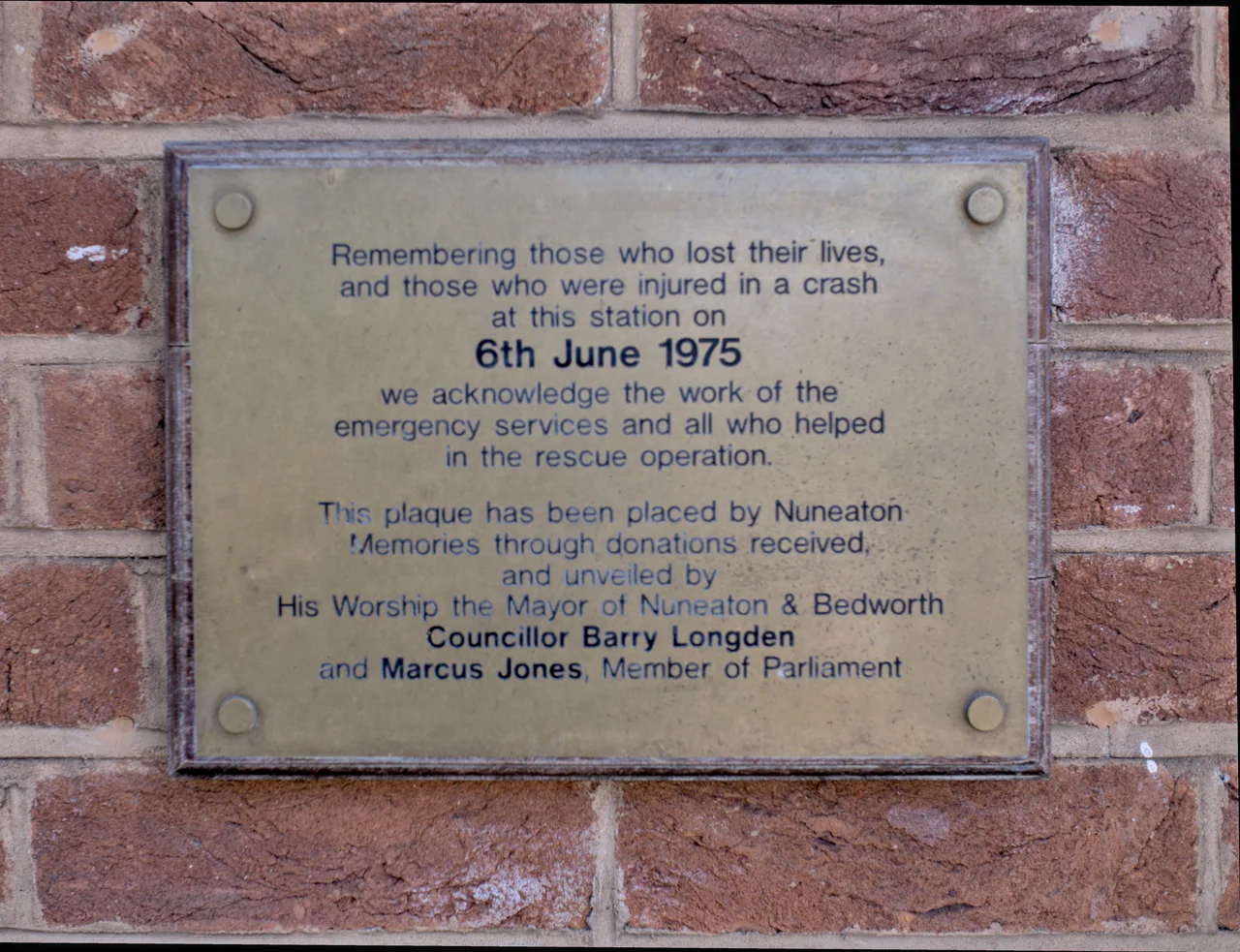
The carriages were cut up on site - too damaged to recover - and most of the locomotives were scrapped over the following decades. One survived in unlikely fashion: Class 86 number 86242 worked British rails until 2004, was sold to a Hungarian freight operator in 2013, and now hauls goods across central Europe under a different number. At Nuneaton itself, the only physical reminder for years was a set of shortened platforms on the down fast line, never fully rebuilt after the impact damaged them. In August 2015, on the fortieth anniversary, a memorial was finally unveiled in the town to the six who died. Trains still pour through Nuneaton on the way north - the West Coast Main Line is one of Britain's busiest - but they cross the curve at full line speed now, on properly aligned track, watched over by the magnets in the ballast.
From the Air
Located at 52.5246 N, 1.4610 W, in northern Warwickshire on the West Coast Main Line just south of Nuneaton station. From altitude, the rail line traces a clean north-south scar through the gently rolling Midlands farmland between Coventry and Leicester. Best viewed at 2,000-3,000 feet AGL where the four-track corridor stands out from the patchwork fields. Nearest major airfield is Coventry Airport (EGBE), about 8 nautical miles south; Birmingham Airport (EGBB) lies 15 nm to the southwest, East Midlands (EGNX) 17 nm to the northeast. Visibility is generally good year-round; haze can flatten the line in summer afternoons.
Nearby Stories
- Round Oak Steelworks 1.7 km away
- RAF Gaydon 6.6 km away
- Ashby-de-la-Zouch 7.3 km away
- Battle of Naseby 7.3 km away
- Stafford Castle 7.5 km away
- Siege of Worcester (1646) 7.8 km away
- Asfordby Colliery 9.7 km away
- Silverstone Circuit 15 km away