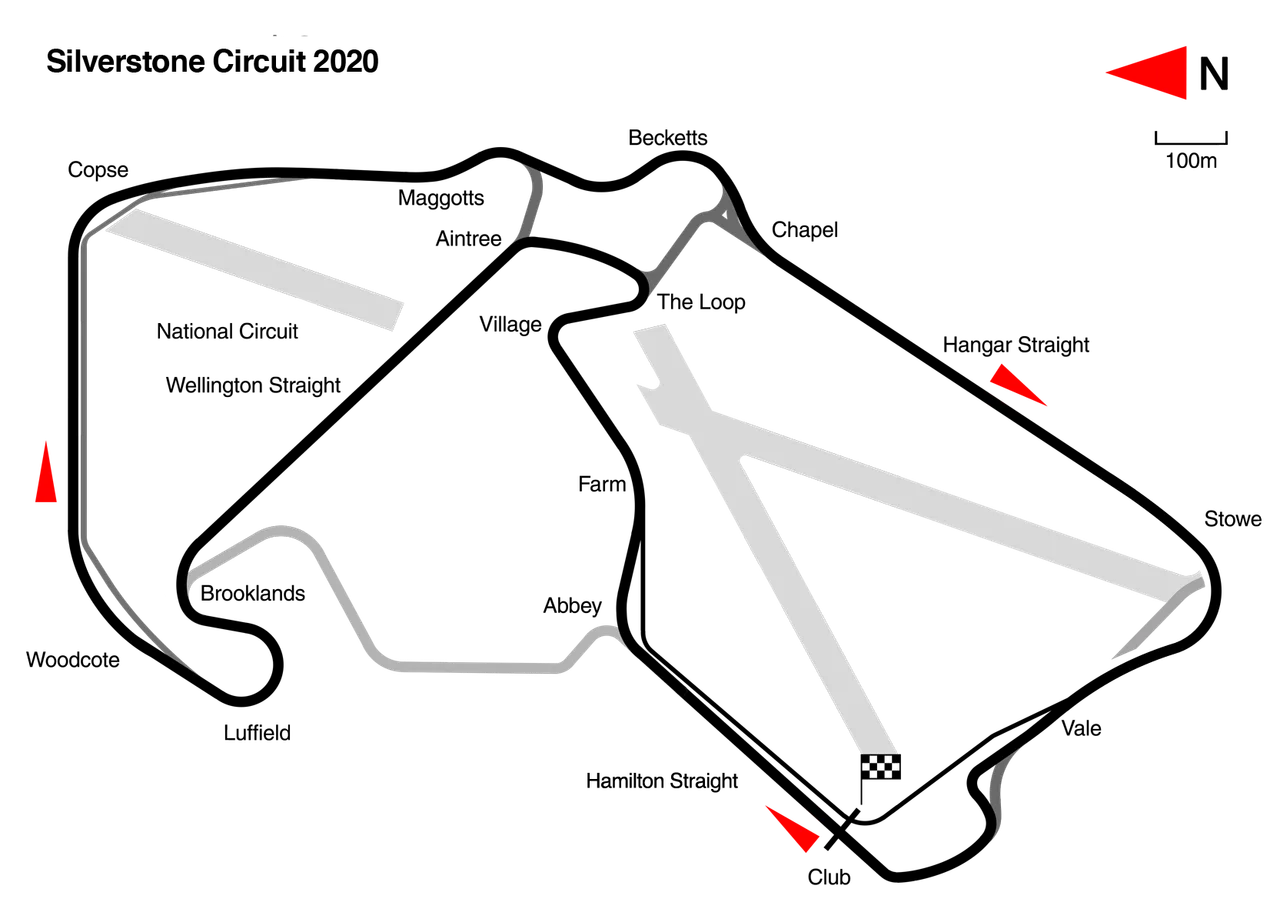

Silverstone Circuit
In September 1947, a man called Maurice Geoghegan and eleven friends turned up at a deserted Northamptonshire airfield with their cars. They set out a two-mile course on the abandoned RAF Silverstone, agreed to race each other for the afternoon, and started their engines. Geoghegan, who lived in the nearby village, knew the runways well. He did not know about the sheep that had wandered onto the field. He hit one. The car was destroyed. The sheep, too. The drivers called it the Mutton Grand Prix and went home. The next year, the Royal Automobile Club leased the field. The year after that, in 1950, King George VI watched the first race of the newly created Formula One World Championship of Drivers from a stand at Silverstone - the only time a reigning British monarch has ever attended a motor race in Britain. Three runways laid out in the standard wartime triangle still trace the outline of the modern circuit.
The Sheep, the King, and the Beginning
RAF Silverstone operated from 1943 to 1946 as a bomber training station for No. 17 Operational Training Unit. The pattern was the same as a hundred other British airfields of the era: three runways meeting in a triangle, hangars and dispersals around the perimeter, a control tower, and miles of taxi-tracks. When the war ended, the bombers left and the buildings emptied. The drivers who arrived in 1947 saw a perfect natural circuit: a closed perimeter road in the middle of the countryside, with no public traffic to close and no neighbours to disturb. The RAC formalized the layout in 1948. The first two races used the runways themselves, with hay bales marking the edges, but for 1949 the perimeter track became the racing line. Silverstone's first official British Grand Prix had run in 1948. The 1950 race made history twice over - the inaugural Formula One World Championship event, and the only motor race a sitting British monarch has ever attended.
Stowe, Copse and the Naming of Corners
The corner names tell their own story. Stowe corner sits at the eastern end of the modern circuit, on land that originally formed the extreme north-east of Stowe Park - the great Buckinghamshire landscape garden whose Wolfe Obelisk was once visible across the woods. Copse corner is named for the small wood that bordered the airfield. Hangar Straight runs past where the wartime hangars used to stand. Becketts and the Maggotts complex commemorate a pair of medieval field names on the estate. The drivers who first raced here did not name the corners systematically; they used what locals and pilots already called the places. The names have stayed long after the cottages and woods that originated them have gone.
Mansell, Senna and the Lift Home
Silverstone has produced as many myths as victories. The most famous of them belongs to the 1991 British Grand Prix - the first race on a major redesign that broke up the old high-speed perimeter into a more technical, modern layout. Nigel Mansell, driving for Williams, won in front of a hometown crowd that had not seen a British winner here in a generation. On his slow-down lap, he came across his rival Ayrton Senna, whose McLaren had run out of fuel on the final lap and stranded him beside the track. Mansell stopped. Senna climbed onto the side-pod of Mansell's Williams. The image of Senna, helmet on, perched on a sidepod as Mansell drove him back to the pits, became one of the defining photographs of British sport. Three years later, Senna and Roland Ratzenberger were killed in the same weekend at Imola, and circuits around the world were modified for safety. Silverstone's Abbey kink was converted to a chicane in just nineteen days to ready it for the 1994 Grand Prix.
The Hamilton Era
Lewis Hamilton has rewritten the Silverstone record book. His 2008 win was the largest Formula One winning margin since 1995 - sixty-eight seconds across the line. His 2019 victory broke a fifty-two-year-old record for most British Grand Prix wins by a single driver, surpassing Jim Clark's five. In December 2020 the British Racing Drivers' Club renamed the pit straight after him - the first time in the circuit's history that any area of the track has been named for an individual. After 945 days without a Formula One victory, he won his ninth British Grand Prix in 2024, extending records that may never be matched. The 2025 race went to Lando Norris, his first win at home, making him the thirteenth British driver to triumph here. Google marked the seventy-fifth anniversary of Formula One in July 2025 with a homepage doodle of the Silverstone Wing building.
A Working Airfield and the Future
Silverstone is more than the Grand Prix circuit. The British round of MotoGP is held here. The Silverstone Classic, one of the largest historic race meetings in the world, fills the place each summer. The American Le Mans Series, World Endurance Championship, British Touring Cars and dozens of club series share the calendar through the year. The Britcar 24 ran here from 2005 to 2018. The course doubles as one of the most technical drift venues in Europe and hosts the iMechE Formula Student competition annually. The Aston Martin Formula One team's headquarters now sits less than a kilometre from the start line. The BRDC and Formula One signed a ten-year contract extension in February 2024, securing the British Grand Prix at Silverstone through 2034 - and the three wartime runways laid out in 1943 remain visible, still tracing the outline of one of the world's most storied racing circuits.
From the Air
Silverstone Circuit is at 52.071°N, 1.018°W on the Northamptonshire-Buckinghamshire border, about five miles southwest of Towcester and accessed from the A43. From altitude, look for the unmistakable triangle of the original wartime runways visible inside the modern racing layout - a perfect example of how British circuit design grew out of disused bomber bases. Sywell Aerodrome (EGBK) sits fifteen miles to the northeast and Wycombe Air Park (EGTB) is thirty miles south. The historic Stowe Gardens lie immediately to the southwest, just over the county border in Buckinghamshire.
Nearby Stories
- Coombe Abbey 3.5 km away
- Waddesdon Manor 3.7 km away
- Battle of Edgehill 5.8 km away
- Battle of Naseby 8.7 km away
- Hertfordshire 9.9 km away
- Connington South Rail Crash 11 km away
- St Neots 13 km away
- Cotswolds 35 km away