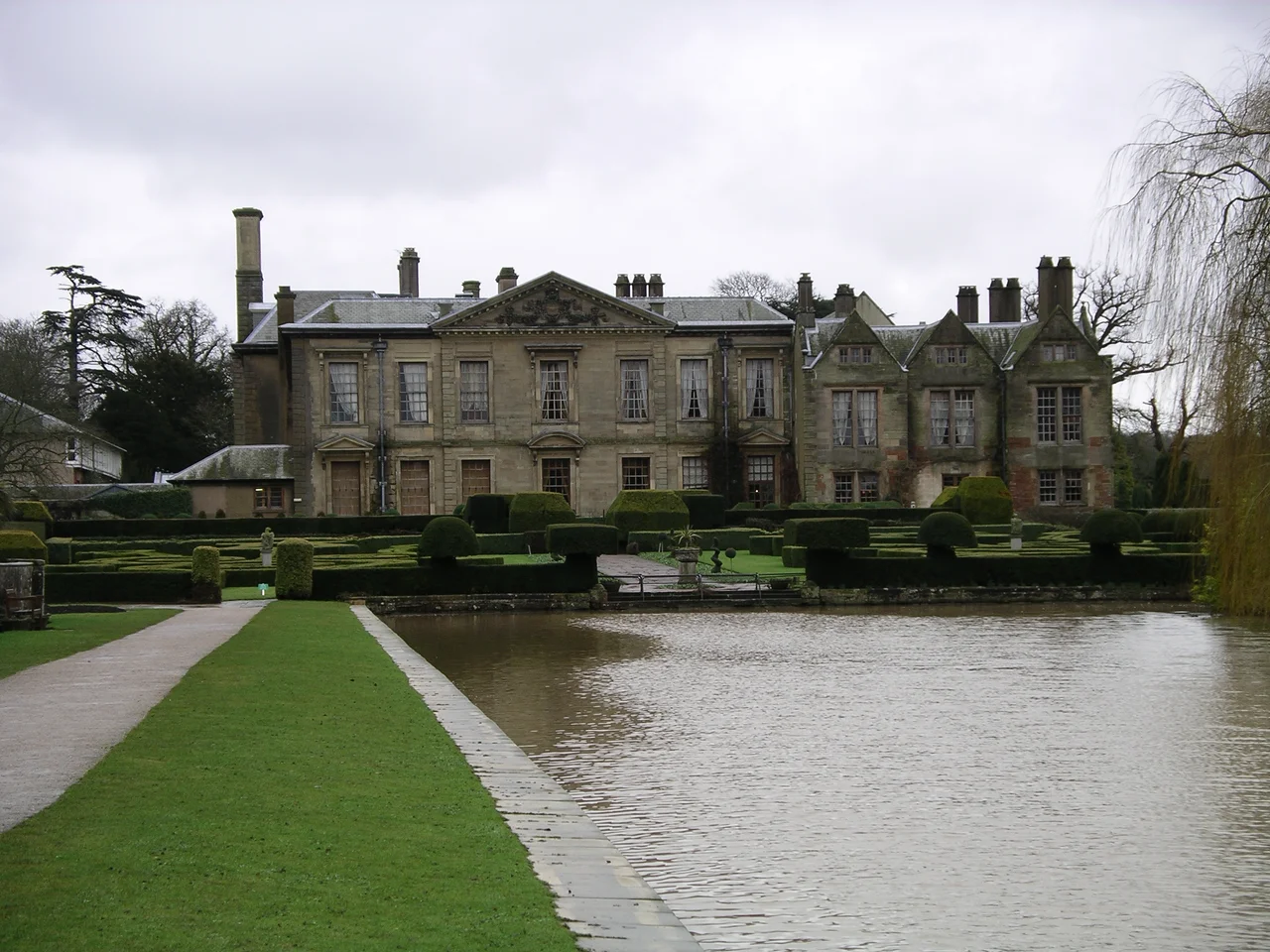

Coombe Abbey
On the morning of 5 November 1605, a nine-year-old princess was bundled out of Coombe Abbey and rushed through the lanes toward the safety of Coventry's walls. The Gunpowder Plot had failed in London, and the Catholic gentry conspiring in Warwickshire now needed Princess Elizabeth Stuart, James I's daughter, as the figurehead for a coup that would not happen. By the time the plotters reached Coombe, the child they meant to crown was already gone. The Cistercian abbey that sheltered her, founded four and a half centuries earlier and rebuilt by Royalist earls, still stands among lakes and woodland in the Warwickshire countryside, its long L-shaped lake glinting through the trees five miles east of Coventry.
Monks by the Smite Brook
The Cistercians arrived in 1150, sent out as an advance party to live in wooden huts while they raised stone buildings dedicated to the Virgin Mary. Their leader, an abbot named Martin, oversaw what would grow into the largest and most influential monastery in Warwickshire, the fifth daughter house of Waverley Abbey. The land had come to them as a gift from Richard de Camville of Didleton Castle, and gifts kept coming for the next four centuries until the monks owned properties scattered across many counties. They gave back what they could. Every Maundy Thursday, money, ten quarters of rye bread, three quarters of malt beer and 300 herrings were distributed at the gate to the poor of the surrounding parishes. King Edward IV stopped here in 1470 on his way to confront the Earl of Warwick during the Wars of the Roses, resting awhile in the chapter house whose 1180s doorway still survives in the present building.
A Princess in Hiding
When the abbey fell to Henry VIII's dissolution in 1539, it passed into private hands and a country house grew up around the surviving cloister. By 1603 Lord Harington, a descendant of Robert Bruce, lived here, and that summer King James VI of Scotland, now also James I of England, sent his seven-year-old daughter Elizabeth to be raised in the household. She arrived with her tutor John Tovey from the Coventry Free School and found a lifelong friend in Lord Harington's niece Ann Dudley. Two years later, on the morning of 6 November 1605, Harington learned that the Gunpowder Plot had collapsed and that Catholic conspirators planning to install Elizabeth as a puppet queen were riding toward Coombe. He sent her to Sir Thomas Holcroft in Coventry, where the mayor and nine citizens armed themselves from the city armoury to mount guard. The plotters arrived to an empty room. Elizabeth grew up to marry Frederick V of the Palatinate and briefly wore the Bohemian crown.
Brown's Serpentine Lake
In 1622 the abbey passed to the Craven family, who would hold it for three centuries. The first Earl of Craven, William, devoted much of his life and fortune to Elizabeth Stuart's lost cause in Germany, and when she died in 1662 she left him her Stuart family paintings, including works by Rubens, Van Dyck and Honthorst that hung at Coombe until the twentieth century. In 1771, the 6th Baron Craven called in Lancelot 'Capability' Brown to remake the grounds. Brown dammed the Smite Brook to create Coombe Pool, a sheet of water 1.5 miles long and ninety acres in extent, bent into a dog-leg that hides its own ends and makes the lake appear endless from any single viewpoint. He designed seven other buildings on the estate with his son-in-law Henry Holland, including the boathouse that still stands, and a hexagonal domed menagerie tower inspired by Louis XIV's at Versailles.
Public Park, Public House
The Craven era ended in 1921 when the 4th Earl died and his widow Cornelia chose to sell. A builder named John Grey bought the estate in 1923, but the great country-house century was over. In November 1964 Coventry City Council purchased Coombe Abbey with 150 acres, and in 1966 the grounds opened to the public as a country park. The house itself now operates as a hotel, a Grade I listed building where guests sleep in rooms shaped by William Eden Nesfield's 1860 reworking for the 2nd Earl, including the ornamental moat whose excavation, regrettably, destroyed what remained of the abbey church's foundations without archaeological record. The mayor's house in the 2009 Martin Freeman film Nativity! was filmed here, the abbey playing a part it has played for nearly nine centuries: looking like the seat of someone important.
From the Air
Located at 52.4141°N, 1.4082°W, approximately 5 miles east of Coventry city centre. Best viewed from 1,500 to 3,000 feet above ground level in clear weather, where the long L-shaped Coombe Pool is the dominant landmark, glinting among woodland with the abbey buildings on its north shore. Coventry Airport (EGBE) sits 8 miles to the south-west; Birmingham Airport (EGBB) is 12 miles to the west. The Coventry-to-Nuneaton railway line runs to the west of the park. Avoid Birmingham CTR airspace when transiting from the west.
Nearby Stories
- Round Oak Steelworks 1.7 km away
- RAF Gaydon 6.6 km away
- Ashby-de-la-Zouch 7.3 km away
- Battle of Naseby 7.3 km away
- Stafford Castle 7.5 km away
- Siege of Worcester (1646) 7.8 km away
- Asfordby Colliery 9.7 km away
- Silverstone Circuit 15 km away