
RAF Waddington
The station badge depicts Lincoln Cathedral rising through cloud. The motto reads For Faith and Freedom. The cathedral is real and only six miles north — a navigational landmark that Waddington's crews used to find their way home in 1943 and still use in 2026. Of all the Bomber Command stations that ringed Lincoln in the Second World War, Waddington took the worst losses. The fields are still here. The runway is still here. The aircraft are different now: instead of Lancasters, Waddington flies the RAF's eyes — Rivet Joint signals-intelligence jets, Shadow R1s, Reaper and Protector drones — and since October 2022, the red Hawks of the Aerobatic Team that used to live up the road at Scampton.
First Lancaster, first Black Buck
Waddington opened as a Royal Flying Corps airfield in 1916, and squadrons cycled through it for the next two decades on Hinds, Blenheims, Hampdens. The base entered the history books on 2 March 1942, when No. 44 Squadron flew the first operational Bomber Command sortie using the Avro Lancaster. Six weeks later, on 17 April 1942, six of 44 Squadron's Lancasters took off from Waddington on Operation Margin — a daylight low-level raid on the MAN U-boat engine plant in Augsburg, deep in southern Germany. Four did not come back. By war's end, more aircrew were lost flying from Waddington than from any other Bomber Command station — a statistic that explains why the International Bomber Command Centre was built deliberately within sight of the runway, on Canwick Hill, just two and a half miles away. After the war, Waddington became a Vulcan V-bomber base. In April 1982, two twenty-two-year-old Vulcans took off from this runway on Operation Black Buck, the longest bombing raid in history at the time, with the Vulcan refuelling seven times on the outbound leg to attack Port Stanley airfield in the Falklands. The spare parts came from scrapyards in Newark and military museums. The crews flew aircraft that had been retired in everything but name.
The intelligence hub
Waddington's modern role looks nothing like its bomber past. The base is now the RAF's Intelligence, Surveillance, Target Acquisition and Reconnaissance — ISTAR — hub, with No. 1 ISR Wing headquartered here. The aircraft on the line are RC-135W Rivet Joints, large four-engine signals-intelligence platforms that listen rather than strike; Shadow R1s, twin-engine Beechcraft King Airs modified for tactical surveillance; and a fleet of MQ-9A Reapers operated by No. 13 Squadron, with the newer General Atomics MQ-9B — known in RAF service as the Protector RG1 — entering service from October 2023 with the reformed No. 31 Squadron. The Reapers and Protectors are flown by pilots sitting in trailers at Waddington, controlling aircraft that may be airborne over Iraq or Mali. The £93 million Protector hangar complex was completed in time for the squadron's stand-up. The base now hosts about 5,500 personnel between RAF and contractors.
The Red Arrows come home
In October 2022, RAF Scampton — the Dambusters' wartime base and the Red Arrows' home since 2000 — closed as an active RAF station. The Aerobatic Team and its 146 personnel relocated nine miles south down the A15 to Waddington. The red Hawk T1s now share the line with grey signals-intelligence jets and unmanned aircraft. The transition was not without friction: Waddington had hosted the largest of all RAF airshows from 1995, drawing 140,000 visitors a year, until the show was cancelled in 2015 over security concerns related to Reaper operations on site. With the Red Arrows now resident and the Scampton airshow also discontinued, public access to RAF aerobatic flying in Lincolnshire is more limited than it once was. The team still trains over the fenland in winter, low and loud, and still flies its display season from Waddington's runway.
What survives
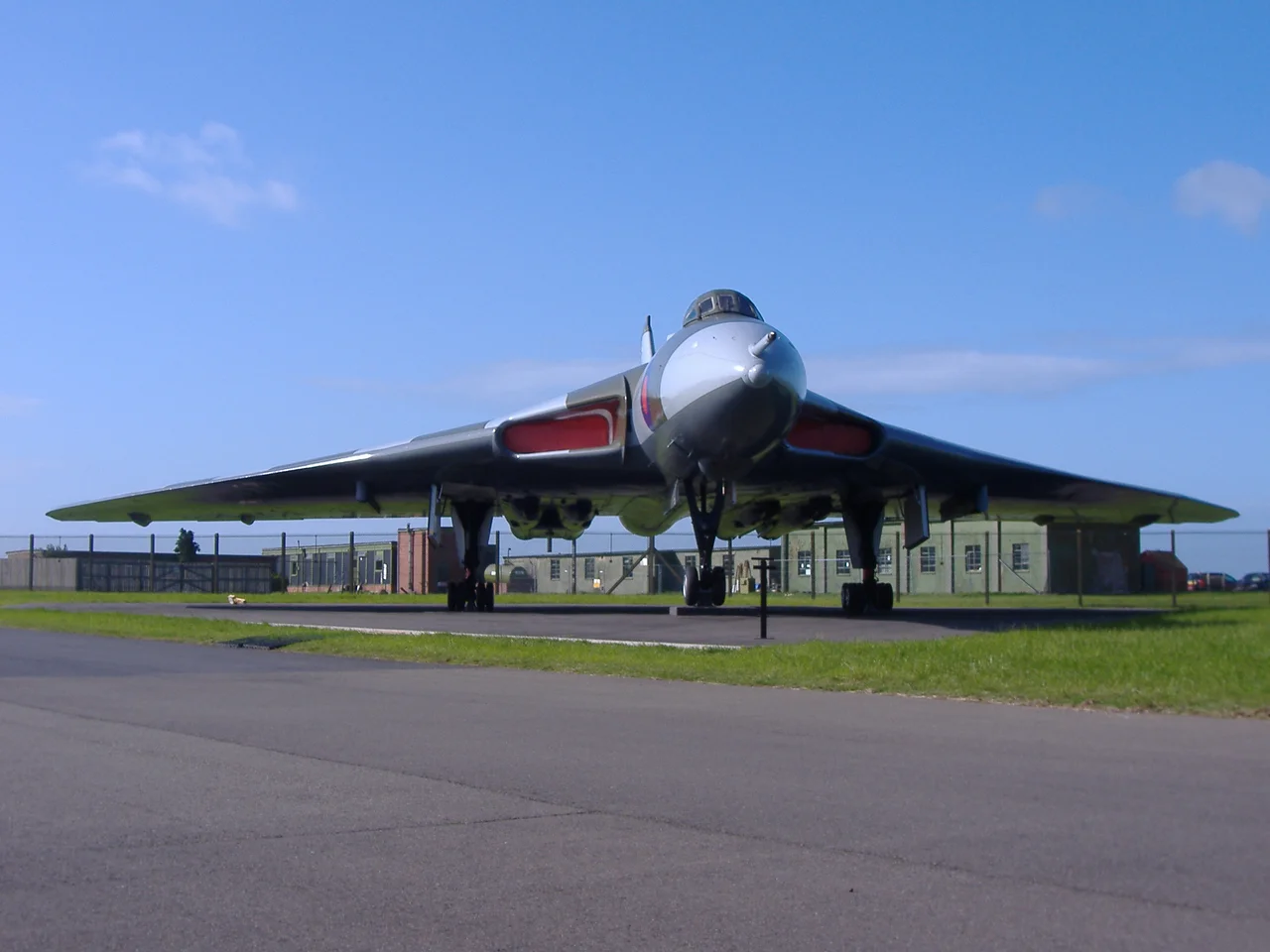
At the main gate stands Vulcan XM607, retired here in 1982 and preserved as gate guardian — the same aircraft type, possibly the same airframe, that flew Black Buck One. The station badge with its cathedral motif dates from a 1955 dedication. Inside the perimeter, hardened aircraft shelters from the Cold War sit next to new drone-operations buildings. The runway itself was rebuilt between 2014 and 2016 in a £35 million project that overran by 14 months and is expected to extend the base's operational life by 25 years. Six miles north, Lincoln Cathedral still rises through cloud, exactly as the badge promised in 1955 and as it did for the Lancaster crews of 44 Squadron in 1942. The aircraft below it have changed beyond recognition. The view from the cockpit, climbing out northeast on a clear morning, has not changed at all.
From the Air
RAF Waddington (ICAO: EGXW) sits at 53.173°N, 0.531°W, immediately south of the village of Waddington and 4.5 nm south-southwest of Lincoln Cathedral. The main runway is 02/20, 2,742 metres long. Waddington's airspace is active 24/7 — this is a working RAF main operating base with Quick Reaction Alert support, ISTAR sorties, Red Arrows training, and Reaper/Protector operations. Avoid overflight without prior coordination. The International Bomber Command Centre memorial spire on Canwick Hill is 2.5 miles northeast, visible from the airfield.
Nearby Stories
- Louth Navigation 2.9 km away
- Major Oak 3.6 km away
- Grantham Rail Accident 8 km away
- South Yorkshire Aircraft Museum 9.3 km away
- Gotham, Nottinghamshire 11 km away
- Alford Windmill 16 km away
- RAF Binbrook 21 km away
- Wisbech 29 km away