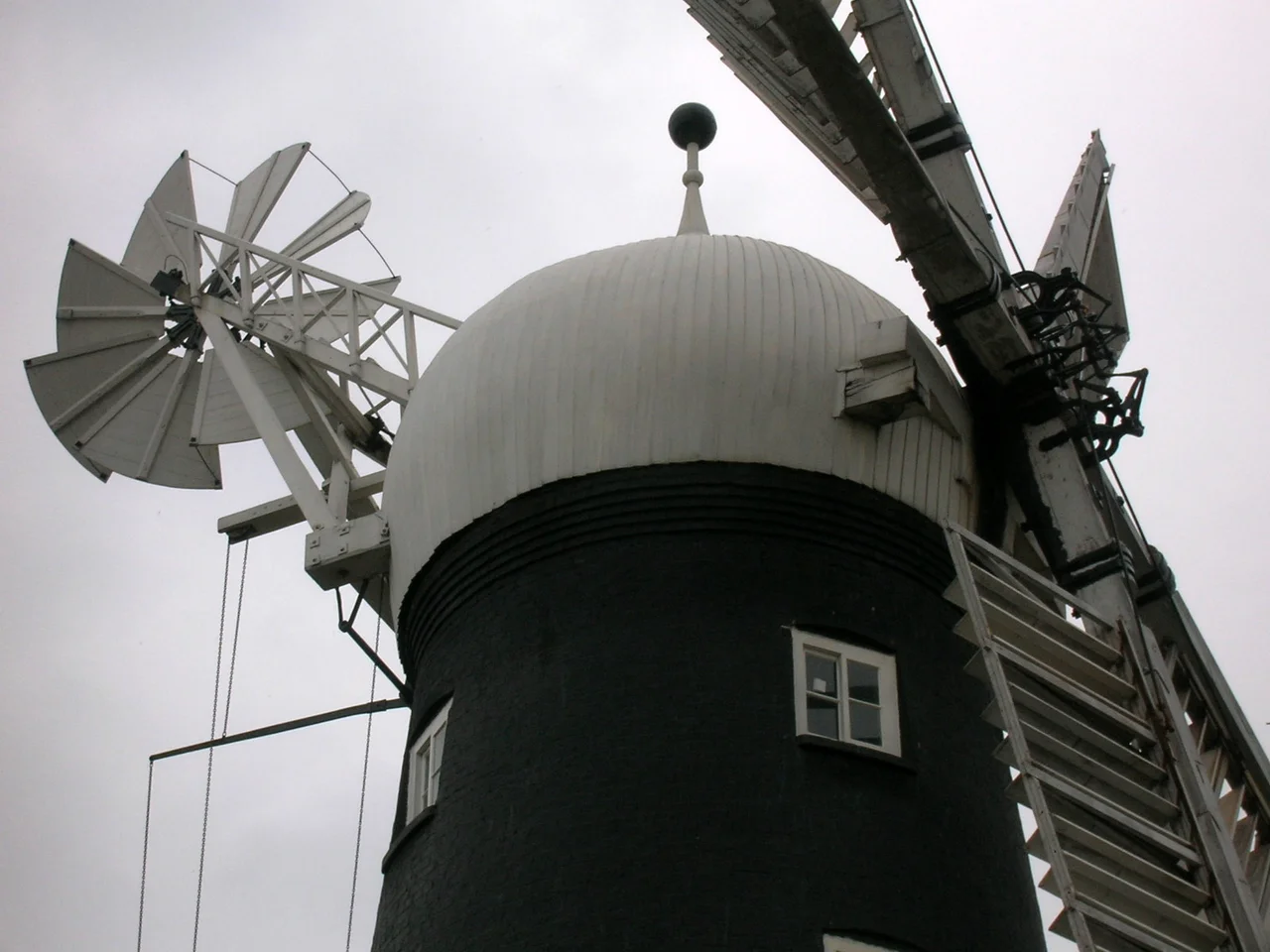

Alford Windmill
Alford once had four windmills. Now it has one. The survivor — a seven-storey tower mill built in 1837 by millwright John Oxley — stands at the edge of town with its five white sails still turning, its tarred brick tower tapering upward to an onion-shaped white cap. The others are gone: one is a stump, one was dismantled in 1973, and one vanished into memory. What remains is among the finest working windmills in England, Grade I listed, and still capable of grinding grain on a good day when the wind is sufficient.
Built to Grind
The Alford Windmill is a Lincolnshire type tower windmill — a style characterised by a slender, tapering brick tower with a movable cap that turns to face the wind. The cap here is white and onion-shaped, the classical ogee form, with a fan-stage supporting a large fantail that keeps the cap oriented correctly. The five patent-shutter sails catch the wind and drive the machinery inside.
Across seven floors, the mill's purpose was entirely practical. The ground floor holds the hurst frame and a fourth pair of millstones driven by an external gas engine — a backup for calm days. The spout floor receives the meal as it comes down from grinding. The stones floor houses the original three pairs: one grey pair cut from Peak District rock, two French quartzite pairs. Above that, two bin floors hold the grain before milling, with a sack hoist on the upper level. The dust floor at the top gives access to the inside of the cap. In its heyday, the mill could grind four to five tonnes of corn a day.
The Hoyles Family and the End of Milling
The windmill was purchased in the early twentieth century by Harry Hoyles, a local farmer and landowner. His sons Walter, Arthur, and Winston — known locally as 'The Miller' — ran the milling and baking operation together. For decades the mill was known as Hoyles's Mill, its flour going to local customers, its sails a familiar sight above the market town.
The business closed in 1955. Advances in large-scale industrial milling made the economics of windmill operation impossible to sustain, a pattern repeated across England in the mid-twentieth century as working mills became unviable one by one. The mill passed to Fred Banks of Kirton in Lindsey, a miller and owner of Mount Pleasant Mill, who recognised its significance and restored it to working order. Under his care, the mill shed its Hoyles name and became simply the Alford Windmill.
Rescue and Restoration
In 1978, Fred Banks had to replace the mill's cap and all five sails — a significant and expensive undertaking. That same year, ownership transferred to Lincolnshire County Council, which took on responsibility for the mill's ongoing restoration. The county had recognised what was at stake: of four windmills that had stood in Alford, only one remained, and if it fell into disrepair there would be nothing left of the town's milling heritage.
The council kept Fred Banks on as lessee until 1986, when he gave up his milling business. James Waterfield of Boston — himself the owner of the famous Maud Foster Windmill — took over the lease the following year. The mill then passed to Geoff Dees, and in January 2010 the current lease holder, Ian Shepherd, took over. The Lincolnshire County Council continues to hold ownership. The mill opens to visitors, its machinery operational, the smell of grain still present on grinding days.
What the Wind Does
The view from ground level is striking: five enormous white sails turning above a tapering black tower, the whole assembly moving with a mechanical grace that is easy to underestimate. Windmills look passive from the outside, but inside, the sound of grain grinding and machinery running fills every floor.
Alford's four mills once defined the town's skyline and its economy. Only this one remains, but it carries the weight of all of them. For a structure built to grind grain and not to last forever, the Alford Windmill has outlasted almost everything around it — the other mills, the generations of millers, the commercial logic that once made it indispensable. It turns because people decided it was worth keeping.
From the Air
Located at 53.27°N, 0.18°E in Alford, Lincolnshire. The windmill's seven-storey tower and five white sails are clearly visible from the air across the flat Lincolnshire countryside. Nearest airport is Humberside (EGNJ), approximately 35 miles north. The mill sits between the Lincolnshire Wolds to the west and the coast to the east, in an area of agricultural flatland typical of the Lincolnshire Marsh.
Nearby Stories
- Church of St Helen, Kilnsea 3 km away
- RAF Cranwell 11 km away
- Humber Bridge 12 km away
- RAF Scampton 14 km away
- Holkham National Nature Reserve 15 km away
- MS Piłsudski 17 km away
- Maud Foster Windmill 17 km away
- Silver Pit 21 km away