
Holkham National Nature Reserve
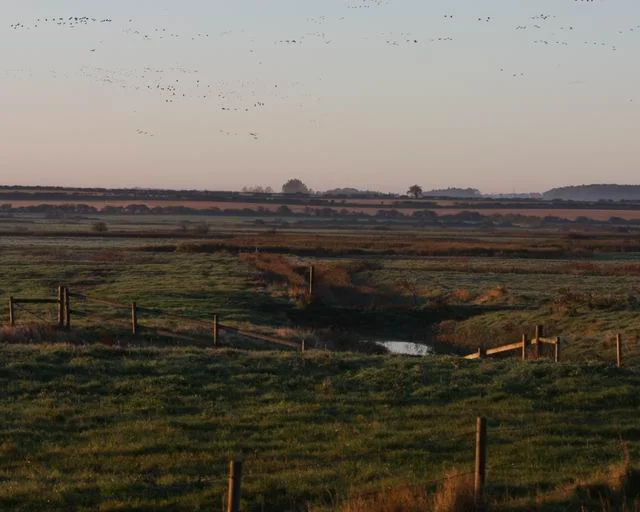
Before dawn on a November morning, the sky over Holkham Bay begins to move. A dark mass lifts from the grazing marshes — tens of thousands of pink-footed geese rising in a single wave, filling the air with a sound like wind through a cathedral. Up to 50,000 of them winter here, an international spectacle that draws birders from across Europe to stand at the edge of the biggest national nature reserve in England, binoculars raised, breath clouding in the cold.
Layers Written in Sand
The name Holkham derives from the Danish for 'ship town' — the Vikings navigated these tidal creeks to establish a settlement here. Before them, an Iron Age fort known as Holkham Camp sat at the end of a sandy spit, enclosed by 2.5 hectares of earthworks and surrounded by tidal wetland. It was in use until 47 AD, when the Iceni tribe was defeated by Roman forces.
The coast here has always been in motion. During the Mesolithic period, as glaciers retreated, rising seas swallowed much of what is now the North Sea floor — a drowned landscape archaeologists call Doggerland. The Norfolk coastline we see today is ancient only in relative terms. Until the 17th century, ships could sail the tidal creeks all the way to a harbour at Holkham village. The Coke family, who have owned the Holkham Estate since 1609, changed all that: they began reclaiming the marshes in 1639, and the final embankment was completed in 1859, converting 800 hectares of tidal wetland to farmland.
Pines on the Dunes
The 3rd Earl of Leicester left one of the reserve's most visible legacies. In the late 19th century he planted Corsican, maritime and Scots pines along the dune ridges to protect agricultural land from wind-blown sand. Those trees now form the only substantial area of woodland in the North Norfolk Coast Site of Special Scientific Interest — a cathedral of conifers that was never meant for wildlife, yet has become a habitat in its own right. Parrot crossbills bred in the pines in 1984 and 1985. Siskins nest in their branches. A single red-breasted nuthatch, recorded in 1989, remains the only individual of its species ever seen in the United Kingdom.
The reserve was created in 1967 from 1,700 hectares of the Holkham Estate and 2,200 hectares of foreshore belonging to the Crown Estate. Its 3,900 hectares of total area make it England's largest national nature reserve — a designation that comes stacked with additional protections: Natura 2000, Special Protection Area, Ramsar site, Area of Outstanding Natural Beauty, and Biosphere Reserve status.
A World-Class Shore
The salt marshes at Holkham are described in their Site of Special Scientific Interest citation as 'among the best in Europe — the flora is exceptionally diverse.' The claim is backed by decades of monitoring. Between 1983 and 1993, the number of wintering wildfowl of four key species rose from 1,215 to 17,305. Breeding wetland bird pairs increased from 120 pairs of ten species in 1986 to 795 pairs of 26 species by 1994. The management of water levels drives numbers that would be remarkable anywhere; at Holkham they have become expected.
Beyond the birds, the dunes hold species rarely found elsewhere in Britain. Holkham is one of only two UK sites with a colony of antlions. Pyramidal orchids bloom among grey hair-grass. The salt marsh carries glassworts and annual seablite in the most exposed sections, giving way to bird's-foot trefoil and the rare Jersey cudweed where conditions allow. Brown hares sprint across the grazing marsh at dusk. European otters work the tidal channels in winter.
A Coast Under Pressure
More than 100,000 people visit Holkham each year. The dunes are fragile — too many feet crossing the same crest triggers blowouts, where wind excavates the sand beneath and a living landscape starts to unravel. The Little Tern colony, holding 7 percent of Britain's breeding population, is cordoned off each season. Boardwalks guide visitors to the beach without undercutting the dune system.
The sea level is rising at an estimated 1–2 millimetres per year. The shingle bank at Scolt Head Island, which helps shelter the coast, is moving westward and southward at up to 3.5 metres annually. The Environment Agency's management plan runs to 2105, betting that the natural defences of the dune system will hold — intervening only if essential. The plan accepts that the coastline will continue to change, as it always has, trading one shape for another in the slow negotiation between land and sea.
From the Air
Located at 52.97°N, 0.81°E on the North Norfolk coast. From altitude, the reserve is identifiable by the dark band of Holkham pines behind a wide beach, with the tidal channels and salt marshes extending east toward Blakeney. The nearest airport is Norwich International (EGSH), approximately 45 km to the southeast. Fly at 2,000–3,000 ft AGL on a clear day to see the full sweep of the coastline from Burnham Overy Staithe to Blakeney Point.
Nearby Stories
- Wroxham 3.2 km away
- East Dereham Windmill 8.5 km away
- Alford Windmill 11 km away
- Mundesley 14 km away
- Batemans Brewery 14 km away
- Wisbech 15 km away
- HMS Cobra 24 km away
- SM U-97 118 km away