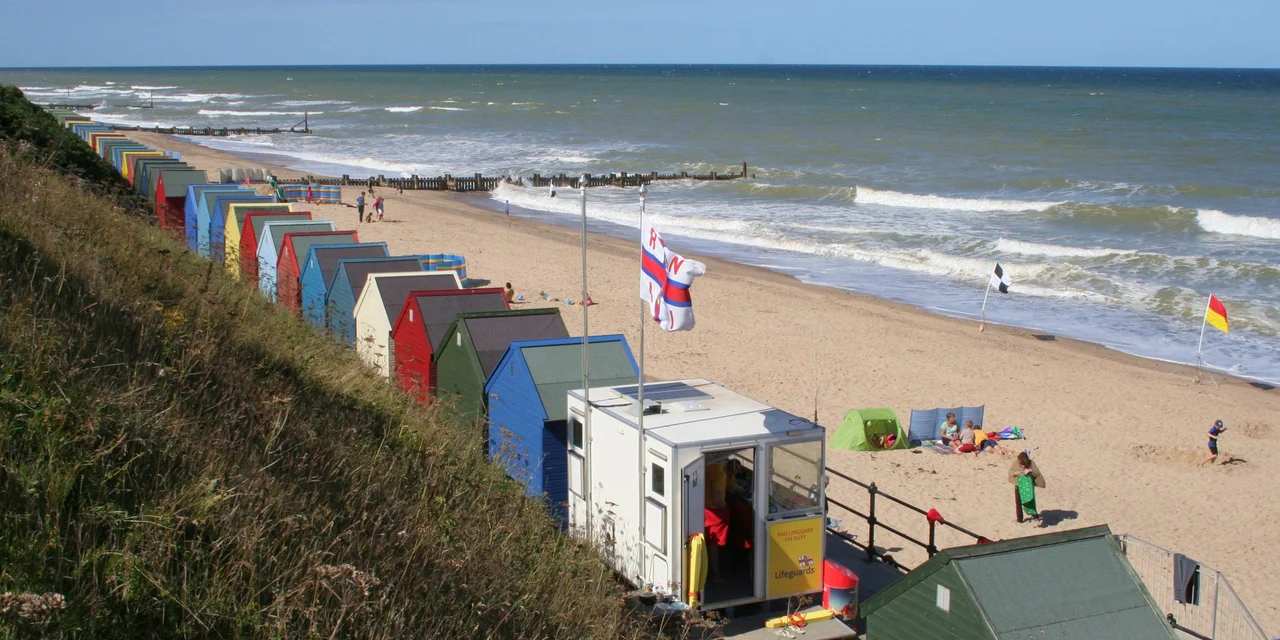

Mundesley
Pronounce it 'Munzley' and the locals will smile politely. Pronounce it as written - 'Mun-des-ley' - and they will smile more politely. The village name, like so many in this part of Norfolk, is spelled one way and said another, a quiet trap for the unwary. On 5 September 2022 Mundesley beach edged out West Runton in the North Norfolk Battle of the Beaches, and held the trophy as the top beach in the district. The judges noted sandy expanses, cliff-fringed setting, and a quietly maintained Victorian seafront. What they did not need to mention is that Mundesley has always known what it is: a small coastal resort with a long memory and a good golf course.
Harry Vardon's Hole-in-One
On the high ground above the River Mun, Mundesley Golf Club has been laying out fairways since 1901. The course was designed with the help of Harry Vardon - six-time Open Champion, one of the most influential figures in early golf - who happened to be convalescing nearby. Vardon was recovering from tuberculosis at the Mundesley Sanatorium, a fashionable retreat for TB patients in the early twentieth century. His long association with the course is part of local pride, and the story goes that he scored his only hole-in-one in his life on what is now the sixth - a club legend confirmed by Vardon himself in print, if it pays to believe a man's own claim about a hole-in-one. The course was modified for wartime farming and redesigned after both World Wars.
The TB Years
Mundesley Sanatorium, opened in 1899, drew patients from London and the Home Counties for its sea air - believed in the pre-antibiotic era to ease tuberculosis. The wealthy convalesced here; some recovered, some didn't. Vardon was one of the recoveries. The sanatorium operated through the first half of the twentieth century until streptomycin and other antibiotics made the long sea-air cure obsolete. The buildings have since been converted to other uses, but the tradition gave Mundesley one of its quiet historical layers - alongside the golf, the Victorian railway tourism, and the older sea-fishing trade that predated either.
Coastwatch and Maritime Museum
Above the beach stands one of the smallest and most efficient maritime museums on the English coast. It doubles as the local lookout station of the National Coastwatch Institution - the charity that maintains volunteer watch points around Britain after the Coastguard withdrew from many small stations in the 1990s. Volunteers staff Mundesley 365 days a year, scanning for vessels in distress, weather changes, swimmers in trouble. The museum itself sits in a small cliff-top building near the war memorial. The Mundesley Memorial Bomb on the seafront commemorates the Army bomb disposal teams who cleared mines from this stretch of beach after the Second World War - a job that took years, since the mines did not always come up where the maps said they would.
All Saints and the Eroding Cliff
All Saints Church stands on the cliff edge above the village, a position that was once safely set back from the sea and now sits within sight of the drop. The medieval church fell into ruin and stood roofless for over a century before being restored in stages in the early twentieth century - the organ chamber added in 1904, the nave extended eastwards in 1914. A short walk from the church is a World War II gun emplacement, originally inland, now perched near the cliff edge by the same coastal erosion that has reshaped this whole shoreline. Houses, churches, and concrete pillboxes are all on the move here. The cliff retreats; the village adjusts.
Ship Inn and Royal Hotel
Two pubs anchor the village. The Ship Inn on the seafront, built of flint in the local style, lists its first landlord as Paul Harrison in 1836 - which means it has been pouring beer in the same building, with various refurbishments, for nearly two centuries. The Royal Hotel sits inland on the Paston road, where local tradition holds that Lord Nelson - born just up the coast at Burnham Thorpe - lived for a while. The Nelson claim is the kind of village legend that is harder to confirm than to enjoy. Mundesley also hosts Stow Mill on the southern road to Paston, a restored windmill that turns again on volunteer power, and a small adventure-island crazy golf park near the seafront that does brisk summer trade.
From the Air
Mundesley is located at 52.876°N, 1.438°E on the North Norfolk coast, about 20 nm NNE of Norwich. Best viewed at 1,000-2,000 ft AGL where the beach, cliff-top church, and golf course in the Mun valley are all visible. Norwich International (EGSH) is the nearest airport at 20 nm. The Norfolk Coast AONB extends along this entire coastline. Stow Mill stands as a clear visual landmark just south of the village. The cliff retreat is visible from the air - the older defensive emplacements sit closer to the edge than originally intended.
Nearby Stories
- RAF Deopham Green 4.3 km away
- Beccles 12 km away
- Binham Priory 13 km away
- Skegness Lifeboat Station 48 km away
- HMS Cobra 50 km away
- Battle of Lowestoft 55 km away
- SM U-97 79 km away
- SS Elbe 94 km away