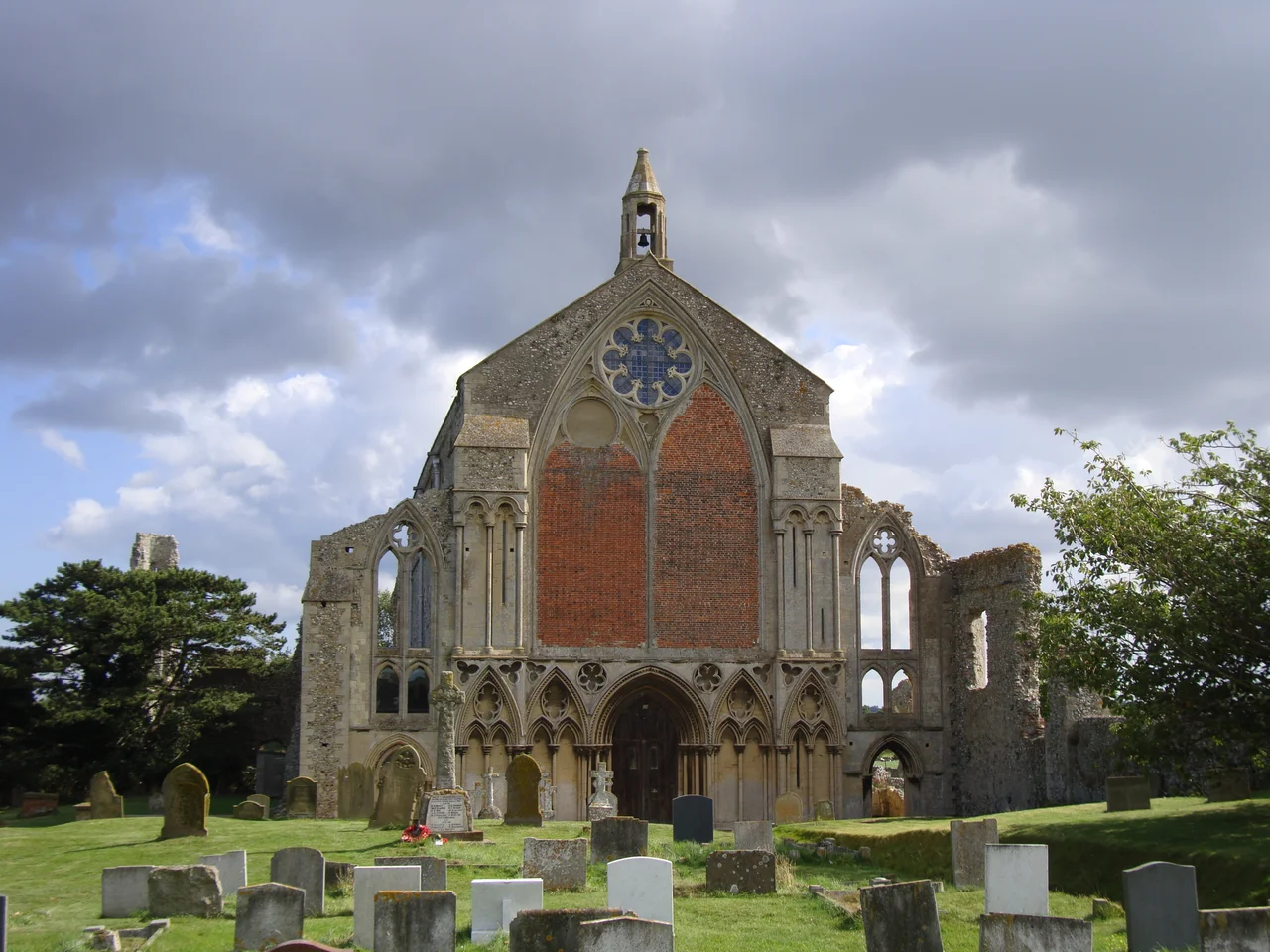

Binham Priory
English Heritage describes Binham Priory's history as 'one of almost continuous scandal.' That is a striking summary for an institution founded as a house of God, but the Benedictine monks of Binham did seem to attract more than their share of conflict. Feuds, sieges, unscrupulous priors, and finally dissolution — the priory's nine centuries of existence were rarely quiet. What remains in the village of Binham today is a ruin, but the ruin contains something no other church in England can claim: the earliest example of Gothic bar tracery on its western facade, predating Westminster Abbey by a decade.
A Norman Foundation
Peter de Valognes received the manor of Binham from William the Conqueror after the Norman Conquest of 1066. In 1091, he established a Benedictine priory at the site as a subordinate house — a 'cell' — of St Albans Abbey. The priory took approximately 150 years to complete, reaching its finished form in the mid-thirteenth century. At its founding it housed eight monks; by the fourteenth century the community had grown to thirteen or fourteen. Immediately before its suppression in 1539, only six monks remained.
Peter de Valognes and his wife Albreda de Saint-Saveur are both buried in the priory, as is their son Roger de Valognes and his wife. The Norman lords who established the house are still here, in a ruin in a Norfolk village, eight centuries on.
A Siege and Continuous Scandal
In 1212, Binham Priory was besieged. Robert Fitzwalter, a powerful baron who features in the legends surrounding Magna Carta, laid siege to the priory over a dispute between himself and the Abbey of St Albans. The forces of King John eventually lifted the siege. This was unusual behaviour even by medieval monastic standards, and it was not the last time Binham would be the scene of extraordinary events.
English Heritage's assessment of 'almost continuous scandal' reflects the long record of priors at Binham who proved, in the institution's own documentation, to be unscrupulous and irresponsible. The specific scandals are now largely lost to history, but the institutional record preserves enough to make the evaluation stick. Binham was not a peaceable house.
The First Gothic Tracery in England
Whatever its internal reputation, Binham produced a work of architectural significance that survives in the western facade of the priory church. The bar tracery in the west front — delicate stone patterns that transform a window opening from a simple arch into something geometrically complex and luminous — is the earliest example of this form in England. Westminster Abbey, begun in 1245, is often cited as the point where Gothic tracery entered English architecture. Binham's west face predates it by roughly a decade.
Bar tracery replaced the earlier plate tracery, where patterns were simply cut through solid stone. The bar technique — building up the window pattern from thin stone bars — allowed for greater intricacy and became the defining visual element of the Gothic style. That the first example in England stands in a small Norfolk village, in the ruins of a priory with a disreputable institutional history, is the kind of irony that medieval architecture specialises in.
After the Dissolution
Henry VIII ordered the dissolution of Binham Priory in 1539. Most of the buildings were destroyed. The priory's wealth was given to Sir Thomas Paston, a local nobleman, who promptly dismantled parts of the structure to provide stone for a house he was building in Wells-next-the-Sea. His grandson Edward Paston planned to build a new house in Binham itself, using more of the priory stone — but gave up on the project before completing it.
The nave of the priory church survived. It became — and remains — the Church of St Mary and the Holy Cross, serving the parish of Binham as it has since the dissolution. The medieval fabric still holds services. English Heritage manages the ruins of the wider priory complex. The gatehouse and other surviving structures are all Grade I listed. The ruin is preserved, the scandal is recorded, and the west window — England's earliest bar tracery — still catches the Norfolk light.
From the Air
Located at 52.92°N, 0.95°E in the village of Binham in north Norfolk. The priory ruins are visible from lower altitudes in the agricultural landscape. Nearest airport is Norwich (EGSH), approximately 25 miles southeast. Binham sits inland from the north Norfolk coast, surrounded by farmland between Wells-next-the-Sea and Holt.
Nearby Stories
- Wroxham 3.2 km away
- East Dereham Windmill 8.5 km away
- Alford Windmill 11 km away
- Mundesley 14 km away
- Batemans Brewery 14 km away
- Wisbech 15 km away
- HMS Cobra 24 km away
- SM U-97 118 km away