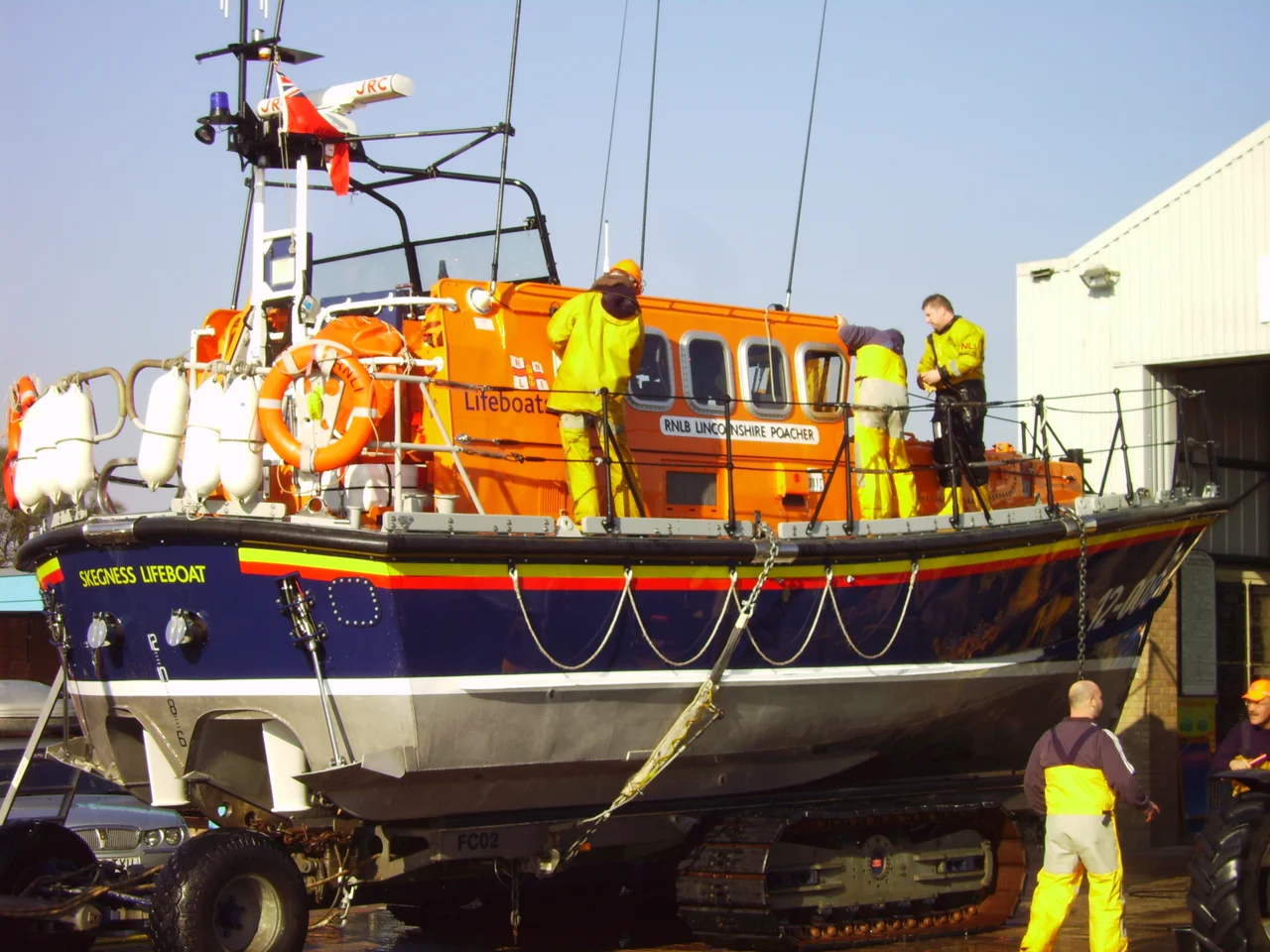

Skegness Lifeboat Station
The Lincolnshire coast is deceptive. From the beach at Skegness it looks calm enough — long, flat sands stretching to a horizon broken only by wind turbines and the occasional ship. But out there, between the shore and the East Dudgeon Lightship, the seabed is a maze of shoals and constantly changing sandbanks, and storms off the North Sea arrive with a ferocity that has been sinking vessels here for as long as people have sailed them. The lifeboat station at Skegness has been answering those storms since 1830.
Gibraltar Point and the First Wreck
The story begins a little to the south. In 1825, the Royal National Institution for the Preservation of Life from Shipwreck established Gibraltar Point Lifeboat Station at the tip of the Point, just one year after the institution's founding by Sir William Hillary. A 24-foot non-self-righting lifeboat was provided, built by William Plenty of Newbury, Berkshire, at a cost of £130. Management passed to the newly-created Lincolnshire Coast Shipwreck Association in 1827.
On 20 January 1830, the sloop Thomas and Mary of Wells-next-the-Sea ran aground on the Skegness Middle Sand. Launching the Gibraltar Point lifeboat into rough conditions was difficult — a broken carriage wheel didn't help. Two of the Thomas and Mary's crew were lost. The rest were saved. But the wreck made clear that the lifeboat belonged closer to the shoals it was fighting. The Gibraltar Point station was closed. A new boathouse was rebuilt among the sand dunes at Skegness, at a location still called Lifeboat Avenue.
The Norwegian Brig and Silver Medals
The RNLI took over responsibility from the Lincolnshire Coast Shipwreck Association in January 1864, bringing with it a new 30-foot self-righting lifeboat named Herbert Ingram. The station's history is measured in rescues, but one stands out for the circumstances alone.
On 9 November 1912, the Norwegian brig Azha suffered heavy storm damage off the Humber estuary. Waterlogged and helpless, she drifted south for four days. Her crew were close to death when she was spotted, having run aground on the Skegness Middle Sand — exactly the shoal that had taken the Thomas and Mary more than eighty years before. The station's last pulling and sailing lifeboat, the Samuel Lewis, launched into severe weather and came alongside the stricken brig. The crew was taken off. The Azha broke up behind them. Coxswain Matthew Grunnill and Second Coxswain Montague Grunnill were both awarded silver medals by King Haakon VII of Norway — a foreign recognition of a local act of exceptional courage.
The Sea Gem Disaster
The station's most significant modern rescue came in the depths of winter 1965. On 27 December, the BP jackup oil rig Sea Gem collapsed approximately 47 miles northwest of Cromer, off Norfolk. The following day, the Skegness lifeboat Charles Fred Grantham launched along with boats from neighbouring stations to search for the 32 crew.
The search lasted 14 hours in high seas, freezing conditions, and gale-force winds. Nineteen of the Sea Gem's crew were rescued. Five were confirmed dead. Eight were never recovered. The RNLI sent the station a letter of appreciation. It is a measured response to an extraordinary effort — fourteen hours in a North Sea winter storm, working the limits of what a lifeboat crew could physically endure.
The Station Today
The current all-weather lifeboat, Joel and April Grunnill (ON 1324), arrived at Skegness in 2017. Her name connects directly to the station's history: she is funded by the legacy of Joel Grunnill, a long-term volunteer, and a donation from his cousin April Grunnill, who also served. The £2.2 million vessel was officially named on 27 May 2017. Alongside her, The Holland Family (D-842) serves as the inshore lifeboat, donated in 2019 by Robert Holland in honour of his family's generations of volunteering at the station.
The names on these boats are the station's real history — not the institutional records, but the people who drove those launches, stood in the cold, and went out when the weather was worst. They still do.
From the Air
Located at 53.14°N, 0.35°E on Tower Esplanade in Skegness. The station sits directly on the seafront, identifiable from the air by its position at the beach edge north of the pier. Nearest airport is Humberside (EGNJ), approximately 50 miles north. The Lincolnshire coast runs straight and low, with offshore shoals not visible from altitude but marked by the position of the lifeboat stations themselves.
Nearby Stories
- North Somercotes 3 km away
- Walsingham Priory 12 km away
- Silver Pit 12 km away
- RAF Waddington 12 km away
- Grantham Rail Accident 20 km away
- True's Yard Fisherfolk Museum 23 km away
- Holkham National Nature Reserve 24 km away
- Humber Bridge 31 km away