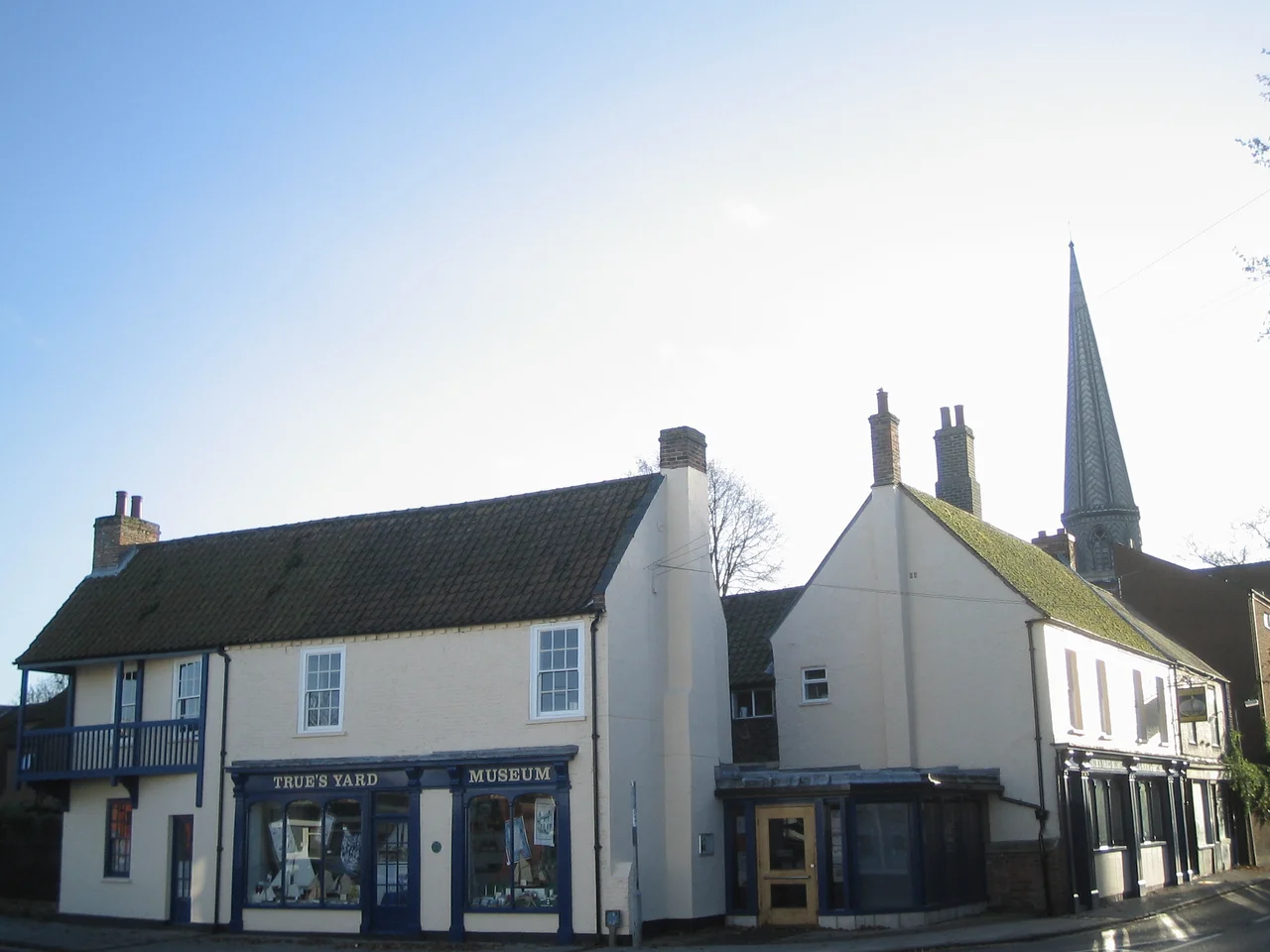

True's Yard Fisherfolk Museum
In cottage number five, a family of eleven once slept in two rooms. The nine children shared a single double bed, lying top to tail, while their parents bedded down on the floor. There were no toilets. A chamber pot under the bed served the entire household. This is not a hypothetical hardship dressed up for a tourist. This is what True's Yard Fisherfolk Museum has carefully preserved at the heart of King's Lynn's old North End, two cottages and a smokehouse that survived a wave of demolition. Most of the North End fishing quarter was knocked down in the slum clearances of the 1930s and 1960s. Two cottages remained because volunteers refused to let go.
What the Slum Clearances Erased
The North End of King's Lynn was the fishing community. It sat north of the medieval town, between the docks and the Great Ouse, a warren of cobbled yards and tight terraces where the herring fleet's families had lived for generations. By the 1930s, council reformers had classified the dwellings as substandard and began clearing them. A second round followed in the 1960s. The fishing families were rehoused on new estates further inland, and an entire close-knit neighbourhood - with its own dialect, its own funeral customs, its own way of smoking fish - disappeared from the streets of Lynn. What survived was the memory carried by those who had lived there, and a couple of cottages off St Ann's Street that volunteers managed to keep intact. The museum is run almost entirely by those volunteers, with early support from the Norfolk turkey magnate Bernard Matthews.
Thomas Westwood's Smokehouse
In the 1890s, a retired fisherman named Thomas Westwood opened a smokehouse behind his cottage on St Ann's Street. He worked with his wife Mary and their three daughters - Mary, Penelope, and Emily - while his two sons Thomas and Charles helped with the trade. The family opened a fishmonger's shop in the front room of the house, selling the fish they smoked in the brick smokehouse out the back. The favourite of the North End was the bloater, a herring smoked whole and ungutted, lightly cured so the oil stayed in the flesh. The smokehouse still stands at True's Yard and still smells faintly of the oak and the herring that passed through its racks for decades. The Westwood family had no public history, no biography, no Wikipedia entry of their own. The museum is, in a way, a corrective - an insistence that ordinary lives in an ordinary street produced enough story to fill a building.
The Cottages You Can Walk Into
Each cottage is just two rooms - one upstairs, one downstairs - and walking into them is the experience the museum is built around. They are tiny in a way that is hard to grasp from photographs. The ceiling beams force tall visitors to duck. The hearth dominates the downstairs room. A narrow staircase climbs to the bedroom, where the great families of the late 19th century made their domestic geometry work the only way they could. The eleven-strong family in cottage five is not a single recorded household but a representative case; the North End regularly produced households of nine or ten or more in spaces this size, with infant mortality stalking the corners and tuberculosis a constant neighbour. The walls were lime-washed and re-lime-washed every spring. The chamber pots were emptied by the parish night-soil men. The cottages remain because something irreplaceable was being lost when they nearly went.
The Quietest Museum in Lynn
True's Yard is small. It will not detain you for more than an hour. But it leaves a residue that the bigger museums of King's Lynn struggle to match. Stories of Lynn, the multi-media exhibition in the vaulted undercroft of the 15th-century Trinity Guildhall, presents the town's grand civic narrative. The Lynn Museum in Market Street holds the Bronze Age timber circle Seahenge, recovered from the beach at Holme-next-the-Sea in 1998. True's Yard sits between these in significance but somewhere else entirely in tone. It speaks for a community that did not write its own history down, that worked the dangerous shallows of The Wash for centuries, and that very nearly left no physical trace. The volunteers who keep it open are themselves often descendants of the North End. Walking through, you are inside a domestic geometry the rest of King's Lynn forgot was ever there.
From the Air
Located at 52.7582 degrees N, 0.3968 degrees E in the historic North End of King's Lynn, just north of the medieval town centre near the River Great Ouse. The museum cottages are tiny and not visible from cruising altitude - look instead for the surrounding North End street pattern and the docks immediately west. Best viewing 1,500-3,000 feet AGL. Nearest airport: RAF Marham (EGYM) approximately 10 nm south-southeast. Norwich International (EGSH) 40 nm east.
Nearby Stories
- RAF East Kirkby 5.9 km away
- RAF Feltwell 8.6 km away
- RAF Matlaske 10 km away
- Chain Bridge Forge, Spalding 10 km away
- Norfolk Tank Museum 12 km away
- Skegness Lifeboat Station 14 km away
- Connington South Rail Crash 20 km away
- HMS Cobra 39 km away