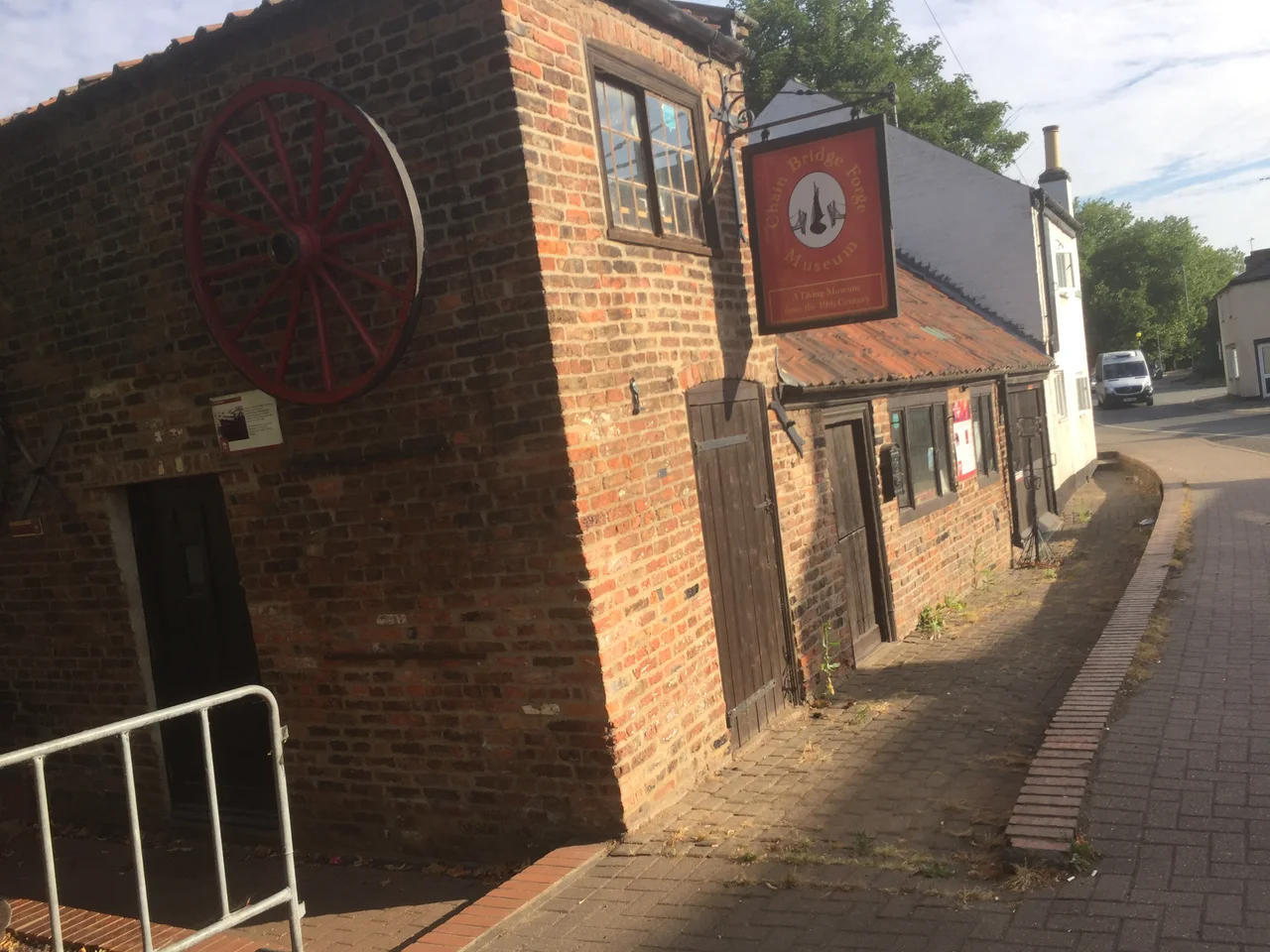

Chain Bridge Forge, Spalding
The fee was one pound. On 20 September 1988, after two years of patient negotiation, the South Holland District Council bought the Chain Bridge Forge from Geoffery Dodd for that symbolic sum - a forge his grandfather George had bought in 1899, that he had inherited and worked all his life, that was now too decrepit to keep going and too important to demolish. Dodd was retiring. The building was nearly two centuries old. It had operated continuously as a blacksmith's workshop since around the 1830s. Three years after the sale, English Heritage paid for the restoration. Twenty-four years after that, the Friends of Chain Bridge Forge opened it as a museum where, today, you can watch the hearth lit and the hammer fall, and try your hand at hammering hot iron yourself. It is, as far as anyone can tell, the last working blacksmith's forge in Spalding - and arguably one of the last in Britain to have run continuously, in family hands, from coach age to motor age to museum age.
Why the Bridge Was Made of Chains
The forge takes its name from a curious neighbour. Beside the building runs the River Welland, and across the river crouches a small footbridge. Today it is ordinary enough - a flat span you would not notice if you were not looking. But the watercolours of Hilkiah Burgess, held in the Spalding Gentlemen's Society collection, show what stood here in the early 19th century: a chain-suspended drawbridge, designed so that boats and barges could navigate up from the Wash to the working port of Spalding. The chains gave the bridge its name. The bridge gave the forge its name. Spalding was a busy inland port then, with vessels of fifty to seventy tons coming up the canalised river to load timber, corn, wool, and coal. The forge's accounts for 1850-1860 show its blacksmith servicing those boats - mending iron fittings, replacing hooks, forging the small ironwork that any working vessel constantly needed. Then steam came, the river silted, the port faded, and the forge turned its attention to the land.
Three Generations of Dodds
George Dodd took possession of the forge in 1899 and the family kept it for three generations. The work changed with the times. For most of the early 20th century, the forge shoed horses - cart horses, plough horses, the gentry's mounts - and made or mended agricultural ironwork: ploughshares, harrow tines, gate hinges, scythes. By the middle of the century the horses were gone. The tractors had taken over. But Geoffery Dodd, George's grandson, found another use for the skills he had been taught. The Spalding Flower Parade, which had run annually from 1959, needed steel frames for its decorated floats - the great wheeled platforms onto which volunteers fixed tens of thousands of tulip petals to make moving sculptures. Geoffery Dodd designed and built many of those frames. The same hands that had shoed Edwardian horses were now welding parade floats. The same hearth that had heated nails for boats heated steel rod for the Tulip Festival.
A Living Museum
The restoration in 1991, done by the Spalding builders R. G. Sharman on behalf of the council, kept the building as the Dodds had left it. The brick hearth still works. The bellows still pump. The anvils are in their places. The tongs hang on the wall where they always hung. When the Friends of Chain Bridge Forge began their volunteer effort in 2011 and officially opened the forge to the public in September 2012, they did so as a living museum: not a display behind glass but a working forge with smoke rising from the chimney, where on demonstration days you can watch a smith heat a bar of iron to lemon yellow and bend it, hammer it, twist it into a hook or a leaf or a poker. There is no other way to learn blacksmithing - and there is no other place in Spalding where you can. The skill is being kept alive here by people who decided it was worth keeping alive.
Iron in the Welland Country
Spalding is flat country, fen country, drained country, the silt soils of the South Holland marshes given over to flowers and vegetables. It is not where you would expect to find a heritage of metalwork. But every fen village had a forge. Every market town had its smiths. The horses and ploughs and gates and pumps and waterwheels of agricultural England all depended on someone in a workshop somewhere keeping a hearth lit and the iron coming. Chain Bridge Forge survives because one family did not let it go and because, when they finally had to, the local council understood what it was worth. Walk past it now on the High Street, see the smoke if a demonstration is happening, hear the hammer if you stop and listen. The river still runs by. The bridge is no longer chained. But the forge is still here, glowing quietly in the centre of a town that has otherwise mostly stopped making things by hand.
From the Air
Chain Bridge Forge sits at 52.79N, 0.14W, on the south bank of the River Welland in central Spalding, Lincolnshire. The town lies in the flat Fenland of South Holland, dominated by the meandering Welland and the long straight drains that keep the surrounding farmland dry. Nearest airports: Peterborough Conington (EGSF) about 18 miles south-west, RAF Wittering (EGXT) similar distance west, RAF Cranwell (EGYD) roughly 25 miles north-west. Best viewed at 2,000-3,000 feet; the river curves through the heart of town with the forge near the historic chain bridge crossing.
Nearby Stories
- RAF Coningsby 1 km away
- Rockingham Castle 5.3 km away
- True's Yard Fisherfolk Museum 7.7 km away
- Belvoir, Leicestershire 8.7 km away
- Connington South Rail Crash 13 km away
- RAF Feltwell 15 km away
- Laxton, Nottinghamshire 19 km away
- Silver Pit 57 km away