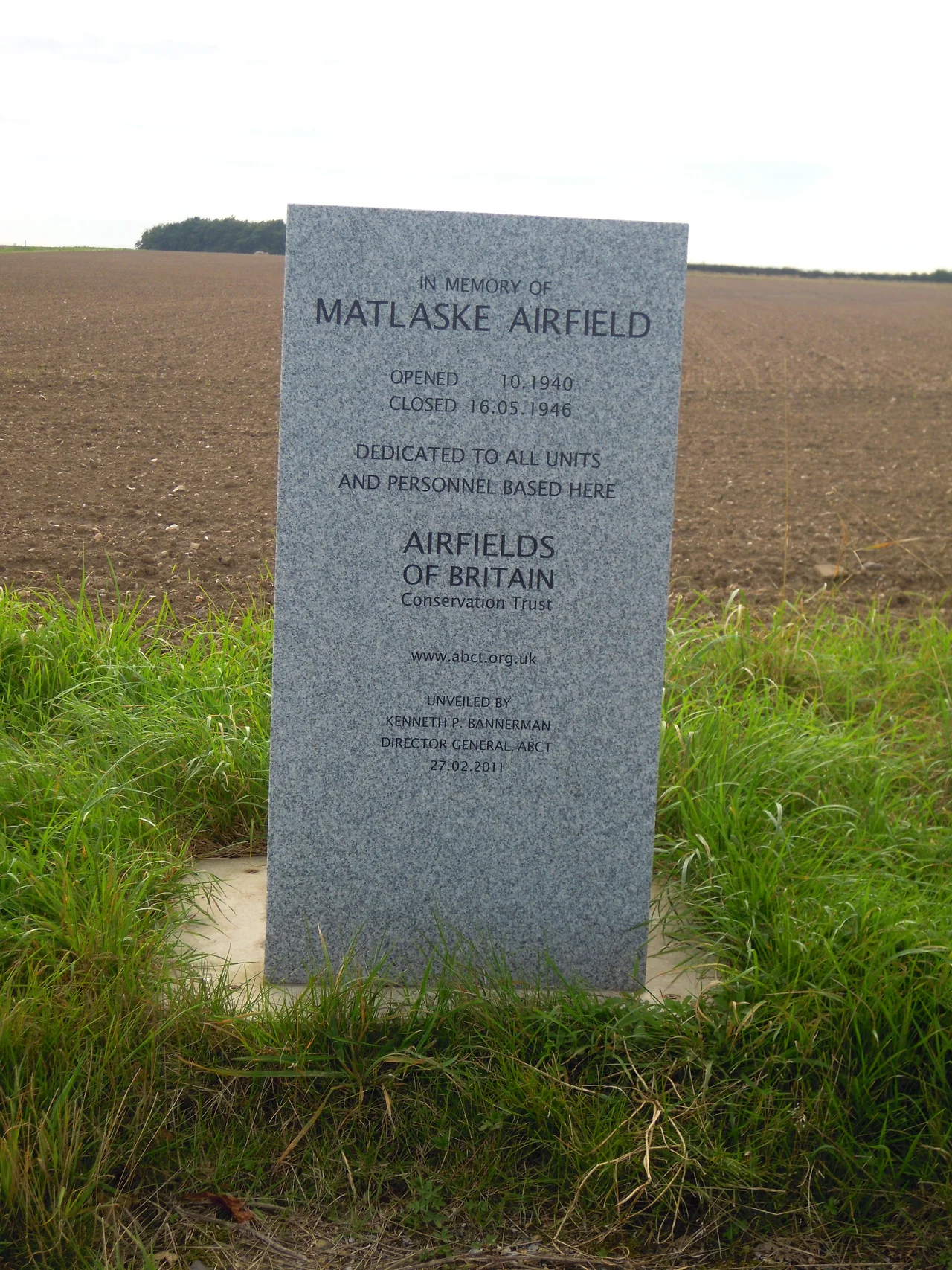

RAF Matlaske
Five Dornier bombers came in low over the Norfolk fields one autumn morning in 1940 and strafed a brand-new aerodrome at Matlaske. The airfield had been operational for days. The Spitfires of 72 Squadron, hurried over from Coltishall after the Luftwaffe bombed that base two days earlier, were caught on the ground. Parked aircraft burned, and the dispersal areas took casualties. RAF Matlaske was a satellite station, the kind of grass strip the Air Ministry threw down across East Anglia to scatter fighter squadrons that needed to be somewhere other than the obvious target. From late 1940 through the end of the war in Europe, the field hosted a procession of squadrons that reads like a roll-call of the British single-engined fighter.
A Field Becomes a Station
There had been a small aerodrome at Matlaske before the war, the details of which have largely been forgotten. In August 1939, with conflict closing in, the Air Ministry approved the site for requisition. Construction crews moved in during the summer of 1940 and laid out a satellite station to support RAF Coltishall, the major fighter base seven miles to the east. Matlaske was operational by October 1940. It would never be a glamorous posting. There was no concrete runway, just grass, and the buildings were the standard prefabricated stuff that went up across hundreds of wartime airfields. The pilots who flew from here lived in dispersed huts among the hedgerows and woods, hidden from the kind of attack that had welcomed them on opening day.
Spitfires, Hurricanes, Typhoons
The squadron list at Matlaske runs to twenty units across five years. 19 Squadron flew Spitfire IIs and Vbs. 56 Squadron brought the heavy, troublesome Hawker Typhoon Mark Ib, which matured here into a useful ground-attack aircraft and was later replaced by the Tempest V. 65, 122 and 453 Squadron Royal Australian Air Force flew North American Mustang IIIs from the field, the long-range American fighter that finally gave the RAF the legs to escort bombers deep into Germany. 222, 229, 611 and 602 Squadrons cycled through with Spitfires. 245 and 609 brought more Typhoons. 486 Squadron, made up largely of New Zealanders, flew Tempest Vs against V-1 flying bombs and into the final pushes across the Low Countries.
The Whirlwinds of 137
Among all those Spitfires and Typhoons, one squadron at Matlaske stood out: 137 Squadron flew the Westland Whirlwind, one of the rarest and most striking British fighters of the war. Twin-engined, low-set, with four 20mm cannons clustered in its nose, the Whirlwind was fast at low altitude and devastating against shipping and ground targets, but its Rolls-Royce Peregrine engines were never developed beyond their early form and only two squadrons ever flew it operationally. 137 was one of them. From Matlaske they hunted German coastal shipping along the North Sea, the Whirlwinds skimming the waves with their cannons hammering. The aircraft were retired in mid-1943, the squadron re-equipped with Hurricanes, and the type vanished from front-line service forever.
Air-Sea Rescue Over the North Sea
Not every flight from Matlaske ended in combat. The Air Sea Rescue Flight based here in 1941, which grew into 278 Squadron RAF, flew Westland Lysanders and Supermarine Walrus amphibians out over the North Sea looking for downed crews bobbing in dinghies among the swells. The Lysander could drop dinghies and supplies; the Walrus, a Supermarine biplane flying boat, could land on the open sea and pluck airmen from the water if conditions allowed. The work was unglamorous and dangerous in roughly equal measure. The same waters that took HMS Vortigern in March 1942 and dozens of merchantmen besides also gave up airmen, some still alive, to the patient circling of these unarmed rescue aircraft.
After the War
RAF Matlaske closed in 1945, its grass runway returning to farmland with quiet inevitability. There was no last great air battle, no parade. Most of the buildings were dismantled or repurposed. The control tower, a recurring feature of British wartime airfield archaeology, survives in fragments. Today Matlaske is again the small Norfolk village it was before the war, surrounded by fields and hedgerows that occasionally yield up the foundations of a dispersal pen or the concrete pad where an aircraft once stood. The Airfields of Britain Conservation Trust maintains the memory of the place. The 56th Fighter Group of the United States Army Air Forces had been allocated here, but its Thunderbolts ended up further south. Matlaske remained a British and Commonwealth field through to the end.
From the Air
RAF Matlaske sat at 52.86N, 1.19E in central Norfolk, about seven miles west-north-west of RAF Coltishall (now closed). From altitude the former airfield reads as a patchwork of fields with faint geometry, edged by woods and the village of Matlaske to the south. Norwich Airport (EGSH) is roughly 12 miles to the south. Look for the angular boundary of the wartime perimeter track and the village church of St Peter to orient on the site.
Nearby Stories
- Houghton Hall 3.1 km away
- Norfolk Tank Museum 7.5 km away
- Weeting Castle 11 km away
- Skegness Lifeboat Station 25 km away
- HMS Cobra 40 km away
- Battle of Lowestoft 79 km away
- SM U-97 101 km away
- Southern Bight 112 km away