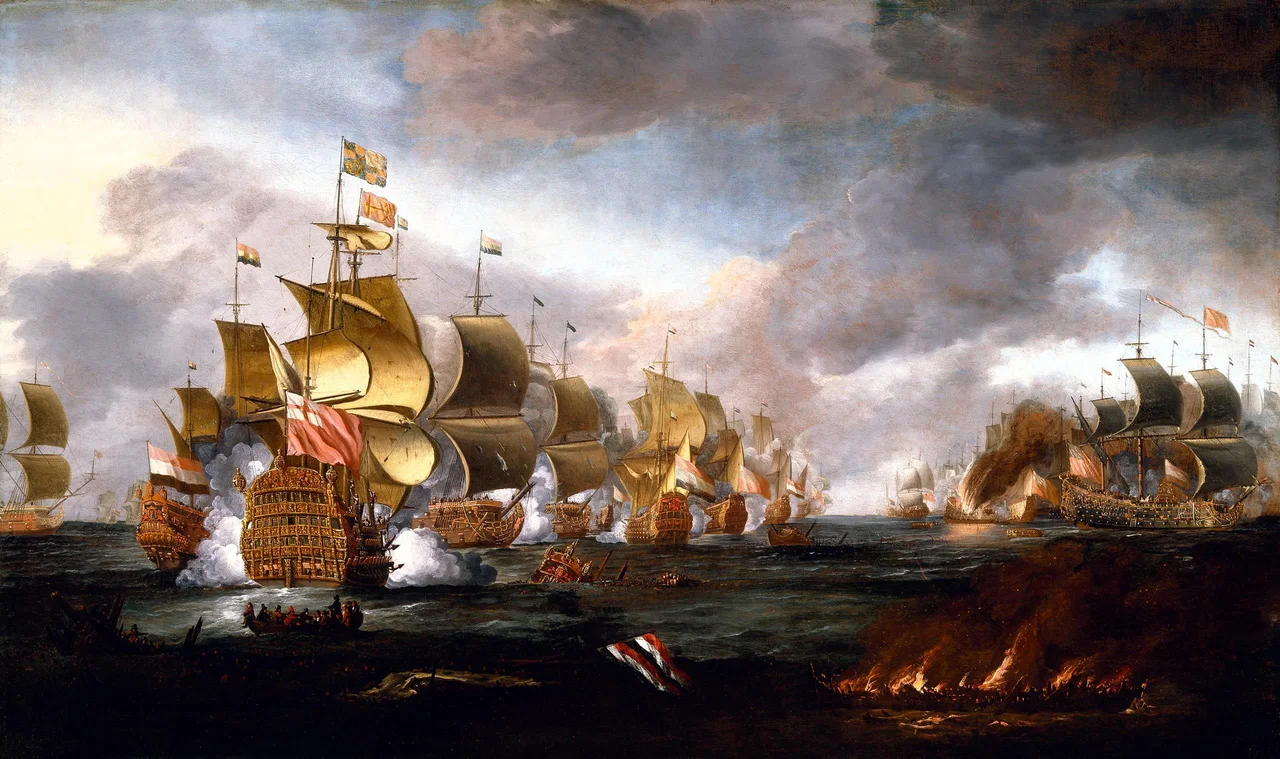

Battle of Lowestoft
At around 3 p.m. on 13 June 1665, an explosion turned the eastern horizon white. The Dutch flagship Eendracht had taken a spark to her powder room, and Lieutenant-Admiral Jacob van Wassenaer, Lord Obdam, the man holding 26 articles of orders from Johan de Witt himself, was gone in an instant - along with most of his crew. Forty miles east of Lowestoft, more than two hundred warships were locked in the largest naval action the world had yet seen, and the man supposed to lead one of them no longer existed.
A War of Ledgers
The Second Anglo-Dutch War was an argument about money dressed up as an argument about flags. England wanted a quick, decisive victory because the Crown's books could not stand a long war; the Dutch Republic needed to break an English blockade before its fishing fleets rotted at the wharves. On 4 March 1665, the States General declared war. Three months later, James, Duke of York - heir to the English throne and Lord High Admiral - took 109 ships and 22,055 men to sea. Across the North Sea, Obdam mustered 103 ships, 21,613 men, and an impossible command structure. The five Dutch admiralties had insisted on their own flag officers for political reasons, and the fleet ended up cut into seven squadrons with 21 admirals, many of equal rank. It was a navy designed by committee, and committees do not fight battles.
The Wind Refuses
For two days the fleets shadowed each other, neither willing to attack. Obdam, knowing his squadrons were under-gunned and ill-disciplined, wanted to fight only with the wind at his back - so that if things went wrong, he could run. On the morning of the 13th, the wind finally settled in the southwest, faintly favouring the English. Obdam attacked anyway. The two lines closed and passed in opposite directions, hammering each other across the open water, then reversed course and did it again. By 8 a.m. the fleets were running northwest together, broadsides at close range. A cannonball cut the Frisian Lieutenant-Admiral Auke Stellingwerf in half on his own deck. Another mortally wounded the veteran Egbert Bartholomeusz Kortenaer, probably the most competent man Obdam had. The battle had barely begun and the Dutch were already losing their commanders.
Death of a Flagship
By mid-afternoon Obdam tried to break through Sandwich's Blue Squadron with five large ships. The giant East Indies hybrid Oranje, under captain Bastian Senten, even boarded the English Montague and briefly took her. James and William Penn turned the Royal Charles against the Eendracht to rescue Sandwich. In the close exchange that followed, a Dutch chain-shot from Obdam's own guns swept across the Royal Charles, killing three young noblemen standing beside the Duke - Charles Berkeley, Earl of Falmouth, was decapitated. Minutes later, the Eendracht's magazine took a hit and the Dutch flagship simply ceased to exist. About five of her crew survived. The man chosen to replace Obdam in advance - Kortenaer - lay dying on his own deck. His flag captain Stinstra, unnerved, fled the battle with Kortenaer's flag still flying, and a whole squadron followed it, assuming their admiral was leading the way.
The Order in the Night
By 6 p.m. the Dutch fleet had come apart. Cornelis Tromp and Cornelis Evertsen fought a rearguard while what remained ran for Texel, the Maas, the Scheldt - anywhere but here. Eight Dutch ships had been sunk, nine more captured, and the Oranje burned to a wreck after losing perhaps half her 400 men. England had lost one. With darkness coming, the English were poised to chase down the rest. And then someone - the histories blame Henry Brouncker, the Duke's master of the bedchamber - went below and quietly ordered the Royal Charles to reduce sail, claiming the order came from James. The rest of the fleet matched her. The Dutch slipped away into the night. Brouncker later fled England rather than face Parliament. The single decisive English victory that might have ended the war was thrown overboard with the canvas.
What the Dutch Learned
Defeat shocked the Republic into reform. The seven-squadron tangle was abolished; new Fighting Instructions in August 1665 specified three squadrons with clear chains of command, better signalling, and concentrated fire. Three Dutch captains were shot in front of their crews for cowardice, three exiled, three dismissed. More importantly, Obdam's place was given to Michiel de Ruyter, who would spend the next two years reminding the English exactly how dangerous a properly led Dutch fleet could be. The waves above the wreck of the Eendracht look like any other patch of the North Sea now, but the explosion that ended Obdam also ended the era of the disorderly mêlée. After Lowestoft, navies fought in line.
From the Air
The battle site lies in the southern North Sea at roughly 52.48 N, 2.92 E, about 40 miles east of Lowestoft on the Suffolk coast. Cruise at FL080-FL100 for a clean horizon. Norwich (EGSH) is the nearest major airport to the west; Rotterdam (EHRD) and Amsterdam Schiphol (EHAM) lie east across the water. In summer the haze can be thick over the southern bight; clear high-pressure days give the long flat sea horizons the Dutch and English navigated by.
Nearby Stories
- Southern Bight 18 km away
- HMS Cressy 27 km away
- Action of 22 September 1914 34 km away
- Four Days' Battle 48 km away
- Lowestoft 48 km away
- Sand Engine 49 km away
- Broad Fourteens 59 km away
- Happisburgh Lighthouse 63 km away