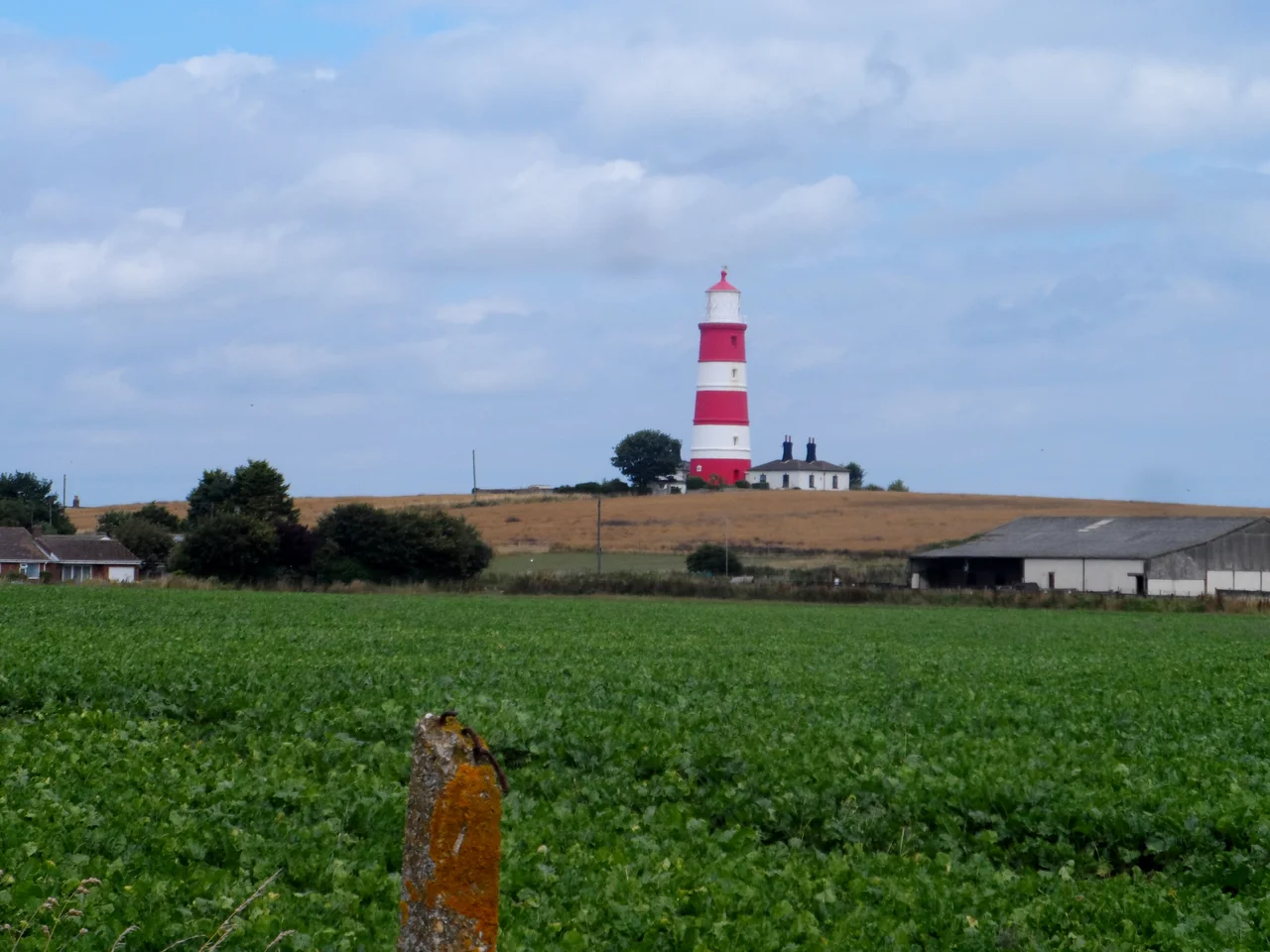

Happisburgh Lighthouse
In 1987 Trinity House, the corporation that has run England's lighthouses since the time of Henry VIII, announced that the red-and-white striped tower at Happisburgh was redundant. The light would be switched off in June 1988. Two centuries of warning ships away from the Haisborough Sands - the offshore sandbank that has eaten more vessels than anyone has bothered to count - would simply end. The village of Happisburgh refused. Petitions circulated. Postponements were granted. And on 25 April 1990, a private Act of Parliament gave Royal Assent to something that had not existed before in British maritime law: a community-run lighthouse, the only one in Great Britain.
The High Light and the Low Light
When Trinity House built Happisburgh in 1790, they actually built two lighthouses standing 400 feet apart - the High Light and the Low Light. From sea, mariners aligned the two beams to confirm they were sailing the safe channel south of the Haisborough Sands, a stretch of sheltered water known to fishermen as 'The Would.' Inside each tower burned thirteen Argand oil lamps, each backed by a polished reflector. The Low Light was demolished in the nineteenth century after coastal erosion brought the cliff edge too close. With only one light remaining, the High Light needed a new identity, and in 1865 it was painted with three red bands - the unmistakable candy-stripe pattern that still distinguishes it from the lighthouse at Winterton along the same coast.
Argand Lamps to LEDs
The lighthouse went through almost every illumination technology a working light could experience. The original Argand oil lamps gave way to coal-gas lighting fed from a small gas works built behind the tower, then to electric incandescent bulbs in 1947, and now to modern lamps inside the original 1868 optic. The light characteristic is Fl(3) 30s: three quick white flashes, then a long dark interval of about 24 seconds, repeating endlessly. The beam stands 135 feet above sea level and reaches 14 nautical miles - just far enough to clear the outer edge of the Haisborough Sands and warn shipping in time.
The Friends of Happisburgh Lighthouse
Independence has not been cheap. The Happisburgh Lighthouse Trust, the registered charity that now owns and operates the tower, depends on donations, summer open days, and the patient work of volunteers. In June 2018 the lighthouse needed repainting - a job that cost about £20,000 and took a specialist team of four painters two weeks. A paint company donated the 300 litres of masonry paint required, specially mixed to match the historic colours. 'The repaint demonstrates our continuing commitment to maintaining Happisburgh lighthouse for future generations,' the Friends said. In 1990 the BBC television programme Challenge Anneka repainted the lighthouse, inside and out, in 33 hours flat for an episode that aired that December - an early televised version of the same volunteer impulse.
Cultural Cameos
The lighthouse's photogenic candy stripes have made it a recurring backdrop in British media. Ellie Goulding shot the music video for her 2010 single 'The Writer' at the tower, its lantern serving as the emotional centre of the song's loop of memory. The 2015 horror film AfterDeath used the lighthouse beam as a recurring visual motif, the rotating flash triggering its characters' flashbacks. For most of the year, though, the lighthouse stands quietly on its clifftop above the village, its red bands visible from miles up the coast, its beam still doing the job it was built for in 1790: telling ships where the sandbank ends and the safe water begins.
A Light at the Edge
The Haisborough Sands - or Haisborough, the older spelling that matches how the village name was once pronounced - sit roughly eight miles offshore, running parallel to the coast for about ten nautical miles. The bank shifts with the tides, shoals appear and disappear, and shipwrecks litter the seabed in numbers that have made it a popular dive site. The lighthouse is the working answer to that hazard. The fact that a village of barely 1,400 people fought to keep it lit, then took on the responsibility themselves, says something about coastal Norfolk's relationship to the sea: dangerous, immediate, personal, and absolutely not something to be left to a distant agency in London.
From the Air
Happisburgh Lighthouse stands at 52.8195°N, 1.53867°E on the cliff edge above the North Norfolk coast, about half a mile south of the village church. Best viewed at 500-2,000 ft AGL where the red-and-white candy stripes are unmistakable. Norwich International (EGSH) lies 19 nm southwest. The Haisborough Sands run roughly NNW-SSE about 8 miles offshore. The lighthouse is one of the most recognisable visual landmarks on this coastline, particularly at low altitude in clear conditions.
Nearby Stories
- RAF Deopham Green 4.3 km away
- Beccles 12 km away
- Binham Priory 13 km away
- Skegness Lifeboat Station 48 km away
- HMS Cobra 50 km away
- Battle of Lowestoft 55 km away
- SM U-97 79 km away
- SS Elbe 94 km away