
RAF Deopham Green
On 9 November 1944, First Lieutenant Donald Gott was flying his B-17 Flying Fortress toward a target in Germany when anti-aircraft fire killed three of his four engines. A fire started in the cockpit. The radio operator and engineer were both seriously wounded, the radio operator unconscious from blood loss. The Fortress was bomb-laden, on fire, and could explode at any moment. Gott conferred with his co-pilot, Second Lieutenant William E. Metzger Jr., about what to do. Their answer was unanimous: continue to the target. They dropped their bombs. Then Gott pointed the crippled bomber toward Allied lines, hoping to put it down in a field and save the unconscious radio operator. Metzger was ordered to bail out with the rest of the crew. He refused. As Gott set up his approach to land, the B-17 exploded in mid-air, killing both officers and the man they had stayed to save. Both received the Medal of Honor posthumously.
Square L from Walla Walla
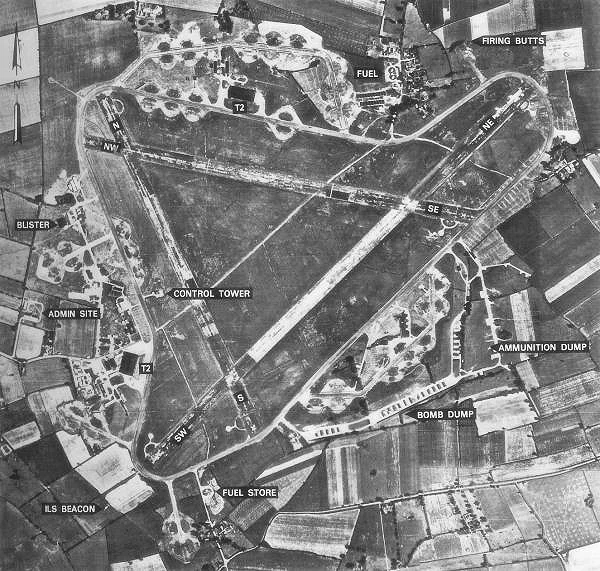
RAF Deopham Green opened on 3 January 1944, built across former Norfolk farmland 2 miles north of Attleborough. It was Station 142, home to the 452nd Bombardment Group (Heavy), which had arrived from Walla Walla Army Air Field in Washington state. Their tail code was a Square L; their bombers were Boeing B-17 Flying Fortresses; their assignment was the 45th Combat Bombardment Wing of the Eighth Air Force. Across the village, in the surrounding farmhouses and pubs, the Norfolk locals adjusted to thousands of young Americans suddenly living next door, men whose accents none of them had ever heard up close before.
Brunswick to Schweinfurt
The 452nd entered combat on 5 February 1944 with an attack on aircraft assembly plants at Brunswick. They went on to bomb the marshalling yards at Frankfurt, aircraft assembly plants at Regensburg, aircraft component works at Kassel, the notorious ball-bearing industry at Schweinfurt, a synthetic rubber plant at Hanover, and the oil installations at Bohlen. The spring of 1944 was punishing. The group sustained one of the highest rates of loss of any Fortress-equipped unit in the Eighth Air Force. By war's end the 452nd had flown 250 missions from Deopham Green and lost 110 bombers, a casualty rate that the surviving veterans would carry with them for the rest of their lives.
D-Day and the Bulge
Strategic bombing was the group's primary mission, but the war on the ground reshaped their schedule whenever Allied infantry needed help. Before D-Day, the 452nd hit airfields, V-weapon sites, and bridges across France. On 6 June 1944 they struck the coastal defenses guarding the Normandy beaches. They supported the Saint-Lo breakthrough in July, the offensive against Brest later that summer, the airborne attack of Operation Market-Garden in September, and the long defensive grind of the Battle of the Bulge through December and January. In March 1945 they bombed in support of the airborne crossing of the Rhine. On 7 April 1945, despite vigorous fighter attacks and heavy flak, they accurately bombed a German jet-fighter airfield at Kaltenkirchen, earning a Distinguished Unit Citation.
Last Mission, Long Memory
The 452nd flew its final combat mission on 21 April 1945, striking marshalling yards at Ingolstadt. By the end of August it was back at Sioux Falls Army Airfield in South Dakota and inactivated. The Norfolk airfield was handed to RAF Maintenance Command on 9 October 1945 as the home of No. 258 Maintenance Unit. Public roads that had been closed since 1942 opened again, one of them following the line of the old main runway. Deopham Green closed for good on 1 January 1948. Most of the buildings were demolished over the following decades. The runways and taxiways remain in reduced form, still cutting their geometric path through the agricultural fields.
Three Memorials
There are three places where Deopham Green is remembered. One memorial stands beside the road that runs through the old airfield. Another is outside Hingham Church. A third stands at Attleborough railway station, where so many American airmen first arrived in Norfolk and where the last of them departed. They came from places like Walla Walla, from farms and towns most of their British neighbors had never heard of. One hundred and ten of their bombers, and the crews inside them, did not come back.
From the Air
RAF Deopham Green sits at 52.55 degrees north, 0.99 degrees east, in central Norfolk farmland 2 miles north of Attleborough. Nearby aviation: Norwich Airport (EGSH) is roughly 16 nautical miles northeast; RAF Marham (EGYM) is 18 nautical miles northwest; RAF Honington (EGXH) lies 13 nautical miles southwest. Recommended viewing altitude is 2,500 to 4,000 feet AGL to pick out the surviving runway and taxiway traces still cutting through the patchwork fields.
Nearby Stories
- Ding Family Murders 1.5 km away
- Bungay Castle 2.6 km away
- Ely and Littleport Riots of 1816 4 km away
- Aldeburgh Festival 7.9 km away
- Bed Burial 12 km away
- Happisburgh Lighthouse 13 km away
- Walsingham Priory 18 km away
- Chain Bridge Forge, Spalding 34 km away