
Bed Burial
The Old English word leger meant both 'bed' and 'grave.' The same word for sleeping described dying. This linguistic fact sits at the heart of a burial practice so rare, so deliberately elaborate, and so concentrated in a single century — the 600s CE — that it stands out in the archaeological record of early Anglo-Saxon England like a whispered secret. Bed burials were almost exclusively for women. Almost exclusively for women of exceptional status. And they have been excavated, slowly and carefully, from the southern counties of England for two hundred years.
Iron Nails and Hidden Beds
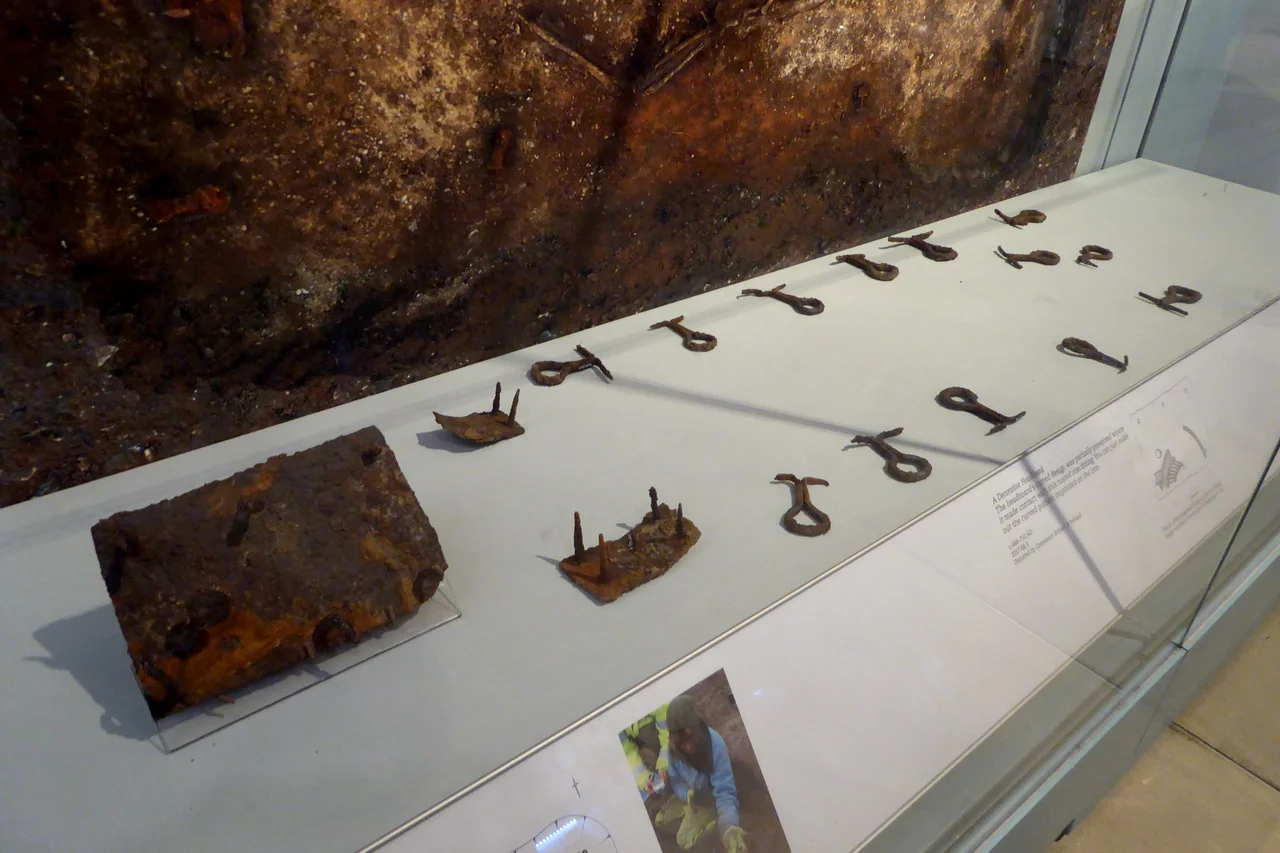
The beds themselves are gone. Wood does not survive a millennium and a half of English soil. What remains is the metal: nails, cleats, grommets, brackets, headboard mounts and railings, arranged in rectangular patterns that outline where the bed once lay. Archaeologists read these iron fittings the way a detective reads footprints — inferring the shape of something no longer there. In some cases, the distinction between a bed and a coffin is uncertain, the fittings ambiguous. But where the evidence is clear, the bed is unmistakable: a piece of household furniture, the most intimate object of daily life, carried to the grave and buried with the dead. About a dozen confirmed Anglo-Saxon bed burials have been excavated in England, predominantly from Cambridgeshire, Suffolk, and Wiltshire, with single examples found as far north as Yorkshire and Derbyshire.
Women of Rank
The grave goods that accompany these burials leave little ambiguity about who these women were. Gold jewellery, fine textiles, and elaborate personal ornaments speak to wealth and standing. The Loftus burial in Yorkshire contained gold work of such quality that archaeologists have suggested the woman buried there may have been a princess. Other burials carry a different kind of marker: pectoral crosses and Christian emblems found alongside the body at Ixworth, Roundway Down, Swallowcliffe Down, Trumpington, and Harpole. In the early Anglo-Saxon period, abbesses were recruited from noble families, and scholars have proposed that some of these women may have held exactly that role — simultaneously great ladies of the church and of their communities. The elaborate mourning rituals associated with these burials suggest that those who arranged them understood they were marking something exceptional.
Sleep as Metaphor
Archaeologist Howard Williams has written that interring the deceased on a bed suggests sleep was understood as a metaphor for death in early Anglo-Saxon culture — and the linguistic evidence supports this. Leger, the Old English word for a place where one lies, referred to both beds and graves in the literature of the period. The symbolic overlap is precise: the bed was where the living surrendered consciousness each night, and it was apparently understood, for these particular women, as an appropriate vessel for the final surrender. Some bed burials share characteristics with ship burials — barrows raised above the grave, chambers constructed around the bed — suggesting that both practices expressed similar ideas about marked departure, about a dignified crossing from one world to another.
From England to Norway, and Beyond
Bed burials are not uniquely Anglo-Saxon. In Norway and Sweden, several Viking ship burials — including the famous Oseberg ship burial, dated to 834 CE — placed the deceased on beds within the ship's hull. These differ from true bed burials, where the bed itself is interred directly in the ground, but they reflect a shared Scandinavian tradition of elevating the dead. And the practice has a peculiar modern echo: in 1910, a man named Morris Lofton was buried in Rose Cemetery in Tarpon Springs, Florida, lying in his iron bed frame, described as his only possession. The bed remains visible in the cemetery today. Across more than a thousand years and thousands of miles, the impulse toward this particular gesture — of sending someone into death as they slept — has surfaced again and again.
From the Air
The geohash u120 covers the Cambridge region in Cambridgeshire, England, at approximately 52.19°N, 0.17°E. Several key bed burial sites are in this general region, including the Trumpington bed burial excavated on the southern edge of Cambridge itself. Cambridge is served by London Stansted Airport (EGSS), approximately 40 km to the south. At low altitude from the south, the flat Fenland landscape of Cambridgeshire stretches to the horizon, the terrain that Anglo-Saxon communities farmed and buried their dead in fourteen centuries ago.
Nearby Stories
- Kentwell Hall 2.5 km away
- Thetford Hoard 2.8 km away
- King's Ely 6 km away
- Bedford 7.8 km away
- White House Farm murders 13 km away
- Oundle 14 km away
- Hemel Hempstead 14 km away
- North Weald Airfield 15 km away