.jpg)
White House Farm murders
Pages Lane runs through flat Essex farmland, hedgerows tangled with bramble, fields stretching toward the Blackwater estuary. On the night of 6 August 1985, a Georgian farmhouse called White House Farm stood at the end of that lane, its windows dark by midnight. Inside slept Nevill Bamber, his wife June, their adopted daughter Sheila Caffell, and Sheila's six-year-old twin sons, Daniel and Nicholas. By dawn, all five were dead. Police gathered outside at first light, hesitant to enter a building they had been told contained a woman with a gun. What they would eventually discover - and what would take seventeen more years to settle in court - turned this quiet stretch of Tolleshunt D'Arcy into one of the most contested crime scenes in English history.
Five Names
Before the case became a courtroom argument about silencers and telephone logs, it was five people. Nevill Bamber was sixty-one, a former RAF pilot who farmed the land his wife had inherited and served as a magistrate at Witham. June, also sixty-one, was intensely religious; she had struggled with depression for decades. Sheila was twenty-eight, a former model who had been diagnosed with schizophrenia and was treated with antipsychotic medication. Daniel and Nicholas Caffell were six years old - identical twins born on the same June morning in 1979, who had been dropped off at the farm by their father Colin two days before the killings. The boys were reluctant to come. They did not like being made to pray. Daniel had recently become vegetarian and worried about being made to eat meat. Colin's last sight of his sons was their small figures waving from the farmhouse drive.
The Call That Did or Did Not Happen
In the early hours of 7 August, a young man named Jeremy Bamber - the family's adopted son, then twenty-four - telephoned Chelmsford police station. He said his father had just called him from the farm, panicked, to say that Sheila had "gone berserk" with a gun. Then the line went dead. Officers drove out, met Jeremy at the gate, and waited. They waited a long time. Inside, when they finally entered, they found Nevill collapsed in the kitchen, badly beaten and shot. June lay upstairs. The twins had been killed in their sleep. Sheila was on the bedroom floor beside her mother, a rifle across her body. Police took the obvious reading: a tragedy of mental illness, a murder-suicide. They did not secure the scene. Within days, that reading would unravel.
What the Cousins Found
Three days after the killings, members of the extended Bamber family entered the farmhouse with the estate's executor. In the gun cupboard - which police had already searched - one of the cousins, David Boutflour, found a silencer flecked with red paint and traces of what looked like blood. The discovery raised an awkward question. With the silencer attached, the rifle was too long for Sheila's arms to allow her to shoot herself. If the silencer had been used during the killings, she could not be the killer. And if she had not used it, why was it in the cupboard, away from her body? The paint flake on the silencer matched scratches found on the mantel above the kitchen AGA, where it appeared a struggle had taken place. The crime scene was suddenly telling a different story.
An Ex-Girlfriend's Second Statement
A month after the murders, Jeremy's girlfriend Julie Mugford walked back into a police station and changed her account. She now said Jeremy had spoken for months about killing his family. He had talked about sedating his parents with sleeping pills, shooting them, blaming Sheila. He had told her he had killed rats with his bare hands to find out whether he could go through with it. The night before the murders, she said, he had told her by phone that it was "tonight or never." The morning after, he had said: "Everything is going well." Mugford and Jeremy had been fighting; he had been seeing another woman; she had reasons to want him punished. But the case against Jeremy - financial motive, inherited estate, knowledge of the farmhouse layout, a girlfriend who could place the words in his mouth - now had weight.
Trial and Aftermath
Jeremy Bamber was convicted of five counts of murder at Chelmsford Crown Court in October 1986, by a jury verdict of ten to two. The judge told him his conduct in killing five members of his family was "evil, almost beyond belief." He was sentenced to life, and in 1994 informed he would never be released. He has protested his innocence ever since. The Court of Appeal upheld the conviction in 2002 after a five-hundred-paragraph judgment; DNA testing on the silencer was complex and incomplete, but the judges found nothing that made the verdict unsafe. White House Farm itself stayed in the family - one of the cousins moved in. The twins are buried together in Highgate Cemetery, the urn of their mother's ashes placed in their coffin so that Sheila, who loved them, was not parted from them in death. Daniel and Nicholas would now be in their mid-forties. They were six.
From the Air
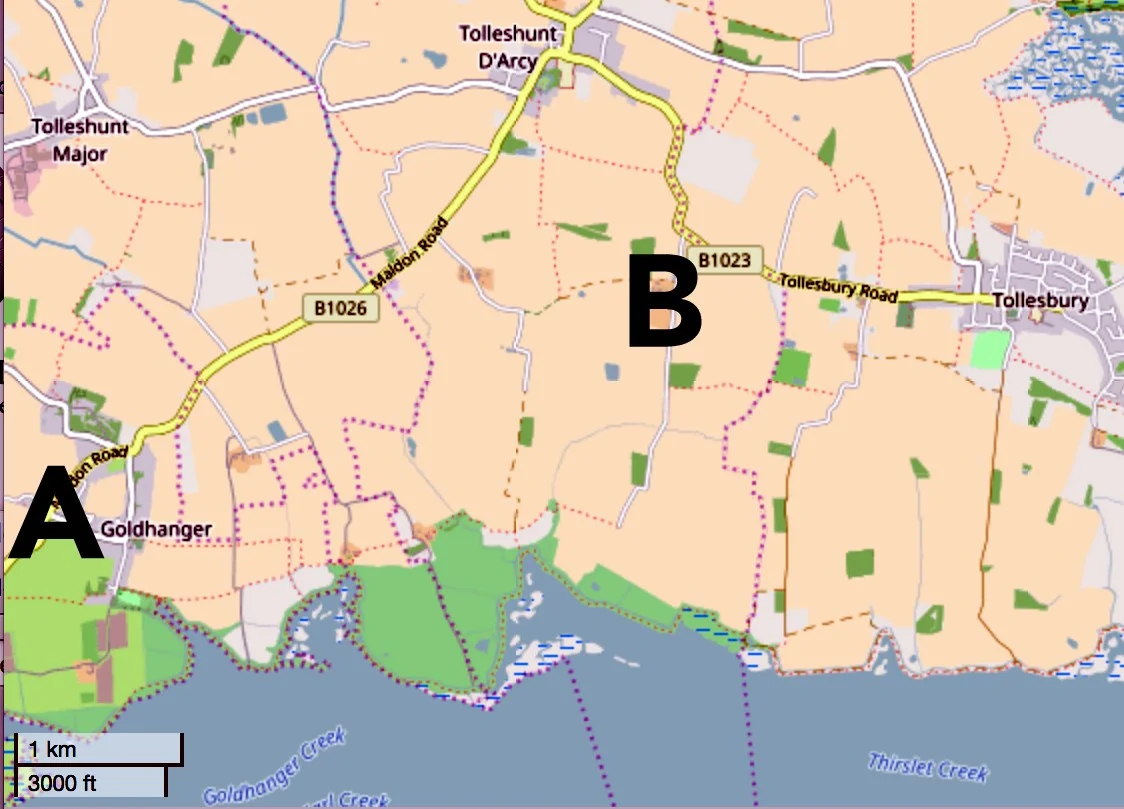
White House Farm sits at approximately 51.76 N, 0.80 E, on Pages Lane in Tolleshunt D'Arcy, a village in the Maldon district of Essex roughly seven miles east of Maldon and twelve miles south-west of Colchester. Recommended viewing altitude is 1,500-2,500 ft AGL on a clear day; the surrounding landscape is flat estuary farmland, the Blackwater estuary visible to the south. London Stansted (EGSS) lies about 35 nautical miles west; Southend (EGMC) is 18 nm south-south-west. Airspace is uncontrolled Class G below the Stansted TMA.
Nearby Stories
- Belmont Castle 3.8 km away
- Lavenham 10 km away
- Memorial to the Home of Aviation 11 km away
- Orford Castle 11 km away
- Kelvedon Hatch Secret Nuclear Bunker 13 km away
- Maunsell Forts 15 km away
- Broadstairs 16 km away
- Parachute Regiment and Airborne Forces Museum 16 km away