
Broadstairs
Charles Dickens called the Anglican parish church of Broadstairs "a hideous temple of flint, like a petrified haystack." He came back every summer anyway, from 1837 to 1859, and he wrote some of his most famous novels in the house above Viking Bay - including David Copperfield, finished in 1850 in a study with a window looking straight down onto the harbour. He named the town his "English Watering Place." Twenty-five thousand people live there now, on the chalk Isle of Thanet, in a town built around seven golden bays and a 16th-century gate that you still walk through to reach the sand.
How the steps got their name
There was a shrine on the cliff first - the Shrine of Our Lady at a place called Bradstow, meaning broad place, named for the wide bay below. By the 14th century, pilgrims and fishermen had cut a flight of steps into the chalk to get from the sand up to the shrine. The shrine is long gone, blown to pieces by 16th-century storms and rebuilt as a chapel in 1601. The steps gave the town its name: Brodsteyr Lynch in 1434, Brodestyr in 1479, Broadstayer in 1565, finally Broadstairs. Charles Culmer is said to have reconstructed them in 1350. The Culmer family then built almost everything else: the first archway across Harbour Street in 1440, the first wooden pier in 1460, and in 1540 the York Gate - the squat flint portal that still spans Harbour Street, once fitted with heavy wooden doors that could be slammed shut when the French sailed in.
Dickens at Bleak House
Dickens first came in 1837, the year Victoria became queen. He returned almost every summer for two decades, swimming off the sands, walking the cliff path to Kingsgate, working at a desk in the house then called Fort House on the East Cliff. It is now called Bleak House - although confusingly, the novel Bleak House is set in St Albans and not here. What Dickens actually wrote at Bleak House is the second half of David Copperfield. The Pickwick Papers, his breakthrough, was partly written here too. In June every year the town stages the Broadstairs Dickens Festival, started in 1937 to mark a century since Pickwick. People wear bonnets and stovepipe hats and Victorian dress for a week, and somebody always stages one of his novels in the open air. The Dickens House Museum on the seafront keeps his letters and ephemera in glass cases. The petrified haystack is still standing, too.
Princess Victoria's beach holiday
Half a century before Dickens, the future Queen Victoria spent her childhood summers here. Between 1826 and 1836 the young princess and her mother, the Duchess of Kent, stayed at Pierremont Hall - a 1785 house in present-day Pierremont Park, built by Samuel Pepys Cockerell. They came for the sea air. Broadstairs was already a respectable resort by then: the new steam packets had cut the trip from London to Margate from 72 hours to a few, and the seaside cure was at its first peak of fashion. Smuggling had been the previous industry. Tea and brandy and tobacco were so heavily taxed in the 18th century that the men of Broadstairs and St Peter's became famous for outwitting customs men, hiding contraband in the network of caves and tunnels worn into the chalk strata beneath the town. The tunnels are mostly sealed now. They are still there.
Seven bays
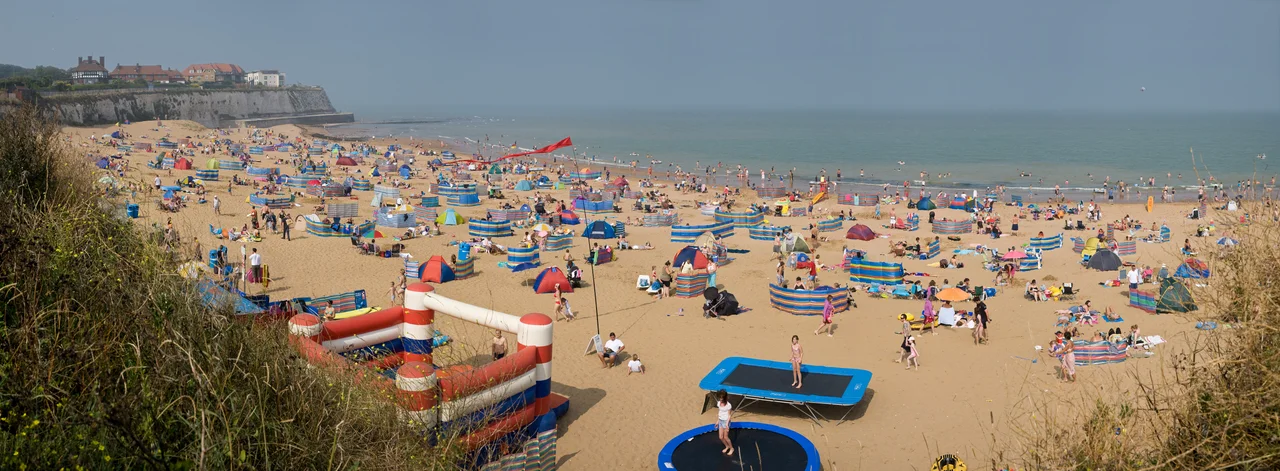
The coast runs in a curling chalk staircase north from Ramsgate: Dumpton Gap, Louisa Bay, Viking Bay, Stone Bay, Joss Bay, Kingsgate Bay, Botany Bay. North Foreland - the chalk headland with its lighthouse - rises between Stone and Joss. Botany Bay and Joss Bay got Blue Flag awards in 2005, Viking Bay in 2006. The water is cold and the tides are tricky: stay between the striped posts at Viking Bay and you are sheltered; venture beyond and you meet the tidal stream of the English Channel running parallel to the coast, fast enough that even strong swimmers will struggle against it. Locals know to swim straight for shore if caught out, not back to where they started. The first Broadstairs lifeboat arrived in 1850, given to the town by Thomas White after the loss of the Irish packet Royal Adelaide off Margate killed 250 lives that spring. It launched 77 times and saved 115 lives.
Who Broadstairs made
Bradstonians, the locals call themselves. The town is unusually full of writers and musicians for its size. Sir Edward Heath, prime minister from 1970 to 1974, was born here in 1916. John Buchan invented The Thirty-Nine Steps after recuperating from illness at a clifftop house near North Foreland in 1915, counting the steps down to the beach. Oliver Postgate, who wrote and animated the Clangers, lived here for years; a mosaic of his moon-knitting creatures is set into a wall near his old house on Chandos Square, with a blue plaque. Frank Muir, the comedian, grew up as one of the Beach Boys on these sands. Bruce Robinson, who later wrote and directed Withnail and I, set his first novel here using neighbours from his Broadstairs childhood. In August the town fills up for Folk Week. In June it fills up for Dickens. The rest of the year it is quieter - a chalk-cliffed Kent seaside town that has had a long quiet life of being everyone's favourite summer.
From the Air
Located at 51.36N, 1.44E, on the Isle of Thanet in east Kent, England. North Foreland and its lighthouse are the dominant coastal landmark - the easternmost chalk headland of Kent, visible from far out in the southern North Sea. Nearest airport is Manston (EGMH) directly west, with Lydd (EGMD) to the south. Seven bays run along about 5 km of coastline between Ramsgate and Margate; from the air the chalk cliffs and golden sand make this stretch immediately recognisable. London is 80 miles west via the Thames Estuary.
Nearby Stories
- Westenhanger Castle 6.6 km away
- MV Tricolor 8.4 km away
- Battle of Dover Strait (1916) 11 km away
- Battle of Bossenden Wood 14 km away
- Battle of Gravelines (1558) 18 km away
- White House Farm murders 19 km away
- Maunsell Forts 25 km away
- Southern Bight 67 km away