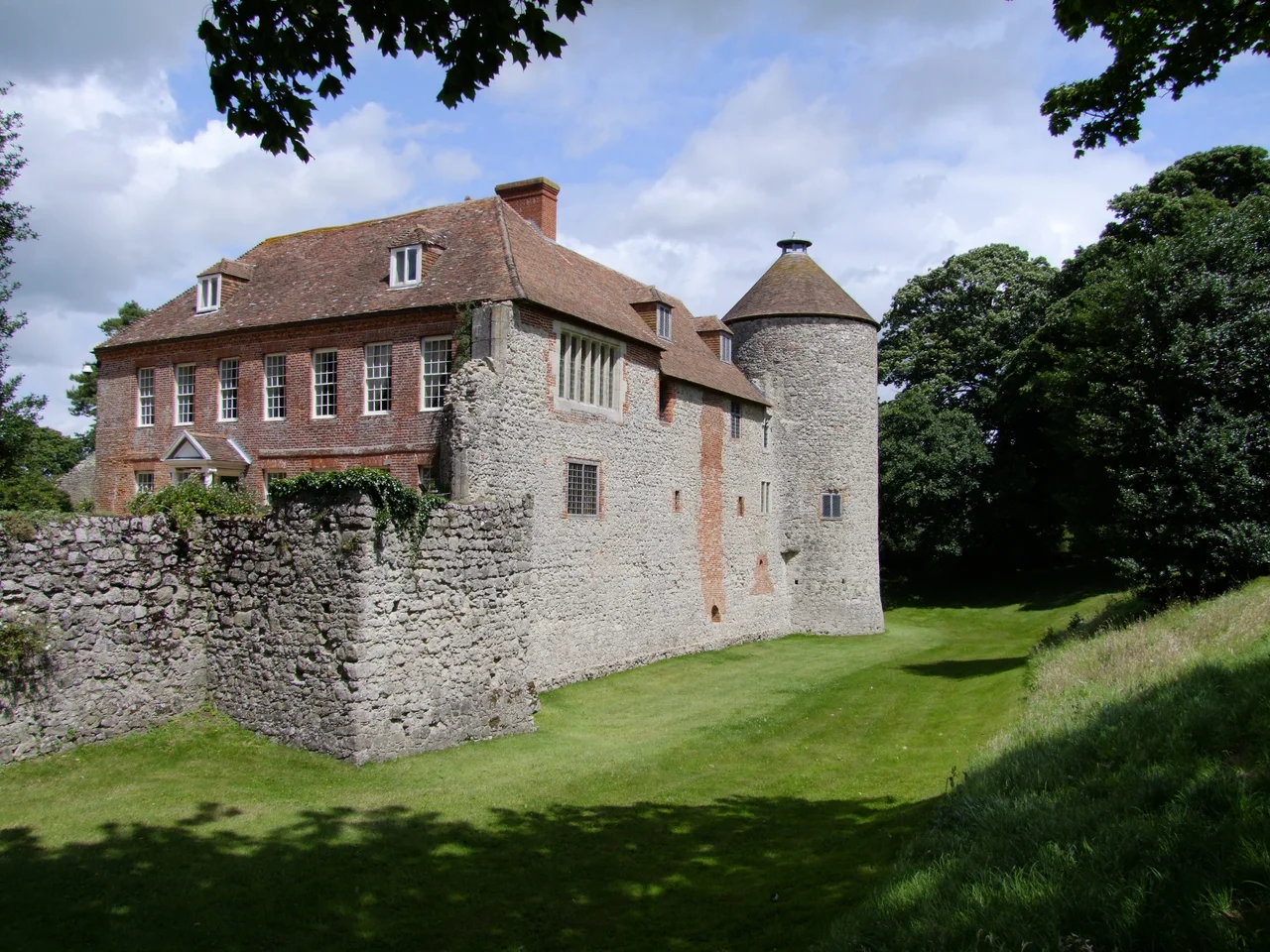

Westenhanger Castle
Thousands of armed men were hiding in the woodlands around Westenhanger in 1656, waiting for a signal. The exiled Charles II had been persuaded to return to England, and Westenhanger - well placed on the Kent coast - was the trap. When the king crossed the threshold, the order would be given, and the conspirators would rush in to murder him and his entourage. The plot was thwarted by a warning that reached Charles just in time. He turned back. Four years later he came across legally, with no ambushes, and took the throne in the Restoration. Westenhanger never housed the king's murder; it housed only the possibility of it, and that is one of half a dozen reasons why this fortified manor house near Folkestone Racecourse deserves more attention than it gets.
King Canute and the Norman Stone
The estate's recorded history begins in 1035, when King Canute - the Anglo-Danish ruler of England, Denmark, and Norway - owned the land. The de Criol family built the first permanent structure on the site in 1343, descendants of the 13th-century Bertram de Criol. What they put up was no modest manor house but a fortified quadrangular complex of 126 rooms - the kind of building that reflected the opulence of the owners more than any actual military need. Stone walls, corner towers, a curtain wall enclosing inner ranges. The castle stayed in the de Criol family until the Wars of the Roses, when Sir Thomas de Criol (also spelled Kyriell) was beheaded the day after the Second Battle of St Albans in February 1461 by order of Queen Margaret of Anjou. Thomas had no sons, and Westenhanger passed to his son-in-law Sir John Fogge. The estate had moved on and was about to keep moving.
Rosamund and the King's Mistresses
Westenhanger's centuries of royal connections collect into a single dazzling list. Henry II spent time here, and tradition links the place with Rosamund de Clifford - Fair Rosamund, the most famous of Henry's mistresses, whose love story with the king passed through legend and into ballad. Edward Poynings, the diplomat-soldier whose name still attaches to the Irish Poynings' Law of 1494, was associated with the estate. Henry VIII passed through. By 1588 the castle had been acquired by Thomas "Customer" Smythe, so called for his lucrative job as Queen Elizabeth's collector of customs duties. When the Spanish Armada threatened the south coast that summer, Elizabeth used Westenhanger as the command centre for Kent's 14,000 troops mustered to defend against invasion. The same fields where Folkestone Racecourse now runs horses once held companies of Elizabethan pikemen waiting for news of Spanish galleons in the Channel.
The Plot That Failed
The 1656 plot to assassinate the exiled Charles II is one of those incidents that hovers on the edge of being a turning point and then steps back from it. With Cromwell in power and the Royalists scattered in exile, agents of various interests were trying to lure the prince back to English soil to kill him. Westenhanger - close to the coast, isolated enough to absorb several thousand concealed soldiers, owned by a family with the right connections - was chosen as the bait. Charles had agreed to come over. The conspirators were in place. But a warning reached him before he embarked, and he turned back. Whether the warning came from a double agent, a loyal courtier, or one of the conspirators having a change of heart is one of those historical details that has been argued about ever since. Either way, England got the Restoration in 1660 instead of a murdered prince - and Westenhanger went on being a quiet, declining country house.
Decline and Discovery
Westenhanger descended in the Smythe family for two and a half centuries until the death in 1869 of Percy Smythe, the 8th and last Viscount Strangford, who died without an heir. The estate went to his nephew Captain Hugh Baillie, who also died childless in 1876. With no clear inheritance and no resident family, the great quadrangular manor began to shrink. Roofs collapsed. Walls came down. Across the centuries the castle was reduced in size and gradually suffered serious neglect. By the late 20th century only fragments of the medieval complex remained, set amid medieval barns that had somehow survived intact outside the curtain wall and were eventually reunited with the castle under one ownership. Since the mid-1990s the current owners have worked with English Heritage on a long programme of stone consolidation, conservation, and restoration. The barns are being brought back toward their original state.
A Ship in Kent
Westenhanger has one more story to tell - and this one connects an obscure Kentish manor to the founding of the United States. Customer Smythe's son, Sir Thomas Smythe, was the founder and governor of the Virginia Company. He commissioned a small ship for the East India Company in 1600 - the Discovery, just 50 feet long - and on 19 December 1606 she sailed for Virginia along with the Susan Constant and the Godspeed under captain John Smith. The three ships entered Chesapeake Bay on 13 May 1607 and the settlers established Jamestown, the first permanent English-speaking settlement in the New World. On 19 December 2008 the Jamestown UK Foundation - set up to mark the 400th anniversary of the settlement - presented a replica of Discovery to Westenhanger Castle, where it sits today as a quiet reminder that a small Kentish manor house produced the man who organised the voyage that founded America. Westenhanger is now hired out as a conference and wedding venue, accessed through the racecourse entrance off Stone Street.
From the Air
Westenhanger Castle is located at 51.0944 degrees North, 1.0314 degrees East, in the village of Westenhanger near Folkestone, Kent. Best viewed at 1,500 to 3,000 feet AGL - the castle sits next to the prominent grandstand of Folkestone Racecourse and Westenhanger railway station, both clearly visible from the air, with the M20 motorway running just to the north. Nearest airfield: Lydd (EGMD) about 6 nautical miles south-west. The Channel and the French coast are visible to the south on clear days.
Nearby Stories
- St Augustine's Church, Ramsgate 0.3 km away
- Crumbles murders 1.3 km away
- Wadhurst Castle 1.4 km away
- RAF Eastchurch 7.7 km away
- Battle of the Narrow Seas 7.8 km away
- Eynsford Castle 11 km away
- Battle of Boulogne 17 km away
- Royal Sovereign Lighthouse 32 km away