.jpg)
Royal Sovereign Lighthouse
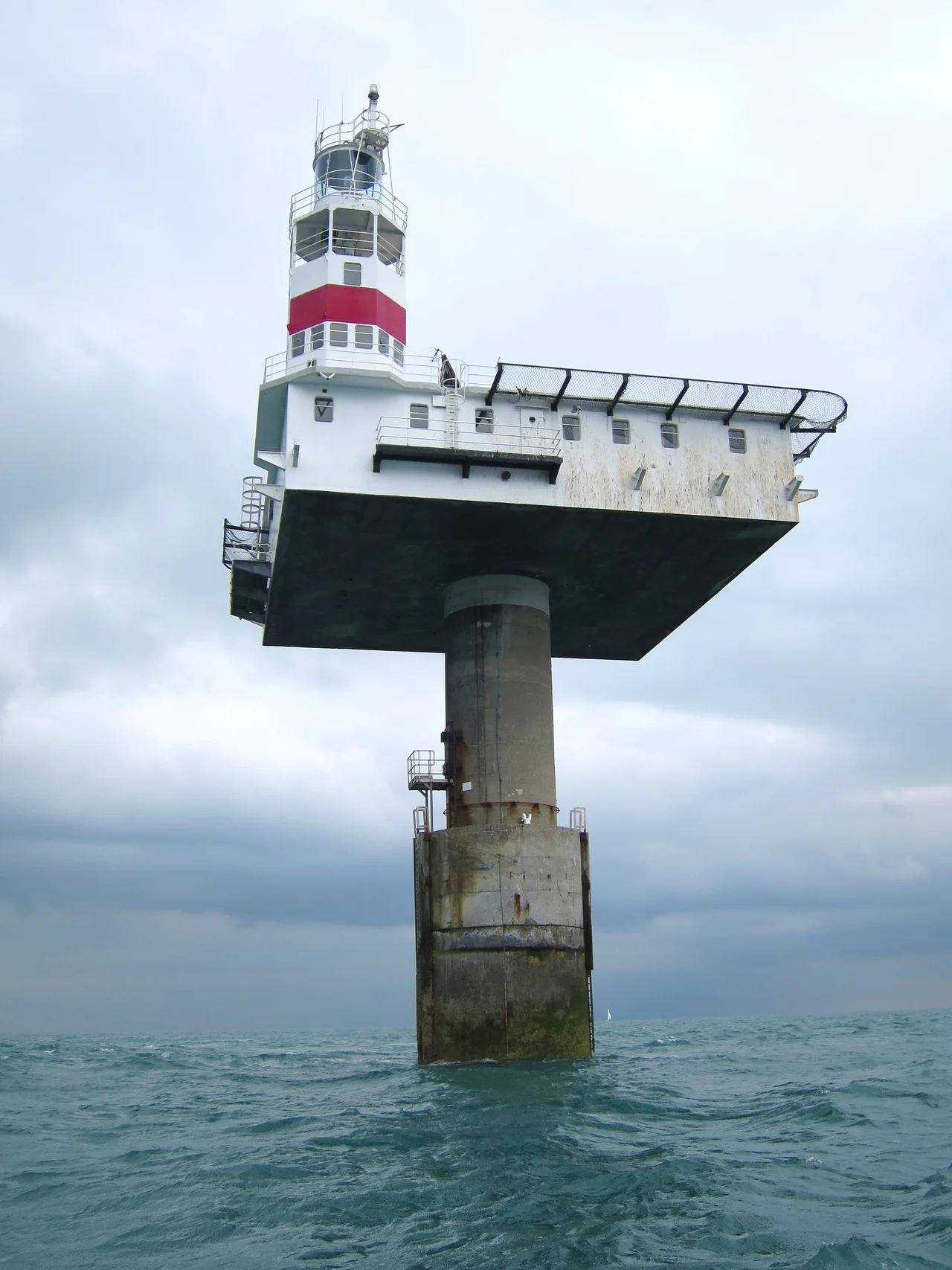
From a distance it looked like an oil rig that had wandered off station: a stark concrete platform supporting a slim white tower, balanced on a single column rising straight out of the sea eleven kilometres off Eastbourne. The Royal Sovereign Lighthouse stood guard over a notoriously shallow sandbank from 1971 until 2022, then was carefully taken apart and shipped to shore in pieces. Most lighthouses outlast everyone who builds them. This one was decommissioned, with some regret from Trinity House, after barely half a century - because the same salt water it had warned ships about for fifty years had eaten through its concrete bones.
Replacing a Lightship
The Royal Sovereign shoal had been marked since 1875 by a lightship - a permanently anchored vessel with a fixed light and crew rotating ashore every few weeks. By the 1960s Trinity House, the lighthouse authority for England and Wales, wanted something more permanent and cheaper to maintain. The result was an experimental design that owed more to North Sea oil platforms than to traditional lighthouses. A cellular concrete base 31 metres across and six metres high would sit on the seabed; a single tapering concrete column would rise from it to support a steel-framed cabin deck and a separate light tower on the corner. The structure was built in two pieces on Newhaven beach in 1970 and floated out to the shoal. The hollow base was sunk first, flooded to settle it into position on the seabed. Then the cabin section was floated out, lowered onto the column as the tide fell, and the inner section of the column was jacked up telescopically to add another thirteen metres of height. The cabin deck contained accommodation, workshops, engine rooms, and a control room. The roof of the cabin was a helipad.
Life on the Pillar
Three full-time keepers staffed the platform on rotation, with room for up to four visiting maintenance workers. The light source originally was a single 1,000-watt bulb mounted inside a revolving catadioptric optic - third-and-a-half order, a precision lens carefully ground to throw a focused beam across many miles of Channel. A diaphone fog horn lived two levels below the lantern, fed by air tanks and compressors and audible far further than the light could carry on a thick day. Four 20-kilowatt diesel generators ran everything, including a crane on the platform for hoisting up supplies. The keepers cooked, slept and stood watches inside what was essentially a steel-and-concrete cabin balanced sixty feet above the waves. In rough Channel weather the whole platform shifted noticeably underfoot. Automation in 1994 made the human keepers redundant. The fog horn was disconnected. The big diaphone went silent, replaced by a quieter electronic emitter. The light continued to flash.
Concrete Cancer
Marine concrete has a finite life. Salt water finds its way to the reinforcing steel through any crack or pore, the steel rusts and expands, and the concrete spalls outward in flakes. By the 2010s the Royal Sovereign tower was showing signs of serious structural deterioration. Trinity House commissioned engineering surveys. In June 2019 the authority announced that the lighthouse would be decommissioned and removed; the nearby Beachy Head Lighthouse, the principal aid to navigation in the area, would be upgraded to take over coverage of the eastern approaches. On 21 March 2022, the light was permanently extinguished. The Admiralty Notice to Mariners was terse: "Royal Sovereign Lighthouse permanently discontinued and light-buoys temporarily established." Four cardinal buoys - north, east, south and west of the old position - were laid to mark the shoal until decommissioning was complete.
The Long Goodbye
Decommissioning was scheduled to span three summers. Ian McNaught, Deputy Master of Trinity House, observed at the time that it had not been an easy decision. Lighthouse engineers and lighthouse keepers across the country watched with quiet professional sadness as the famous platform began to come down. On 1 October 2023, the accommodation block was lifted off by heavy-lift barge - the light tower itself had already been removed and taken to Shoreham, where it now sits as a preserved relic of mid-century lighthouse engineering. The single pillar that supported everything was scheduled for removal in 2024, leaving only the cellular base on the seabed. The shoal itself remains, of course. The cardinal buoys still mark it; ships still pick their way along the southern channel past Beachy Head. But the unmistakable silhouette that generations of Channel sailors used to navigate by - that strange concrete heron standing on one leg over the sea - is gone from the horizon.
Eastbourne's Beacon
From the seafront at Eastbourne the lighthouse used to be a fixed point on the eastward view: a small white speck eleven kilometres out, often invisible in haze, sometimes startlingly clear in winter sunlight. Locals would point it out to visitors. Fishermen learned to time their lines by its flashing pattern. After dark, on a clear night, the beam swept across the bedroom windows of Eastbourne hotels every few seconds, a regular pulse felt rather than seen. Children grew up with that rhythm. When the light went out in March 2022, an Eastbourne newspaper noted that something had been lost that was hard to name precisely. A Sussex maritime charity now preserves the salvaged light tower at Shoreham. The 1972 documentary that recorded the lighthouse's construction is still available, a half-hour record of one of the more unusual lighthouse builds in British history. The structure that replaced a lightship was itself replaced by buoys - and the open water where it stood for fifty-two years is back to being empty sea.
From the Air
The former lighthouse site is located at approximately 50.72°N, 0.44°E, on the Royal Sovereign shoal about 11 km offshore from Eastbourne in the English Channel. The structure was removed between 2022 and 2024 and is no longer a navigational landmark; the position is now marked by four cardinal light buoys (north, east, south, west). Nearest airfield is Shoreham/Brighton City (EGKA) about 35 km west; Lydd (EGMD) is roughly 35 km east-north-east. Best viewed at 2,000-4,000 ft AGL from along the Eastbourne to Hastings coastline; the Beachy Head Lighthouse 6 km to the west still operates and is the most prominent navigational marker in the area.
Nearby Stories
- Bodiam Castle 3.1 km away
- Saltwood Castle 12 km away
- Brighton Palace Pier 15 km away
- The Carrington Event: The Solar Storm That Could Happen Again 32 km away
- Battle of Boulogne 39 km away
- Courrieres Mine Disaster 131 km away
- Cléon 131 km away
- German Auxiliary Cruiser Komet 135 km away