
Battle of Boulogne
They were not supposed to be soldiers. The 1,500 men of No. 5 Group, Auxiliary Military Pioneer Corps, were construction labourers - recalled reservists and half-trained reinforcements waiting to be shipped home from France in May 1940. Then the 2nd Panzer Division appeared on the ridges south of Boulogne. The Pioneers were combed for anyone who had ever fired a rifle, handed the weapons of the rest, and rushed into the gap between two Guards battalions. Their commander, Lieutenant Colonel Donald Dean, already wore the Victoria Cross from another war. For three days they fought tanks with hunting rifles and petrol bombs while the Royal Navy shot its way in and out of the harbour - and while, behind them, the road to Dunkirk stayed open one more day.
The Wrong Side of the Channel
By 21 May 1940 the Channel ports had become catastrophe corridors. The German breakthrough at Sedan had cut the British Expeditionary Force off from its southern bases. Rear headquarters had retreated from Arras to Boulogne; supply troops, labourers and stragglers were piling up in the harbour town waiting for transports home. Heinz Guderian's XIX Corps tanks reached Abbeville and turned north up the coast. They wanted Boulogne, Calais and Dunkirk - and they wanted them quickly, before the British could organise a defence or an evacuation. The French naval commander at Boulogne, Captain Dutfoy, panicked, ordered the coastal guns spiked, and slipped away to Dunkirk. Discipline collapsed in his wake. Civilians fought for places on departing ships. Then, on 22 May, the 20th Guards Brigade landed.
The Welsh and the Irish
Brigadier William Fox-Pitt's two battalions - 2nd Welsh Guards and 2nd Irish Guards - had been training at Camberley in Surrey the previous morning. By the next dawn they were digging in on the high ground around Boulogne with a single anti-tank battery between them and the German panzers. The Irish held the right flank, anchored from St Leonard down to the sea at Le Portel. The Welsh held the left, dug in across the slopes of Mont Lambert ridge. General Pierre Lanquetot's French 21st Infantry Division was meant to hold the southern approaches, but most of his men were ambushed on the trains bringing them up and never arrived. When the 2nd Panzer Division attacked the Irish Guards positions that evening, the Irish knocked out the leading tank and held for an hour. Through the night, German probes against the Welsh were thrown back again and again.
Pioneers with Rifles
By dawn on 23 May the situation had changed. Fort de la Creche above Wimereux had fallen. German armour blocked any reinforcement from Calais. Fox-Pitt realised he would have to defend a Channel port with two infantry battalions and a brigade of labourers. Lieutenant Colonel Dean's 800 Pioneers were rushed into the gap between the Guards battalions, armed with whatever rifles could be scraped together. They had no anti-tank weapons. They claimed one tank destroyed by setting fire to petrol beneath it. They held isolated road blocks in hand-to-hand fighting. Above them, Stukas of Fliegerkorps VIII smashed the fortifications while RAF light bombers and Spitfires from across the Channel tried to keep the Luftwaffe off the harbour. The Guards were pushed back into the town centre. Fox-Pitt cabled London: situation grave.
The Destroyers Shoot Their Way In
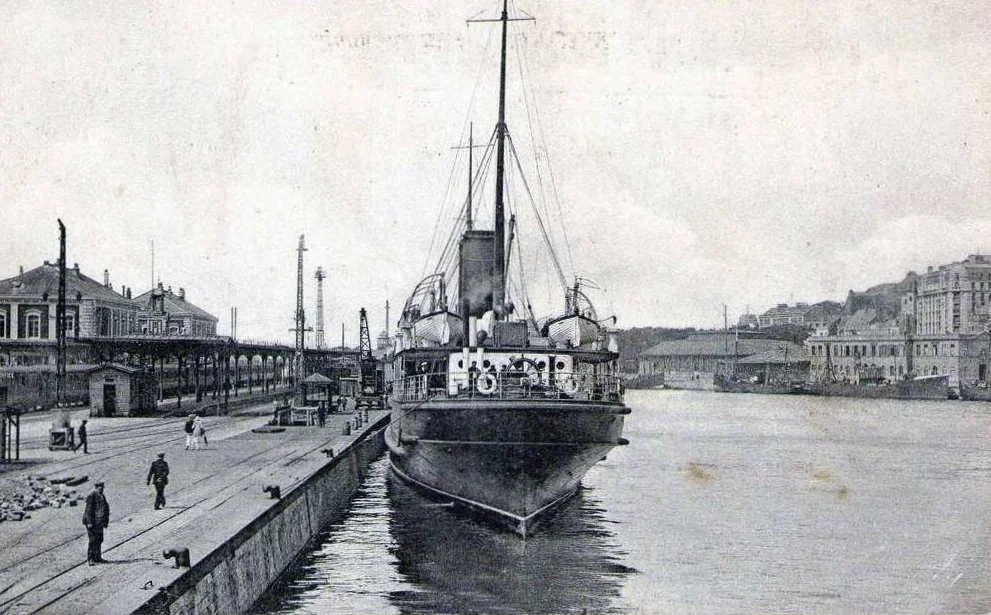
What followed remains one of the Royal Navy's most extraordinary close actions. Destroyer after destroyer ran the gauntlet of German tanks now firing directly onto the quays. HMS Vimy and HMS Keith berthed and began embarking wounded and Pioneers; both captains were killed by sniper fire from the shore. French destroyers Chacal, Jaguar, Fougueux, Frondeur, Bourrasque, Orage, Foudroyant, Cyclone, Siroco and Mistral poured fire onto the German positions. Frondeur was disabled by Stukas. Orage was scuttled. The Welsh and Irish Guards barricaded the streets with vehicles and pulled back toward the harbour, demolishing bridges as they went. HMS Venomous, her rudder jammed, fought a duel with German tanks on the quayside - one tank, struck by a 4.7-inch shell, was seen rolling "over and over, like a child doing a cart-wheel" - then reversed out of the harbour steering with her engines.
The Last Stand at the Gare Maritime
Not everyone got out. Three companies of Welsh Guards lost their radios and the evacuation order never reached them. Major Windsor Lewis's 3 Company reached the quayside at dawn on 24 May to find HMS Vimiera already gone. He gathered a mixed force of guardsmen, Engineers, unarmed Pioneers and refugees, fell back into the Gare Maritime - the harbour railway station - and built sandbag barricades. They repulsed a German boat party that approached the quay. They held through 24 May under fire from tanks and machine-guns. Out of food, out of ammunition, with no hope of evacuation, Lewis surrendered on the morning of 25 May. Meanwhile in the Haute Ville, General Lanquetot organised the defence with the remnants of his division. At dawn on 25 May the Germans came over the medieval walls with grenades and flamethrowers, backed by 88-mm guns. Lanquetot surrendered. The Germans put most of the prisoners to work repairing harbour defences against the British amphibious return they correctly anticipated.
What Three Days Bought
Guderian later wrote that the halt order, and the German decision to keep the 10th Panzer Division in reserve during the attacks on Boulogne and Calais, cost his army the chance to destroy the BEF outright. The Welsh and Irish Guards received the battle honour "Boulogne 1940." Operation Wellhit in 1944 returned, in liberation. But the deeper meaning of those three days is harder to pin to a citation. The naval historian Stephen Roskill, writing in 1954, concluded only that the defence of Boulogne "undoubtedly contributed" to the success at Dunkirk. The Pioneers - construction workers handed rifles - have their own quiet memorial: the Boulogne Bowl, a silver trophy commemorating men who were not meant to be soldiers and who, for three days in May, were.
From the Air
Coordinates 50.725°N, 1.6125°E. View from 2,000-3,500 feet AGL to take in the harbour, the Liane valley and the Mont Lambert ridge that dominated the southern approaches. Nearest airfield: Le Touquet-Cote d'Opale (LFAT), 30 km south; Calais-Dunkerque (LFAC) 35 km north-east. The Gare Maritime, fortified medieval walls of the Haute Ville, and Fort de la Creche near Wimereux are all visible from the air on clear days.
Nearby Stories
- Siege of Gravelines (1644) 1.7 km away
- Battle of Dungeness 4.8 km away
- 1996 Channel Tunnel fire 6.3 km away
- Battle of Saint-Omer 11 km away
- Dungeness Lighthouse 23 km away
- Courrieres Mine Disaster 56 km away
- Cléon 126 km away
- Battle of Cocherel 156 km away