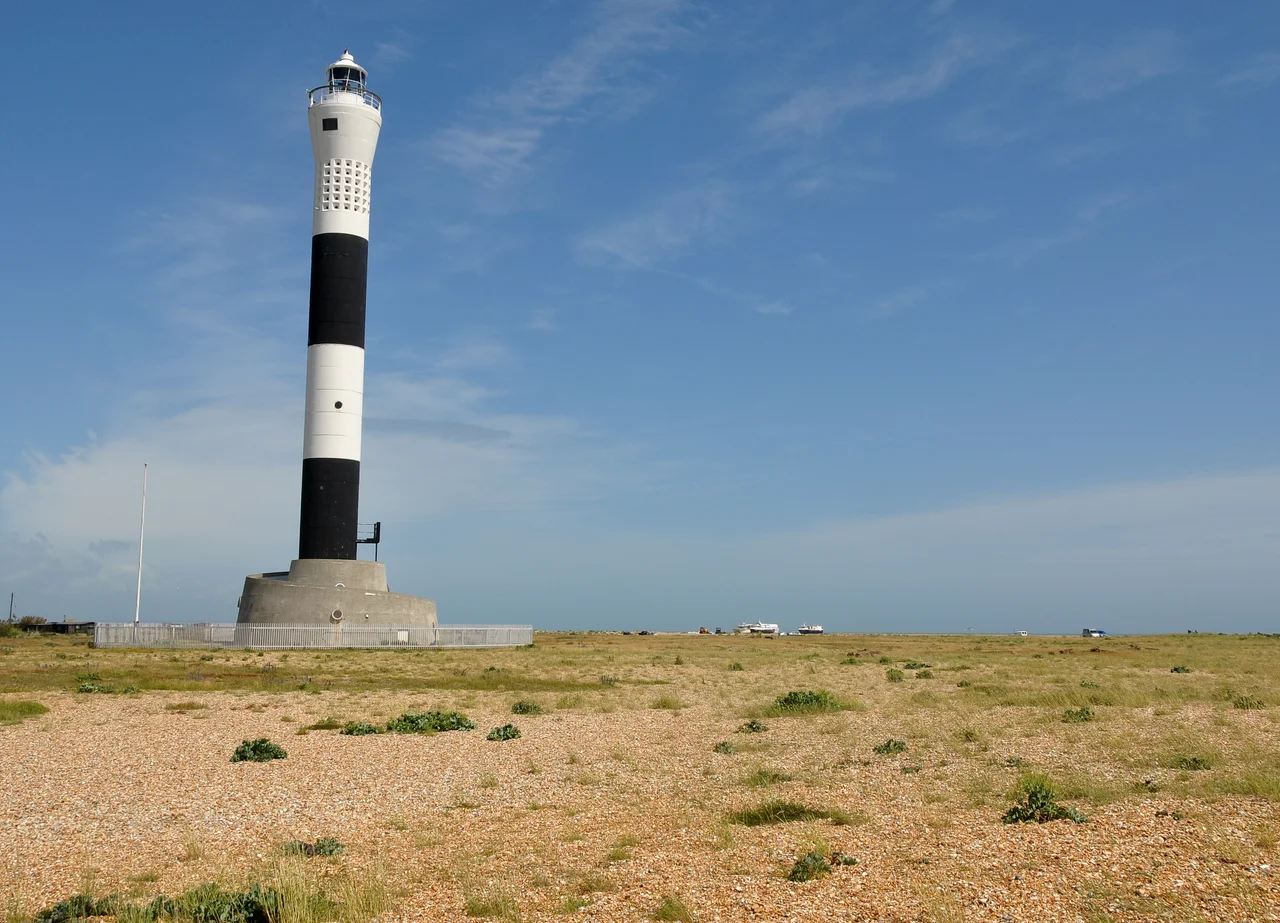

Dungeness Lighthouse
Five lighthouses, in roughly the same place, over four hundred years - all chasing the same retreating shoreline. Dungeness is a cuspate foreland, a great triangular tongue of shingle that the English Channel keeps piling up faster than anything else on Britain's coast, and every generation of mariners has had to plant a new beacon a little further out to keep up. The current tower, opened on 20 November 1961, is a 43-metre cylinder of pre-cast concrete rings with its black and white stripes impregnated into the material itself. It went up because the new nuclear power station next door was blocking the view of its predecessor - and someone had to keep warning ships off the shingle.
A Shore That Will Not Stay Put
Dungeness is geology in motion. The Channel currents sweep shingle counter-clockwise along the south coast and dump it here, building the spit eastward by several metres a year. The very first beacon went up sometime before 1615, replaced by a proper lighthouse that year, which then had to be replaced again in 1635 by Lamplough's Tower because the sea had walked away from it. Samuel Wyatt built a new one in 1792 for Thomas William Coke, who held the patent and collected the light dues. By 1865 it had alternating red and white horizontal bands; in 1866 sector lights were added to mark the anchorages on either side of the point. Each tower, in its turn, was steadily abandoned by the sea it was meant to overlook. Eight lighthouses in total have stood here - five main lights and three subsidiary low lights to help ships pick up the unlit eastern flank as the shingle pushed onward.
Faraday's Electric Experiment
In the early 1860s Michael Faraday, the great electrical physicist and Trinity House's scientific adviser, chose Dungeness as the first British lighthouse to receive a permanent electric installation. A carbon arc lamp backed by a silvered reflector, suspended above the old oil lamps that were retained as emergency backup. It was a true experiment - the technology was barely a decade old - and it did not entirely succeed. The arc was too brilliant, the tower too low, and ships' crews complained of being dazzled when they sailed close inshore. By 1875 the electric light was abandoned for a multi-wick oil lamp with a first-order Fresnel lens, cleverly designed so that light that would otherwise have wasted itself on the landward side was redirected and condensed through prisms to intensify the red sector beams. Dungeness was where Britain learned that newer was not always better at sea.
Trumpets and Sirens
The fog work at Dungeness was as experimental as the light. In 1862 the American inventor Celadon Daboll demonstrated his reed-driven compressed-air trumpet here to the Elder Brethren of Trinity House, sounding it against a bell and a steam horn for comparison. The trumpet won. The Treasury bought the prototype on the spot and kept it sounding once every twenty seconds from a small wooden hut on the shore, run by a caloric engine - the first fog horn ever installed at a Trinity House station. By 1881 a two-tone signal sounded a high note followed by a low note every two minutes, eerie and unmistakable across miles of grey water. In July 1958, when the modern lighthouse was being designed, a fresh round of trials compared a diaphone, siren, supertyfon and a new triple-frequency electric signal. The electric system won and was built into the 1961 tower. In 2022 its rhythm changed again, to a single blast every thirty seconds.
The Old Tower
Just inland from the current concrete cylinder stands the fourth lighthouse, the one that the nuclear station obscured. The Prince of Wales - the future George V - lit it on 31 March 1904. It is a circular brick tower 41 metres high, 11 metres across at the base, with 169 steps spiralling up to the lantern room. The original PVB lamp, the Fresnel lenses, and the clockwork motor that once turned the optic are all still in place. When it opened, its incandescent mineral-oil light was claimed to be the second most powerful on the English Channel, beaten only by Cap Gris-Nez on the French coast opposite. It is now a Grade II listed building and open as a visitor attraction; from its lantern gallery you can see the whole geometry of Dungeness laid out below - shingle ridges, fishing boats hauled up the beach, the strange wooden cottages, the power station, and the new lighthouse standing watch where the sea used to be.
What the Stripes Are For
Up close, the 1961 tower has the slightly austere look of mid-century engineering done well. The black and white bands are not paint - the pigment was cast into each precast concrete ring, so the markings cannot fade or peel. Inside, the lamp itself has been replaced more than once. Originally a flashing xenon arc - another experimental choice, another one that did not quite work - then sealed-beam units, and since 2000 a small rotating fourth-order optic transferred from Lundy South Lighthouse. The light is now monitored remotely from Trinity House's operations centre in Harwich, Essex, hundreds of miles away. Since 2003 the lighthouse has been a Grade II* listed building, recognised as a piece of post-war heritage as much as a working aid to navigation. The shingle, meanwhile, keeps creeping out toward France.
From the Air
The Dungeness Lighthouse stands at 50.9135 degrees North, 0.9760 degrees East, on the shingle tip of the Dungeness headland in Kent. The two towers are visible from 2,000 to 4,000 feet AGL in clear conditions - the striped concrete 1961 tower and the brick 1904 tower stand together on the spit, with the distinctive shape of the headland and the Dungeness A and B nuclear power stations forming an unmistakable visual reference. Nearest airfield: Lydd (EGMD) about 4 nautical miles north. Watch for Channel traffic and the controlled airspace around Manston and Lydd.
Nearby Stories
- Herstmonceux Castle 2.2 km away
- Tonbridge Priory 7.1 km away
- HMS Niger (1892) 7.9 km away
- Shrub's Wood Long Barrow 8.9 km away
- Battle of the Narrow Seas 13 km away
- Le Paradis Massacre 88 km away
- Courrieres Mine Disaster 145 km away
- D-Day: The Longest Day 160 km away