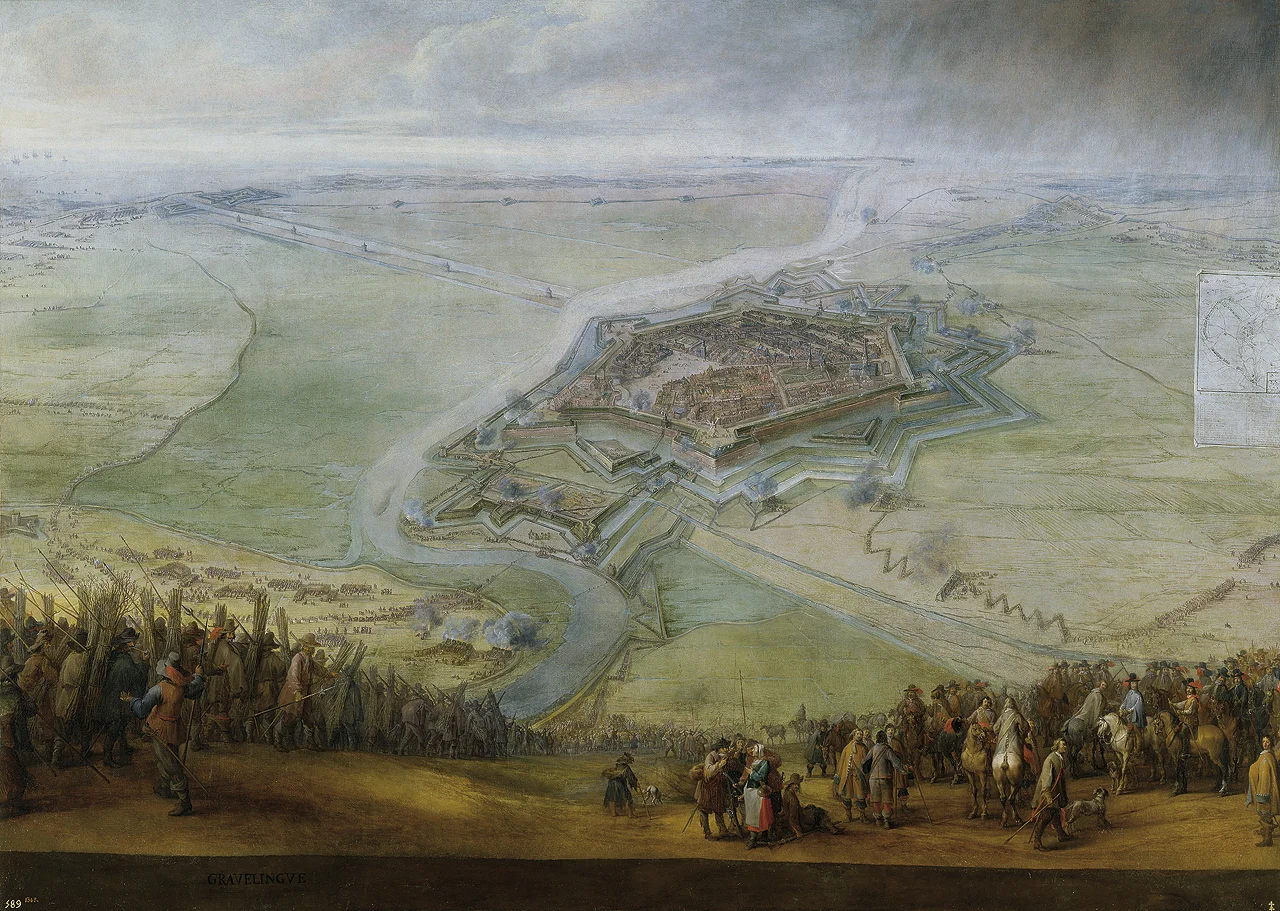

Siege of Gravelines (1644)
After two months of trenches dug through marsh and four repulsed assaults and a stubborn Spanish defence that held up the entire French campaigning season, the gates of Gravelines opened on 28 July 1644. The defenders marched out under the rules of war, weapons shouldered, free to walk to Dunkirk. And on the French side, the two senior officers - La Meilleraye, Master of Artillery, and Jean de Gassion, Conde's deputy at Rocroi - very nearly drew swords on each other over who would have the honour of riding through the breach first. La Meilleraye stormed off to Paris in disgust. De Gassion withdrew to Watten. The siege had been won; the partnership had failed.
An Orleans Whim
The Habsburg-Valois rivalry had matured by 1644 into something more grinding and bureaucratic than the dynastic dramas of a century before. France had been at war with Spain since 1635, picking off Habsburg fortresses along its borders. Conde had shattered the Spanish Army of Flanders at Rocroi the previous year. The obvious move was to consolidate the gains in Lorraine. But Gaston, duc d'Orleans - allegedly jealous of his nephew Conde's glory - insisted on a separate offensive into French Flanders. The cabinet of the boy-king Louis XIV, run by his mother Anne of Austria and Cardinal Mazarin, indulged him. The target chosen was Gravelines, a fortified port at the western end of the Spanish Netherlands defensive line, where a French capture would cut the Spanish coastal communications and please the Dutch by removing a privateering base.
A Marsh and an Army of Twenty Thousand
The ground around Gravelines was the problem. Marsh, dyke, polder, and tidal creek - the kind of country where a besieging army drowned its own siegeworks if it was careless. Around 20,000 French troops arrived on 28 May 1644. Orleans held nominal command, but actual operations fell to two professionals. La Meilleraye, as Master of Artillery, controlled the entire trenching and gunpowder supply. De Gassion, who had been Enghien's deputy at Rocroi, commanded the assault troops. Both were experienced. Both were proud. De Gassion would later claim that La Meilleraye, controlling the supplies, simply refused to share them fairly with the second siege column. The French dug from two directions: one set of trenches from the east, one from the south, the two senior officers each running their own little war.
Fort Saint-Philippe Falls
Every fortress had outer works. Gravelines had Fort Saint-Philippe, an isolated bastion that had to be taken before the town itself could be invested. It fell on 13 June after a hard local fight, and only then could the main siege begin. The trenches crept forward. A combined battery of 20 guns was assembled where the two French columns met, and opened fire on 20 June. The Spanish governor of the Netherlands, Francisco de Melo, had decided to prioritise holding Ghent and Antwerp - the great Flemish trading cities further north - and Gravelines could not expect to be relieved. Inside the walls, the garrison knew they were on their own. They still made the French earn every yard.
Four Repulses
Four separate French assaults bounced off the Gravelines fortifications. The garrison was small but it was professional, and the seventeenth-century rules of war gave them a clear incentive to keep fighting: if they surrendered before the besiegers established themselves on the main walls, they could leave with their weapons; if they were stormed once the walls were breached, they could be killed and the town sacked. So they held the breaches, repaired the parapets, fired into the trench heads, and waited. By 26 July the French had finally established a lodgement on the outer walls. The two-month window had closed. On 28 July the garrison commander beat the chamade - the drum signal of surrender - and walked his men out under safe passage to Dunkirk, weapons and possessions intact, having absorbed the entire 1644 French campaign on this one corner of the Spanish Netherlands.
Won, Then Lost, Then Won Again
The town was barely French. Gravelines was retaken by the Spanish in 1652 during the Fronde rebellions, when France's energies were turned inward. It changed hands again in 1658, after Turenne's victory at the Battle of the Dunes opened the whole Flemish coast to the French. Only the Treaty of the Pyrenees in November 1659 fixed it in French hands for good. La Meilleraye and de Gassion did not live to see that final settlement - both had moved on to other commands, and de Gassion would die of wounds at Lens just three years later. Their squabble over precedence at Gravelines became a textbook example, retold for generations, of how personal rivalry could nearly undo a successful siege.
From the Air
Coordinates 50.99 N, 2.13 E - on the Channel coast 16 km southwest of Dunkirk. The fortified town survives as one of the finest examples of Vauban-era star-bastion engineering, instantly recognisable from altitude. The river Aa, the canals, and the polder fields of French Flanders define the approach. Nearest airports: Calais-Dunkerque (LFAC) 15 km west, Lille-Lesquin (LFQQ) 80 km southeast.
Nearby Stories
- Mines in the Battle of Messines (1917) 4 km away
- Yser Towers 4.6 km away
- Abbey of Saint Bertin 5.8 km away
- MV Tricolor 7.2 km away
- Battle of Dover Strait (1916) 11 km away
- St James's Day Battle 12 km away
- Chateau de Boulogne-sur-Mer 13 km away
- Zeebrugge Raid 27 km away