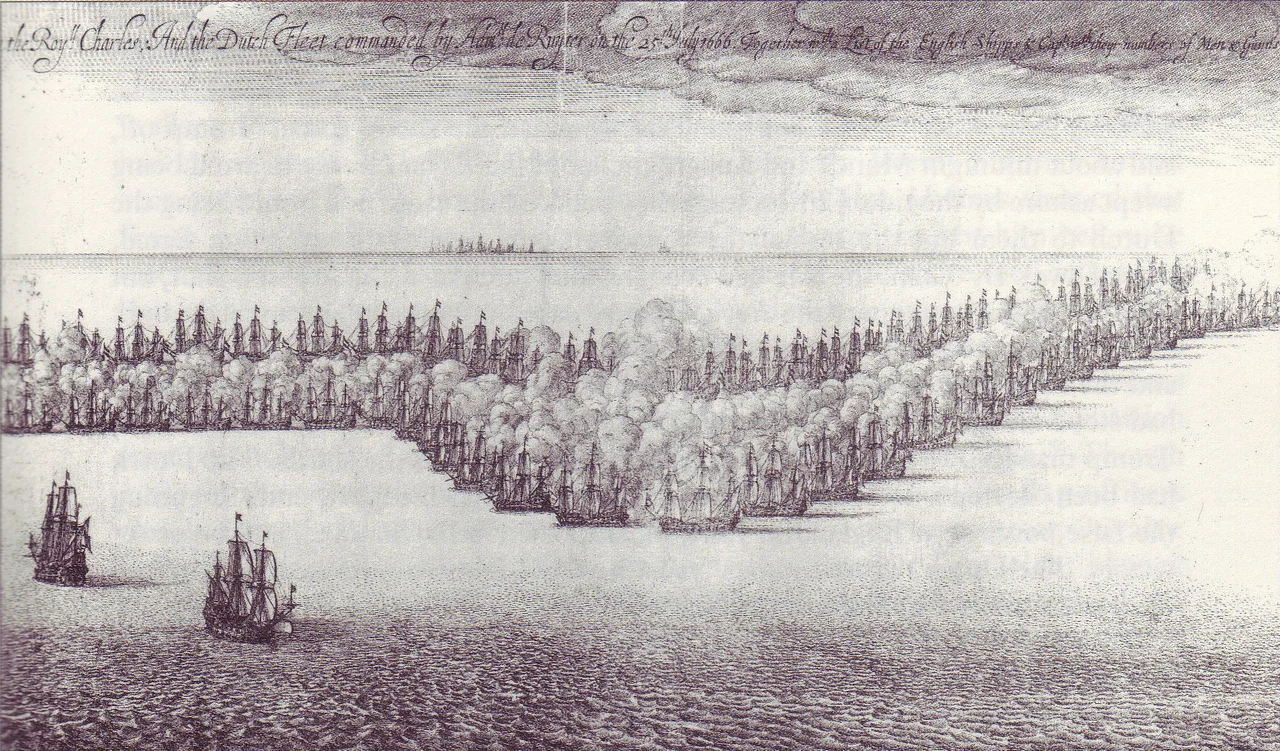

St James's Day Battle
Cornelis Tromp drank gin to steady his nerves. Michiel de Ruyter, the most respected admiral in Europe, stood on the open deck of De Zeven Provincien and shouted up at God: "Amongst so many thousands of cannonballs, is there not one that would take me?" None of them did. For two days in the high summer of 1666, off North Foreland on the Kent coast, the Dutch Republic and the Kingdom of England tried to destroy each other in one of the largest fleet actions of the age of sail - and the men in charge came apart at the seams as their ships did.
How they got here
Seven weeks earlier the Dutch had won the Four Days Battle, mauling the English fleet so badly that the grand pensionary Johan de Witt ordered de Ruyter to finish the job. The plan was bold: land 2,700 marines of the brand-new Dutch Marine Corps - the first marine corps in history - and burn the English fleet in Chatham dockyard where it was being repaired. The French were supposed to join up. They didn't. Bad weather smothered the landing. De Ruyter settled for blockading the Thames. On 1 August he found the English fleet at sea earlier than expected. A storm drove him home. On 3 August he sailed again. By dawn on 25 July (Old Style - 4 August by the calendar everyone else in Europe was using), the two largest fleets in the world stood facing each other off the North Foreland chalk.
Eighty-eight against eighty-nine
The Dutch had 88 ships. The English had 89, commanded jointly by Prince Rupert of the Rhine - cavalier of the Civil War, now in his forties and grey - and George Monck, the army general who had handed Charles II his throne back six years before. The wind shifted twice before the firing started. When the breeze came back from the northeast, Thomas Allin's English van caught the disorganised Dutch van and broke it apart in line of battle. Vice-Admiral Rudolf Coenders was killed in the first hours. Lieutenant-Admiral Tjerk Hiddes de Vries had an arm and a leg shot away by the same broadside and went on trying to give orders until he died. From the centre of the Dutch line de Ruyter could see the Frisian ships drifting south as floating wrecks, and could hear, above the cannon, the moaning of the men dying on their decks.
Tromp's wild ride
Far astern, Cornelis Tromp commanded the Dutch rear. He saw the disaster unfolding and decided, in the words of the chronicler, to give the correct example - which is to say, he did something spectacular and possibly mad. He turned sharply west, cut clean across the line of the English rear under Jeremiah Smith, and chased it off the field. He shot the crew off Smith's flagship three times over until it caught fire and had to be towed home. He drove the English so far west he lost sight of his own fleet. Edward Spragge, the English vice-commander Tromp had humiliated, became his personal enemy for life; seven years later Spragge would die trying to pay Tromp back at the Battle of Texel. Tromp meanwhile, exhilarated and then terrified by his own success, spent the next morning dodging English squadrons all the way back to Flushing, drinking gin to keep his hands steady.
De Ruyter wants to die
By dawn on 5 August, de Ruyter was finished. Forty ships, most of them barely seaworthy survivors of the broken van. A strong easterly pinned him against the Flemish shoals. Fifty English ships closed in a half-circle from the west, bombarding him from a safe leeward position. When his second-in-command Aert Jansse van Nes came aboard for a council of war, de Ruyter said: "What's wrong with us? I wish I were dead." Van Nes, a close friend, joked: "Me too. But you never die when you want to." Minutes later, a cannonball smashed the cabin table they had just left. Topside, de Ruyter exposed himself on deck and asked God to kill him. The only thing harassing his flagship in that hour was Fan-Fan, Prince Rupert's tiny personal pleasure yacht, rowed up to needle De Zeven Provincien with its two little guns while the English crews howled with laughter.
How it ended, and didn't
Then the wind turned west and saved them. De Ruyter formed a line, threaded the Flemish shoals, and brought his fleet home. Only two Dutch ships, Sneek and Tholen, struck their colours; the English burned both. The English lost about 300 men killed. The Dutch lost about 1,200. It was a clear English victory - and a useless one. The Great Plague and the Great Fire of London had hollowed out Charles II's treasury. He had funded this one last battle and had nothing left. The next year a Dutch fleet sailed up the Medway, burned the English fleet at its moorings, and towed the Royal Charles home as a trophy. Off the North Foreland on calm days you can sometimes still see the chalk cliffs that watched it all - a quiet horizon for a fight that ruined two reputations and changed nothing.
From the Air
Battle site approximately 51.37N, 1.60E, in the southern North Sea off the North Foreland, the chalk headland marking the easternmost tip of Kent. Nearest airfields: Manston (EGMH) directly west, Lydd (EGMD) to the south. The North Foreland Lighthouse is the obvious landmark from the air. The fleet engagement ranged across roughly 30 miles of open sea east of the Kent and Essex coasts. Look for the Goodwin Sands to the south - the same shoals that complicated 17th-century manoeuvre still mark themselves at low tide.
Nearby Stories
- Westenhanger Castle 6.6 km away
- MV Tricolor 8.4 km away
- Battle of Dover Strait (1916) 11 km away
- Battle of Bossenden Wood 14 km away
- Battle of Gravelines (1558) 18 km away
- White House Farm murders 19 km away
- Maunsell Forts 25 km away
- Southern Bight 67 km away