
Maunsell Forts
On 2 September 1967, Paddy Roy Bates climbed onto a derelict naval gun platform eleven kilometres off the Suffolk coast and declared himself the sovereign of a country. The platform was Roughs Tower, a 1942 reinforced-concrete fortification that had stood with one hundred Royal Navy gunners aboard during the Blitz and then been abandoned for twenty years. The country was the Principality of Sealand. Bates had a flag, a constitution coming, and a story about how a British court had declined to extend its jurisdiction over him, which he took as recognition. Six decades later his descendants still issue passports and aristocratic titles from the same two concrete legs. They are not alone on the Maunsell Forts. A whole subculture of pirate radio stations, artists, micronationalists, and conservation eccentrics has grown up around these seven strange installations, all because of one Royal Engineers civil engineer named Guy Maunsell.
Towers to Stop the Bombers
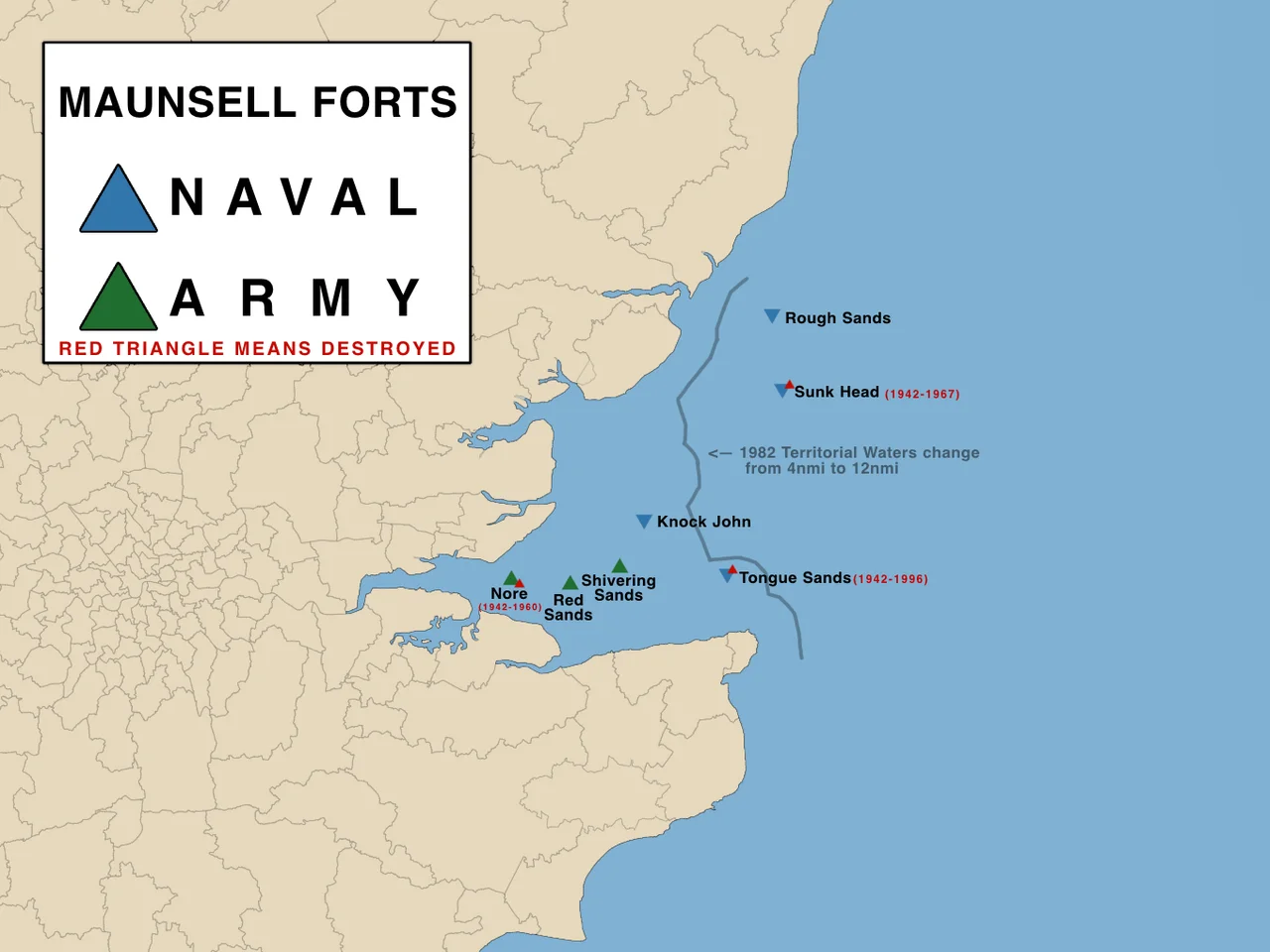
Guy Maunsell was a British civil engineer who specialised in concrete and the sea. In 1941 the Admiralty asked him for a way to extend air defence further out into the Thames Estuary, where the Luftwaffe was using the river as a navigation landmark to find London and to lay mines in the shipping channels. Maunsell's answer was modular. The naval forts were built as a single reinforced concrete pontoon, fifty-one metres by twenty-one, with two hollow concrete towers eighteen metres tall standing on it like grain silos. The whole structure, around 4,500 tonnes, was towed out, flooded, and grounded on a sandbank. Four of these were grounded in 1942: Rough Sands (U1), Sunk Head (U2), Tongue Sands (U3), Knock John (U4). The army version was even stranger. Seven separate steel platforms on long stilts, arranged like a constellation, each tower holding a different element: 3.7-inch anti-aircraft guns, Bofors guns, a searchlight, a control centre. From the air they look like a flock of metallic spiders standing in the water.
Active Service
The forts fought a real war. Their guns claimed twenty-two enemy aircraft and around thirty V-1 flying bombs over the course of the conflict, and tracked countless minelaying raids. On the night of 22 January 1945, Tongue Sands Fort picked up fifteen German E-boats on radar off the Kent coast. One of the patrol boats, S.199 out of IJmuiden in occupied Holland, came under fire from the fort's 3.7-inch guns. The captain, unsure where the shells were coming from in the dark, manoeuvred violently and rammed another E-boat. He scuttled his own crippled vessel afterward. The Mersey forts, sent to defend Liverpool from raids out of the west, never fired a shot in anger; the bombers stopped coming before they were finished. Six army forts, four navy forts, around a thousand men on rotation. By 1958 they were all decommissioned, the army forts dismantled or abandoned, the navy forts left to rust in the salt and the gulls.
Pirate Radio Era
Then the 1960s arrived and Britain wanted pop music the BBC was not willing to play. The forts were offshore, structurally sound, and big enough to mount radio antennas. In 1964 Screaming Lord Sutch installed Radio Sutch in one of the Shivering Sands towers. He got bored quickly and sold it to Reginald Calvert, who renamed it Radio City and expanded into all five connected towers. Red Sands Fort was occupied by Radio Invicta, later renamed Radio 390. Knock John was Radio Essex, run by an ex-army major called Paddy Roy Bates. The towers became transmission castles, with DJs ferried out by trawler, sleeping in concrete rooms still bearing the navy's painted instructions, broadcasting Beatles and Rolling Stones tracks to a Britain that had not yet been allowed to hear them officially. The era ended in 1967 with the Marine Broadcasting Offences Act and the dynamiting of Sunk Head Fort by the Royal Engineers on 21 August that year, 3,200 pounds of explosive bringing the entire superstructure down. Calvert, founder of Radio City, had been killed earlier in a dispute over ownership. The court ruled it was self-defence.
Sealand
Paddy Roy Bates lost his Radio Essex transmitter when Knock John was found to lie within British territorial waters. On 2 September 1967 he occupied Roughs Tower instead, which sat eleven kilometres offshore in what was then international water. When the authorities arrested his teenage son Michael over a confrontation in which warning shots were fired at a Trinity House buoy tender, the court dismissed the case for lack of jurisdiction. To Bates this was de facto recognition. He issued a flag, a constitution, a national anthem, passports, and a peerage. The Principality of Sealand has been continuously occupied since, first by Bates, then his widow Joan, then his son Michael. A 1978 attempt to overthrow the family by German and Dutch businessmen ended with Michael Bates retaking the tower by helicopter and holding the lead conspirator as a prisoner of war until the German government formally requested his release. No country has ever recognised Sealand. It still sells noble titles by the hundred.
Aesthetic of Decay
The remaining forts are wearing out. Tongue Sands collapsed in storms during the night of 21 February 1996. Red Sands was inspected in 2021 and found to be in such poor condition that six of the seven towers had severe structural defects, with elements already in the sea. A campaign called Project Redsands has been trying for years to raise enough money to preserve at least one. Shivering Sands lost a tower in 1963 to a passing freighter in fog. The 1968 Doctor Who serial Fury from the Deep was filmed at the nearby Red Sands Fort. U2 used the silhouette of Shivering Sands in the 1984 music video for 'A Sort of Homecoming'. The Hunger Games: Catching Fire used the towers as a glimpse of dystopia. The forts have become exactly what they look like: the iron skeletons of a war that ended a lifetime ago, drowned in the same shipping lanes they were built to guard, beautiful in the way that all useful objects become beautiful once they have outlived their purpose.
From the Air
Rough Sands (Sealand) at 51.895N 1.481E, about 11km off Felixstowe, Suffolk. Red Sands and Shivering Sands clusters are visible in the outer Thames Estuary near the Kent coast at roughly 51.6N. The Mersey forts have been dismantled. From cruising altitude the army forts appear as small constellations of black dots; Sealand looks like a goalpost in the sea. Nearest airfields: Southend (EGMC), Manston (EGMH), Cambridge (EGSC), London City (EGLC).
Nearby Stories
- Sizewell Nuclear Power Stations 2.7 km away
- Flatford Mill 2.8 km away
- Haughley Castle 6.4 km away
- Battle of Assandun 26 km away
- Four Days' Battle 27 km away
- Margate Surfboat 35 km away
- MV Tricolor 35 km away
- Battle of Lowestoft 63 km away