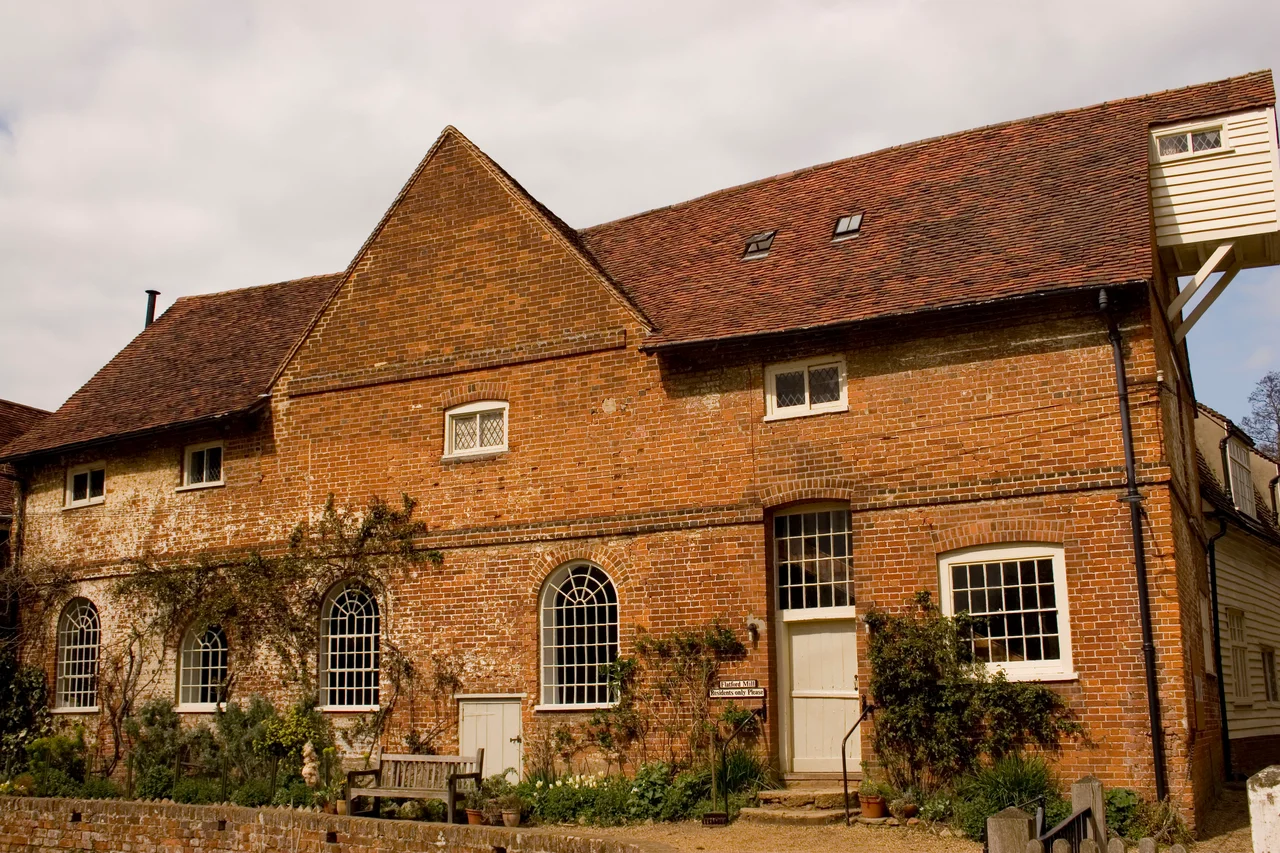

Flatford Mill
There is a particular bend in the River Stour where a horse-drawn hay cart once forded the river in front of a thatched cottage with a brick mill behind. In 1821 a 45-year-old painter set up his easel in the doorway of the mill, looked across at his neighbor Willy Lott's house, and made the picture that would become The Hay Wain. The mill is still there. The cottage is still there. The river still loops past in the same way. Two hundred years later, Flatford is one of the few painted views in the world where you can stand on the exact spot and see almost exactly what the artist saw.
Golding Constable's Mill
The date stone on the watermill reads 1733, though parts of the structure may be older. The miller's cottage attached to the mill dates from the 17th century. In the late 18th century the mill was owned by Golding Constable, a Suffolk corn merchant who ran a fleet of grain barges down the Stour Navigation to Mistley and the Essex coast. His son John, born up the hill at East Bergholt in 1776, grew up around the millponds, locks, and barges. He did not want to take over the family business. He wanted to paint. And what he painted, again and again across forty years, was the small triangle of countryside where he had grown up - Flatford, Dedham, the river, the mill.
The Hay Wain and Its Siblings
The Hay Wain was exhibited in 1821 as Landscape: Noon. It did not sell well in Britain. Three years later, when Constable exhibited it in Paris, it won a gold medal and changed French landscape painting; Delacroix is said to have repainted the background of his Massacre at Chios after seeing it. The mill and its surroundings appear in many other Constable works: Flatford Mill (Scene on a Navigable River), The Lock, Flatford Mill from a Lock on the River Stour, and several views from different angles in different seasons. Constable was painting his own childhood. He once wrote that the sound of water escaping from mill dams "made me a painter."
What Field Trips Look Like
The mill was Grade I listed in 1955. It is owned by the National Trust, which leases it to the Field Studies Council, an educational charity that has run a field studies centre on the site since 1943. Generations of British schoolchildren have come here on residential trips to learn about river ecology, geology, and painting - and to row boats on the same stretch of water Constable rowed on. The Trust also looks after Bridge Cottage, Valley Farm, and Willy Lott's Cottage, the modest farmhouse that anchored the right side of The Hay Wain. Together these few buildings form a complete and intact corner of late-Georgian rural England, preserved because of one man's paintings.
Walking the Vale
From Flatford a footpath runs along the Stour to Dedham, a flat, easy mile through meadows that the painter knew by every gate and stile. The river is narrow here, lazy, fringed with willows. Punts can be hired. The water level is low enough in summer that you can wade across at the ford that gave Flatford its name. Above the meadows, the village of East Bergholt rises on the slope where Constable was born. The whole landscape is now formally protected as the Dedham Vale National Landscape, a designation that says, in essence: this place looked important enough to a painter 200 years ago to be worth keeping looking like that.
The View That Outlasted
Look at The Hay Wain on the wall of the National Gallery in London, then walk three hours east and look at the actual spot. Willy Lott's cottage is whiter now. The trees are taller. The cart is gone, naturally. But the water, the bend, the brick of the mill, the angle of light off the river - the same picture, just running 200 years later. Few painted scenes in the world have held still so well. Flatford Mill is not a monument to Constable so much as a still-functioning piece of the landscape he persuaded the world to look at.
From the Air
Flatford Mill lies at 51.96 N, 1.02 E, on the River Stour at the Suffolk-Essex border, about 8 miles south of Ipswich. From altitude, look for the silver thread of the Stour winding east toward Manningtree and the Stour Estuary; Flatford sits just below East Bergholt on the Suffolk (north) bank. Nearest airports: Stansted (EGSS) 50 miles southwest, Cambridge (EGSC) 60 miles west, RAF Wattisham (EGUW) 15 miles northwest, Southend (EGMC) 35 miles south. The Dedham Vale stretches like a green crease through otherwise cultivated farmland.
Nearby Stories
- Woolpit 2 km away
- Tilty Abbey 3.6 km away
- Saxmundham 5.6 km away
- RAF Bottisham 6.5 km away
- Kelvedon Hatch Secret Nuclear Bunker 6.6 km away
- Maunsell Forts 7.4 km away
- Battle of Assandun 15 km away
- Broadstairs 36 km away