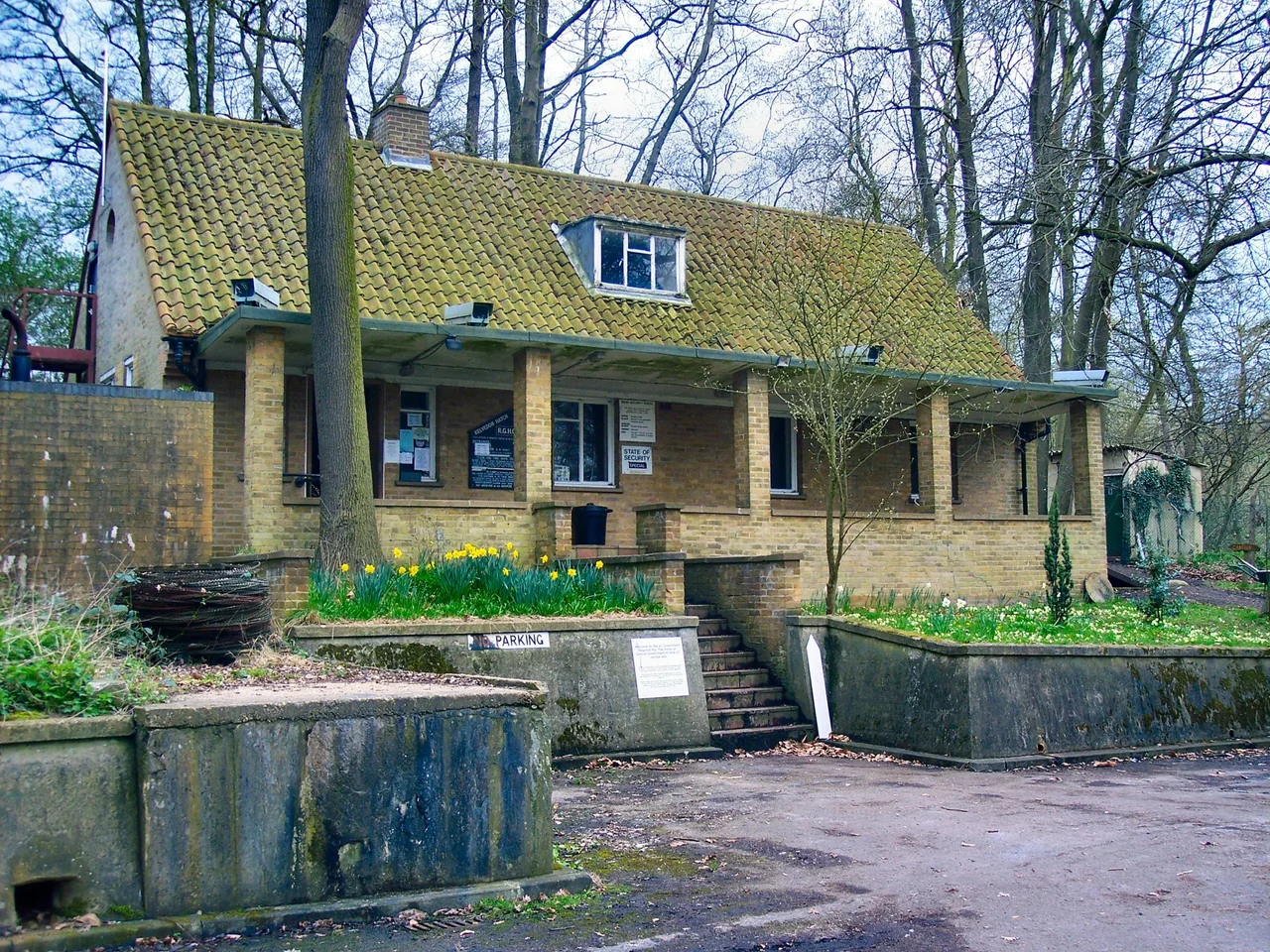

Kelvedon Hatch Secret Nuclear Bunker
The brown highway signs read "Secret Nuclear Bunker" and arrow off the country lane, which is the kind of contradiction the English seem to particularly enjoy. Down a wooded track in Essex, past a few discreet warnings about private property, stands an ordinary 1950s bungalow. Tile roof, white walls, a porch light. Nothing about it suggests that behind its front door waits a hundred-yard tunnel descending 125 feet into the earth, into three concrete floors built to outlast nuclear war. For forty years the British government insisted Kelvedon Hatch did not exist. Now it has its own gift shop.
Built for the End of the World
Construction began in 1952, when the threat was Soviet bombers and the response was a thing called ROTOR - a programme to harden Britain's air defence network against attack. Peter Lind & Company of London, a firm still trading today, poured concrete on compulsory-purchased farmland and built what was officially called an 'R4' Sector Operations Centre. The plan was simple in the way that only Cold War planning could be: provide command and control for the London Sector of RAF Fighter Command, deep enough underground that a near miss would not stop it working. As the technology of catastrophe evolved from bombers to missiles, the bunker's role changed with it. By the 1960s it had become a Regional Seat of Government - a place from which civil servants and military officers would attempt to organise the survival of the population after a nuclear strike, and continue some form of government once the bombs had fallen.
The Bungalow Above, the City Below
The disguise was deliberate. A standard ROTOR 'Guard House' bungalow set among trees, indistinguishable from the small commuter homes scattered around the Essex countryside. Walk inside, and the floorplan disappears - the building is really just a stair head, leading down through a hundred-yard tunnel to the lowest of three floors. Above are two more levels, then the artificial hill that covers it all, then a radio mast at a discreet distance through the woods. The bunker could hold hundreds of personnel and sustain them for up to three months. Its lungs were the original ROTOR air conditioning plant, breathing through filters designed to keep radioactive dust outside. Its water came from mains and a deep bore hole drilled into the chalk. Its communications were a tangle of acronyms - MOULD, CONRAD, MSX teleprinters, EMP-hardened lines - a vocabulary built to outlast the world that named it.
What the Walls Remember
Walking the rooms today is like stepping inside the anxiety of an era. The map of Essex on the wall still shows where the fallout would have settled. The dormitories are stacked with iron-frame beds, three high, with no real privacy and no real comfort - this was a place to survive, not to live. There is a small BBC broadcast studio from which the Wartime Broadcasting Service would have read prerecorded announcements to whatever audience remained. There is a sick bay equipped to deal with radiation poisoning, and a chapel for the moments when medicine ran out. The kitchens could feed four hundred people. The plotting tables still wait for markers that were never moved. Everything works, more or less, because that was the point - a bunker that did not work was no bunker at all.
Sold Back to the Farm
By 1992 the Soviet Union had dissolved, and Britain decided it no longer needed the place where it had planned to govern after Armageddon. The bunker was decommissioned and sold back to the Parrish family - the farmers who had owned the land in the 1950s before the government took it for the nation's defence. The Parrishes opened it as a museum. The brown signs went up shortly after, directing visitors with the kind of dry irony that British humour particularly favours, the irony that Top Gear once filmed an entire feature around. New Tricks shot an episode here in 2014. The 2016 video game The Bunker, a full-motion live-action thriller, was filmed entirely within these walls, using the bunker's claustrophobia as its set. The independent post-apocalyptic horror film S.N.U.B! came here in 2010 looking for an end-of-the-world atmosphere. They did not have to build anything.
The Question That Lingers
Standing in the operations room, where civil servants would have tracked nuclear strikes on illuminated maps, you find yourself doing arithmetic the planners did. How many cities would have been hit. How many people would have arrived at the surface entrance, beating on the blast doors. How the small staff inside would have decided who to admit. The bunker was built to preserve government continuity, which is the technical phrase for a particular kind of cold mathematics. It was also, in a strange way, an act of optimism - the belief that someone, somewhere, would still need a government to come back to. That optimism never had to be tested, which is the best outcome any of these bunkers could have hoped for. Now school groups file through, and somebody sells coffee in the canteen where Cabinet ministers would have eaten rations, and the silence in the deepest level is just silence, not the silence after.
From the Air
Kelvedon Hatch sits at 51.67°N, 0.26°E in the Borough of Brentwood, Essex, roughly 22 miles northeast of central London. The bunker itself is buried, but the radio mast and the wooded site are visible from low altitude. Nearby airports include London Stansted (EGSS) to the north and London City (EGLC) to the southwest. Best viewed from 3,000-5,000 feet against the patchwork of farmland and woods that conceals it.
Nearby Stories
- Waytemore Castle 2 km away
- Prittlewell Royal Anglo-Saxon Burial 4.2 km away
- Sevenoaks 5.6 km away
- Central line (London Underground) 6.4 km away
- River Lea 9.7 km away
- Surrey 11 km away
- Mercury Theatre, Colchester 14 km away
- Faversham Munitions Explosion Memorial 14 km away