.jpg)
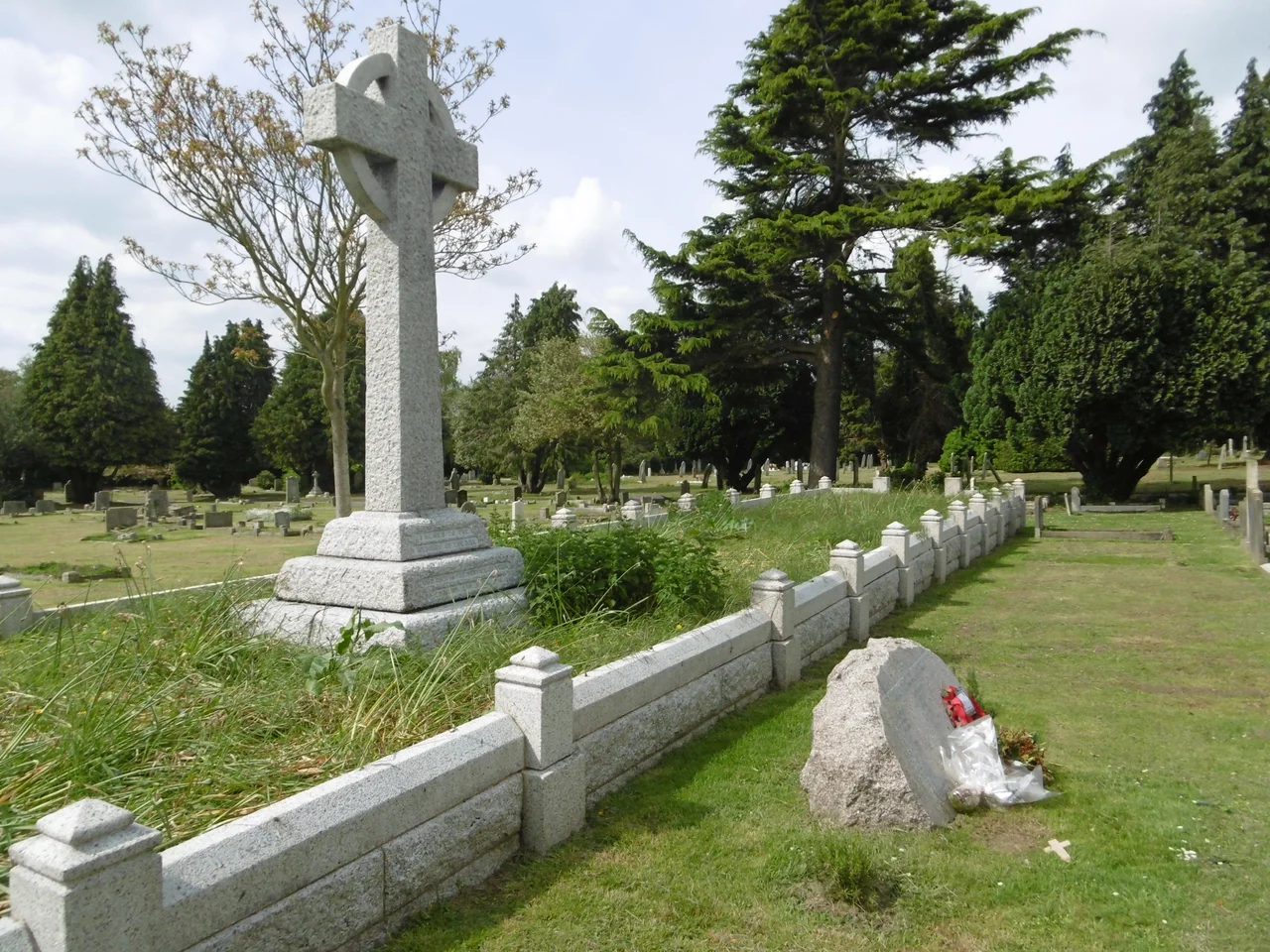
Faversham Munitions Explosion Memorial
Thirty-four names are carved in lead lettering along the granite kerb of the mass grave at Faversham. Thirty-nine more bodies in the same grave are recorded as "male person unknown." Another thirty-five names appear on a separate stone nearby - victims whose families chose to bury them elsewhere. On 2 April 1916, at 2:20 on a Sunday afternoon, three TNT explosions tore through the Explosives Loading Company's factory number 7 at Uplees on the salt marshes outside Faversham. At least 108 men and boys were killed, the youngest seventeen and eighteen, the oldest in their sixties. Almost a hundred more were injured. Because the country was at war and wartime censorship kept the story out of the newspapers, most of Britain never learned what had happened. The memorial in Love Lane cemetery is now Grade II*-listed - one of the highest protections English heritage law can give a structure - and the centenary of the explosion in 2016 finally gave the dead the public recognition the original moment had denied them.
The Town That Made the Gunpowder
Faversham had been making explosives since the 16th century - the first gunpowder factory in England was established here, taking advantage of the salt marshes that pushed potentially-dangerous work safely away from the town centre, and of the deep-water creek that let finished material be loaded onto ships. By the First World War the industry was central to Britain's military supply, and the Explosives Loading Company had built factory number 7 on the salt marsh at Uplees specifically to make the TNT charges that filled British shells and mines. The work was dangerous but the workers were thoroughly trained in safety procedures - no smoking, no metal tools that might spark, careful segregation of the most volatile materials. The men working at Uplees on the weekend of 1 to 2 April 1916 were ordinary working-class people from Faversham and surrounding villages, doing wartime work in a wartime economy. None of the plant's female workers were on the site that Sunday.
Building 833
Building 833 was a wooden shed. Inside it sat 15 tons of TNT and 150 tons of ammonium nitrate. The initial inquiry, delivered on 17 April just two weeks after the disaster, found that empty linen sacks - used for transporting explosives, piled up against the outside of the shed - had been ignited by sparks from a fault at a nearby boiler house. This finding was later upheld by the official report from a committee headed by the Minister of Munitions, David Lloyd George. The fire broke out and the workers and firemen knew immediately what they were facing. They desperately tried to put it out and to remove the explosives from the vicinity. They did not succeed. Three large explosions at 2:20 pm excavated a crater wide and deep in the salt marsh. A worse disaster was averted only by accident - several thousand tons of TNT stored elsewhere on the site did not detonate. The shockwave broke windows in Southend across the Thames Estuary. The sound was heard in Norwich, over a hundred miles away, and as far as the French coast.
Who They Were
The first dead were the men who had been trying to put the fire out. The entire fire brigade of the factory was killed in the blast. Twenty workers from the neighbouring Cotton Powder Company who had come over to help fight the fire died as well. Six soldiers from the 4th Battalion, The Buffs - East Kent Regiment - who formed the site's military guard were among the dead. The youngest of those killed were seventeen and eighteen years old; the oldest were in their sixties. Many remains could not be identified at all. Another seven people were recorded as missing - never found. Almost a hundred others were injured. These were not professional soldiers dying in trenches abroad. These were tradesmen, foremen, schoolboys at their first jobs, fathers of young children, neighbours who had walked over from the next factory because their friends were in trouble. They died running toward the fire, not away from it, doing work the country had asked them to do, in a country that the war had given no margin for grief.
Buried in Silence
Wartime press censorship kept the explosion almost entirely out of the British newspapers. The country could not afford the public to know how vulnerable its munitions supply was, or how badly things could go wrong on the home front. The funerals went ahead in near silence. Many of the bodies were buried together at Love Lane cemetery in Faversham on Thursday 6 April 1916, in a service conducted by the Archbishop of Canterbury Randall Davidson - the senior cleric of the Church of England, called in to give weight to a moment the nation was otherwise being told not to dwell on. Further burials took place on the 7th and 8th. In all, 73 people were interred in the mass grave; only 34 could be named. The families of another 35 victims chose to bury their dead privately, elsewhere. The factory was quickly rebuilt and was back in production within months. The war went on. The dead were carried, by their families and by the town of Faversham, mostly alone.
The Stone That Names Them
The memorial in Love Lane cemetery was paid for by the Explosives Loading Company, the firm that had owned the factory. They also undertook to maintain it. It was unveiled and dedicated on 27 September 1917 by the Archbishop, the same Randall Davidson who had taken the funerals. The mass grave itself is a long rectangular block of granite, oriented north to south, surrounded by a low kerb with urns on pillars at each end. At the centre stands a free-standing granite Celtic cross on three steps, inscribed: SACRED TO THE / MEMORY OF THE MEN / WHO DIED IN THE SERVICE OF THEIR / COUNTRY 2ND. APRIL 1916. // FATHER IN THY GRACIOUS KEEPING / LEAVE NOW THY SERVANTS SLEEPING. The quotation comes from John Ellerton's 1870 hymn "Now the labourer's task is o'er." The names of the buried run in lead lettering around the edge of the kerb wall. A separate stone records the thirty-five names of those buried elsewhere. The memorial became a Grade II listed building in 1989 and was upgraded to Grade II* in March 2016, just before the explosion's centenary - so that on 2 April 2016, exactly a hundred years after the blast, the country could finally afford to acknowledge what these men had died doing.
From the Air
The Faversham Munitions Explosion Memorial is at 51.3109 degrees North, 0.9042 degrees East, in Love Lane cemetery in Faversham, Kent. The original explosion site is on the salt marshes at Uplees, about 2 miles north-west of the town. Best viewed at 1,500 to 3,000 feet AGL - the historic centre of Faversham and the salt marshes of the Swale estuary are both clearly visible, with the Isle of Sheppey just to the north. Nearest airfield: Manston (EGMH) about 16 nautical miles east. Watch for the busy Thames Estuary air traffic and the controlled airspace around Manston.
Nearby Stories
- Hadlow Castle 2 km away
- HMS Niger (1892) 3.2 km away
- Rye Harbour 9.3 km away
- RAF Hornchurch 11 km away
- Kursaal Amusement Park 11 km away
- Hellingly Hospital Railway 12 km away
- 2008 Channel Tunnel fire 18 km away
- Maunsell Forts 44 km away