
Hellingly Hospital Railway
In 1903, a small electric tramcar with space for twelve passengers rolled out of Hellingly station under a single overhead wire and trundled down a private line through the Sussex fields. Its destination was a brand-new institution then called the East Sussex County Lunatic Asylum, soon renamed Hellingly Hospital, a sprawling complex designed by George Thomas Hine for nearly a thousand patients. The little locomotive that followed the tramcar would still be running at closing day in 1959, by then the oldest working electric locomotive in the British Isles - a curious distinction earned by a railway built to serve people the rest of England had quietly set apart.
A Line Built for an Institution
East Sussex County Council bought four hundred acres at Park Farm from the Earl of Chichester in 1897, intending to build a county asylum large enough to relieve the older institution at Haywards Heath. Construction began in 1900 to Hine's plan, the bricks and stone arriving by a private standard-gauge siding from the goods yard at Hellingly station on the Cuckoo Line. The London, Brighton and South Coast Railway agreed to the connection on the condition that the council pay the £1,700 cost - roughly the price of a small house, then, for the privilege of feeding a building site. By 1902, with the patient wards rising and a power plant going in to light them, the council decided to electrify the whole line. The first hospital train ran on 20 July 1903, the same day the wards opened. Patients and coal arrived on the same wire.
The Smallest Tramcar in Sussex
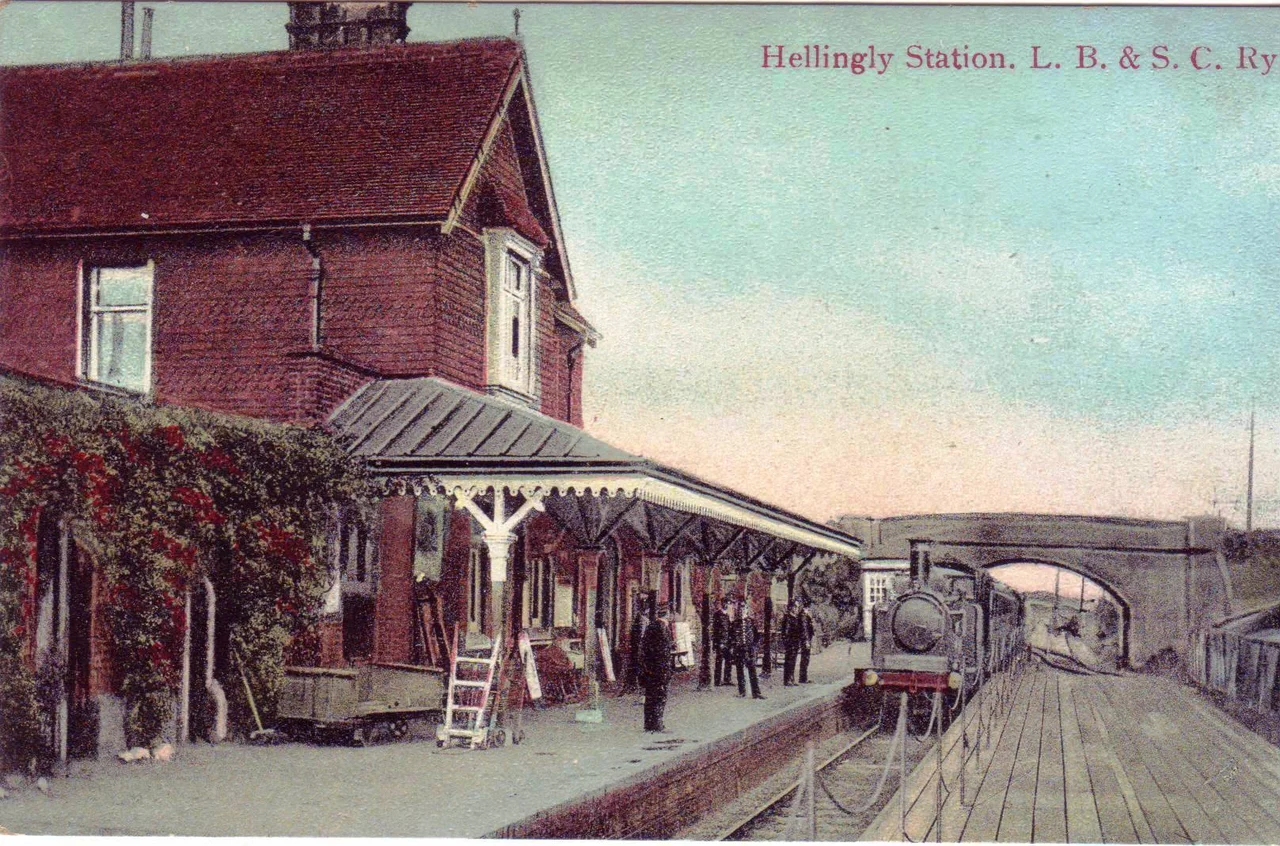
The electrical work was contracted to Messrs Spagnoletti, a family firm with deep roots in early British electric traction. The line ran on 500 volts of direct current drawn from a single overhead wire, powered from the hospital's own generating plant. Robert W. Blackwell & Co supplied a tiny 0-4-0 electric locomotive capable of pulling two loaded coal wagons; the company's records have since vanished, but the controls suggest it may have been built in Germany. The Brush Engineering Company built the tramcar, a single-decker fitted with a trolley pole and benches for twelve. There was no timetable. Trains ran when patients needed transferring, when coal needed bringing in, when food and supplies arrived at the main line. A small wooden platform at Hellingly station, kept chained off when not in use, let passengers cross between the LBSCR and the hospital line - an architectural detail that quietly declared the asylum apart.
Sundays in the Park
Hellingly Hospital, like other large Victorian and Edwardian asylums, was designed to be self-contained. Patients lived, worked, and sometimes died within its grounds. They were people - farm workers, mothers, soldiers home from the Great War, anyone whose mind had bent in ways their families or doctors could not cope with. The hospital's railway carried staff to work, brought relatives in for Sunday visits, and moved the patients themselves between the main wards and the Park House annexe. Service patterns shifted with patient numbers and with the seasons; the busy months for the boilers were also the busy months for the line. By 1922, passenger numbers had fallen enough that the wooden platform at Hellingly was drastically shortened. In 1931 passenger services ended altogether, and the small platform at the hospital was converted into a coal dock. The tramcar, after twenty-eight years of carrying people most of England preferred not to think about, was retired.
A War, a Plan Unused
On 22 November 1939, with Britain at war, plans were drawn up to restart passenger services so ambulance trains could reach the hospital. Authorisation was granted. The trains never ran. Park House did serve as a hospital for the Canadian Army through the Second World War, but patients reached it by road from Hellingly station rather than along the old electric line. Only two accidents are recorded across the railway's entire life: a car that struck the locomotive while driving through the grounds, and a wagon whose brakes failed at Farm Siding and rolled gently down to Hellingly station, where it stopped. For a small private line operated essentially by feel rather than timetable, that is a remarkable safety record.
What Remains
The railway closed officially on 25 March 1959, after the hospital converted its coal boilers to oil. The last coal wagon left, the overhead wire was de-energised, and the elderly electric locomotive - that quiet survivor from 1902 - was retired. Hellingly Hospital itself closed in 1994. The engine shed burned in a vandals' fire in 2004; planning permission to redevelop the site as housing was granted in 2009. Much of the line is now a footpath, part of the Cuckoo Trail that follows the old Cuckoo Line route. A cast-iron pole that once carried the overhead wire still stands in the woods. A short stretch of track sits half-buried in moss. The buildings the line once served are mostly gone, redeveloped or demolished, the wards converted to apartments and the airing courts to gardens. Walking the path today, with the asphalt smooth and the birds loud overhead, it is easy to forget that this gentle route through the Sussex countryside was once the only railway in Britain built to serve a mental hospital - and that the people it carried deserved, and still deserve, more remembering than they got.
From the Air
Located at 50.89°N, 0.26°E in East Sussex, between Hailsham and Horam. The Cuckoo Trail footpath, which follows the old line, runs roughly north-south through a patchwork of fields and woodland. Nearest airfield is Deanland (EGCD), about 9 km west. Lydd Airport (EGMD) lies further east on the Romney Marsh. Best viewed from 2,000-3,500 ft AGL in clear conditions; the rail-trail shows as a green corridor between Hellingly and the redeveloped hospital site.
Nearby Stories
- Chiddingstone Castle 4.4 km away
- Kent 4.6 km away
- Camber Castle 5.4 km away
- Surrey 13 km away
- Amberley Museum & Heritage Centre 13 km away
- Swanage Lifeboat Station 113 km away
- Le Paradis Massacre 137 km away
- Wellington Clock Tower 150 km away