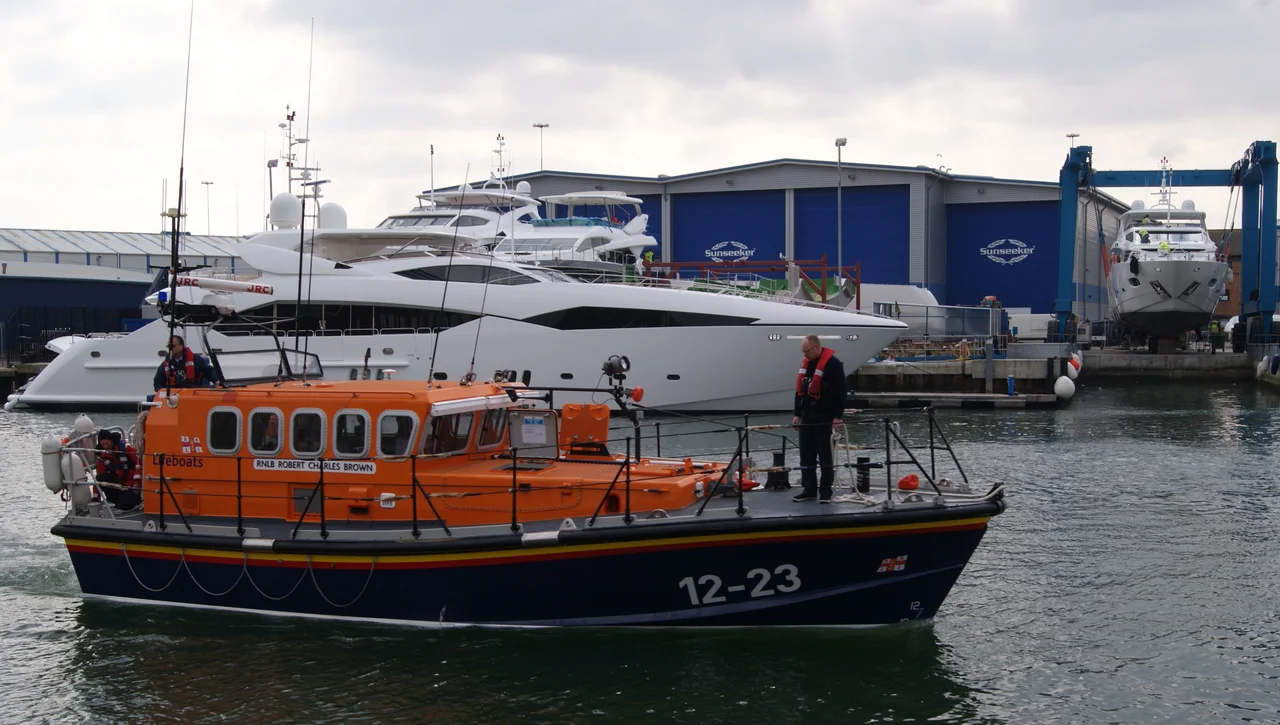

Swanage Lifeboat Station
On 23 January 1875, the brigantine Wild Wave of Exeter, carrying coal from the north to Poole, came onto the rocks at Peveril Point in a winter gale. The first day's rescue attempt failed. On the second, when the crew of four men and a boy were finally pulled from the wreck, the local Coastguard Officer, John Lose, was awarded the RNLI Silver Medal. The wreck did something else as well. It forced the question that Swanage had been avoiding for years: why was there no lifeboat in the town?
Founded by a Wreck
Prompted by the Wild Wave, local residents petitioned the Royal National Lifeboat Institution for a station. On 4 March 1875, just six weeks after the wreck, the RNLI committee approved the proposal. The Earl of Eldon granted a suitable site on Peveril Point, the headland at the southern end of Swanage Bay. The lifeboat house and its stone slipway cost £526. The boat herself, a thirty-five-foot Pulling and Sailing vessel with ten oars and a mast, came as a gift from S. J. Wilde of London, presented in memory of his late aunt Miss M. K. Wilde. On 16 September 1875, a large crowd watched the Rev. B. D. Travers conduct prayers, and Wilde's representative named the boat Charlotte Mary at the donor's request, in memory of her two sisters. The boat was launched into the bay and her self-righting capability demonstrated. The first call came less than six months later, in March 1876, when she saved the ketch William Pitt of Poole as it drifted ashore near Bournemouth.
A Century of Crews
From the Charlotte Mary onwards, the station became part of the rhythm of the town. Ten RNLI medals for gallantry have been awarded to Swanage crews over the years, five silver and five bronze, the last in 1996. The names recur across decades: Ronald Hardy as coxswain in the 1970s, Victor Marsh through the 1970s and 1980s, Christopher Haw across the 1990s. In December 1943 the station was the focus of an unusual operation involving the motor launch Chasseur 5 of the Free French Naval Forces. After the war, the French Government and the French Lifeboat Society both awarded the Swanage crew their medals, and a letter of thanks arrived from the Commander in Chief of the French Naval Forces in the United Kingdom. The station's coxswain mechanic Robert Charles Brown received the British Empire Medal in 1977, and the station's recent operations manager Captain Neil Michael Hardy was appointed MBE in 2015.
Rebuilding for the Shannon
The boathouse went through a major rebuild in 1992, with the roof raised and the building extended sideways to make room for a new generation of lifeboat. Two decades later, the station needed another, bigger transformation. The RNLI's new Shannon class all-weather lifeboat is jet-propelled rather than driven by conventional propellers, capable of higher speeds and tighter turns, and it requires a different kind of launching infrastructure. Work on a completely new boathouse and slipway began in 2015 and 2016. On 8 April 2016 the new boat arrived. On 22 April 2016 the old all-weather lifeboat, the Robert Charles Brown, left Swanage for the last time after more than 23 years of service. Slipway trials began on 8 November and the boat moved into her new home on 14 December. In February 2017 the smaller inshore lifeboat Phyl & Jack followed her into the new boathouse, and the rebuilt station was officially opened later that spring.
Peveril Point Today
The station today stands at the eastern end of Swanage seafront, where Peveril Point juts into the Channel between Swanage Bay and Durlston Bay. Visitors can walk to the headland, look down at the slipway and the rolling chop where the lifeboat enters the water, and on open days step inside the boathouse itself. The Shannon class boat sits ready on her hydraulic cradle. The inshore boat waits beside her. A line of photographs and medals on the wall tells the story of every crew since 1875, and a board lists the names of every coxswain who has held the wheel. The station's reach extends from St. Alban's Head west of Swanage round to Bournemouth and beyond, covering some of the busiest small-boat waters in southern England.
Why It Still Matters
A lifeboat station is an unusual institution. It is almost entirely volunteer-run, supported by donations rather than taxes, and its product is hard to measure except by counting the people who got home. The Swanage crew have launched thousands of times since 1875. They have saved fishermen, yachtsmen, swimmers, kayakers, and the occasional unlucky cliff-walker. They have lost no one of their own number to the sea. The station's quiet importance shows in the small details: a fundraising shop on the seafront, schoolchildren on tours of the boathouse, a coxswain whose grandfather held the same role. Peveril Point keeps watch over a coast that still produces wrecks, and the Charlotte Mary's distant descendants are still ready to launch into them.
From the Air
Located at 50.607°N, 1.947°W on the eastern tip of the Isle of Purbeck, immediately south of Swanage town. The boathouse is at sea level on the small Peveril Point headland; the new slipway angles south-east into Swanage Bay. Best viewed from 1,500-2,500 feet, with Durlston Castle visible 1 nm to the south. Nearest airfields: Bournemouth Airport (EGHH) 18 nm east-north-east, Compton Abbas (EGHA) 28 nm north-west. The seafront and pier are easy visual references from the air.
Nearby Stories
- Calshot Castle 7.3 km away
- Battle of Portland 16 km away
- Sherborne Castle 16 km away
- Carisbrooke Castle 18 km away
- German Submarine U-672 25 km away
- Wardour Castle 28 km away
- Operation Donnerkeil 31 km away
- D-Day: The Longest Day 141 km away