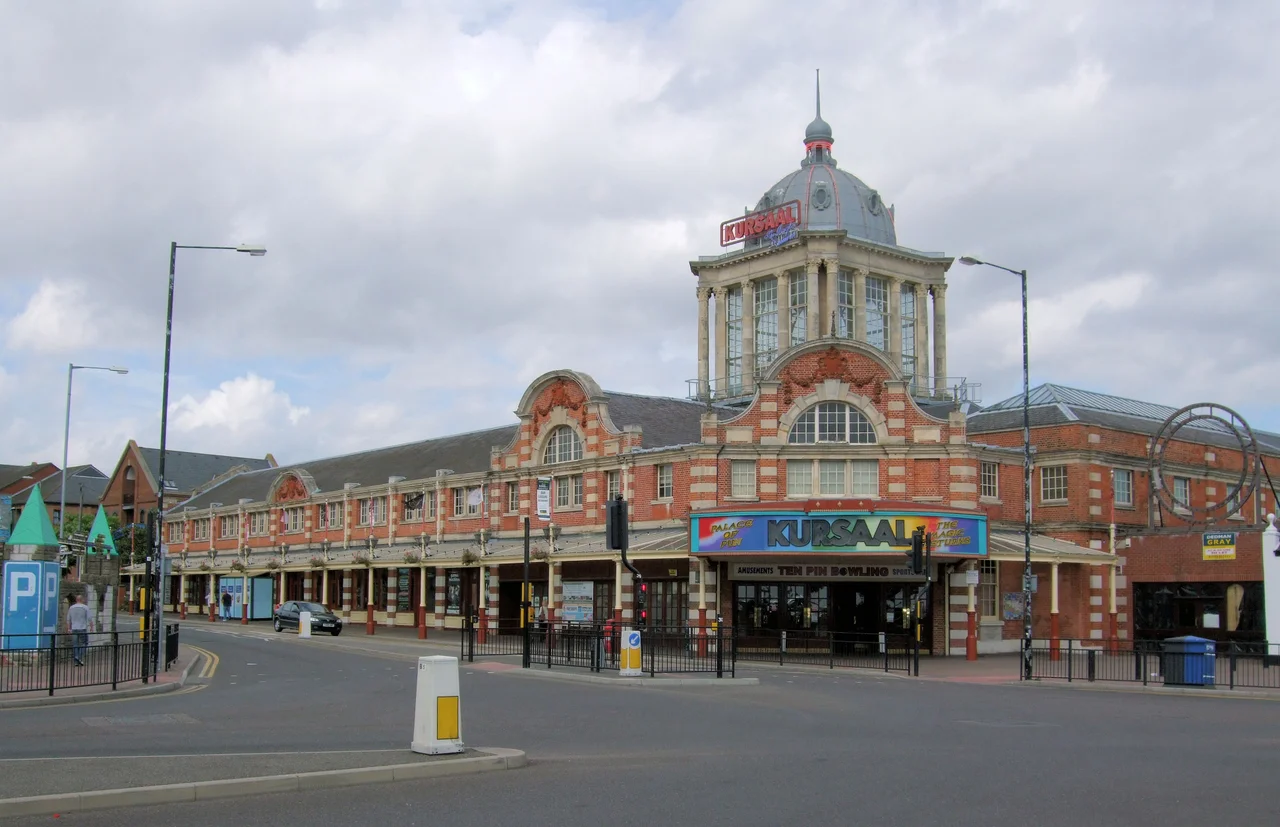

Kursaal Amusement Park
The word Kursaal is German, meaning literally 'cure hall' - the grand banquet room of a spa town where well-heeled Victorians went to take the waters and listen to music. So when Henry Austen named his new entertainment pavilion the Kursaal Palace in 1901, he was promising Southend-on-Sea the kind of cosmopolitan glamour usually reserved for Baden-Baden. The dome went up at the edge of the Thames Estuary, fifteen acres of fairground spread out behind it, and a specially commissioned train pulled up at the station carrying Lord Claud Hamilton of the Great Eastern Railway to cut the ribbon. For the next seventy years, almost everything that mattered to working-class English leisure happened beneath that dome.
The Cure Hall by the Sea
The Kursaal grew out of an argument over alcohol. In 1894, Austen had opened the site as Marine Park and Gardens on land leased from the Tollhurst family - a respectable Victorian pleasure garden with a bandstand, a two-acre lake, and a 15,000-square-foot sprung dance floor. When the Women's Temperance Movement objected to his plans for a licensed pavilion, the Tollhursts were so offended on his behalf that they threatened to sell the whole site for housing. The solution was bigger and more defiant: the Kursaal Palace, designed by George Campbell Sherrin and John Clarke, containing a circus, ballroom, arcade, dining hall, and billiard room, all beneath a dome that became the silhouette of the Essex coast. By 1903, despite its parent company going into voluntary liquidation, Southend's Kursaal was the largest fairground in the south of England.
Roller Coasters and Princess Dinubolu
What followed was a century of rides with names that read like a Victorian fever dream: the Skids, the Whirlpool, the Caterpillar, the Tumblers, the Never Stop Railway, the Toboggan Slide. The Cyclone, opened in 1921, was a wooden roller coaster that towered over the seafront for thirty-six years. Petboats came in 1933 and were eventually destroyed by fire. The Flying Boat ride sent eleven people to hospital with serious injuries in 1929. In 1908, the park hosted a beauty pageant and a woman calling herself Princess Dinubolu of Senegal entered as the only Black contestant - a piece of Edwardian theatre that still puzzles historians, who debate whether she was an actual West African aristocrat or a savvy local performer working a gimmick. Either way, she walked the same dance floor that would later host AC/DC.
Football, Greyhounds, and Bristol Rovers in the Dark
From 1919 to 1934, the Kursaal also served as a football stadium. David de Forrest Morehouse, then directing the park, offered Southend United a lease within the grounds for an eventual purchase price of £9,500. The first greyhound meeting drew 5,000 spectators and the inaugural race was won by a dog named Self Starter at 2-1 odds over 500 yards. New floodlights went up in October for the racing. Then, during a match against Bristol Rovers in murky November conditions, someone turned them on - and someone hastily turned them off again when officials remembered that the Football Association forbade floodlit matches. The greyhound track crossed the football pitch at the corners, chewing it to mud. After the FA started issuing warnings and four games were postponed for pitch damage, the English Football League finally ordered the club to stop racing in July 1928.
Let There Be Rock
In the post-war decades, the Kursaal Ballroom became one of Britain's great rock venues. Status Quo recorded their 1975 set there and used it for the single 'Roll Over Lay Down.' Two years later, AC/DC played a show on 19 March 1977, and the photograph on the cover of their album Let There Be Rock - lead guitarist Angus Young mid-leap in his schoolboy shorts - was taken that night beneath the Kursaal dome. Black Sabbath, Thin Lizzy, Rory Gallagher, Dr. Feelgood, Tangerine Dream, The Move, The Troggs, Van der Graaf Generator - the lineup reads like a complete history of British heavy rock and prog. The Kursaal Flyers, formed in Southend in 1973, took the venue's name out into the wider world.
A Tesco Beneath the Dome
Decline came the way it came to every English seaside town. The outdoor amusements closed in 1973; the Woodgrange Estate rose on the cleared site. The ballroom shuttered at the end of 1977. The remaining park gave up in 1986. A 1988 plan to convert the site into a water park collapsed when Brent Walker went into liquidation. After a multi-million-pound council-led redevelopment, the main building reopened in 1998 with a bowling alley and casino - both gone by 2020, leaving only a Tesco Express occupying part of one of the most architecturally significant entertainment buildings in England. In 2011 the dome featured on a Royal Mail special stamp. In 2024, the Victorian Society put the Kursaal on its list of the ten most at-risk historic sites in Britain. From the air, the dome still rises over Southend like a promise the rest of the building can no longer keep.
From the Air
Located at 51.533°N, 0.725°E in Southend-on-Sea on the north shore of the Thames Estuary. The distinctive dome rises above the modern townscape; from cruising altitude on approach to London airports, the estuary's curve and Southend Pier extending 1.33 miles south are the easier navigation cues. Nearest airfield is London Southend Airport (EGMC), about 2 nautical miles north. London City (EGLC) lies roughly 30 nm west along the river.
Nearby Stories
- Port of Ramsgate 0.7 km away
- Faversham Munitions Explosion Memorial 2.6 km away
- St John's Abbey, Colchester 3.7 km away
- Brentwood Cathedral 4.4 km away
- Maunsell Forts 6.7 km away
- Tilty Abbey 6.9 km away
- Shipbourne 9.9 km away
- Broadstairs 26 km away