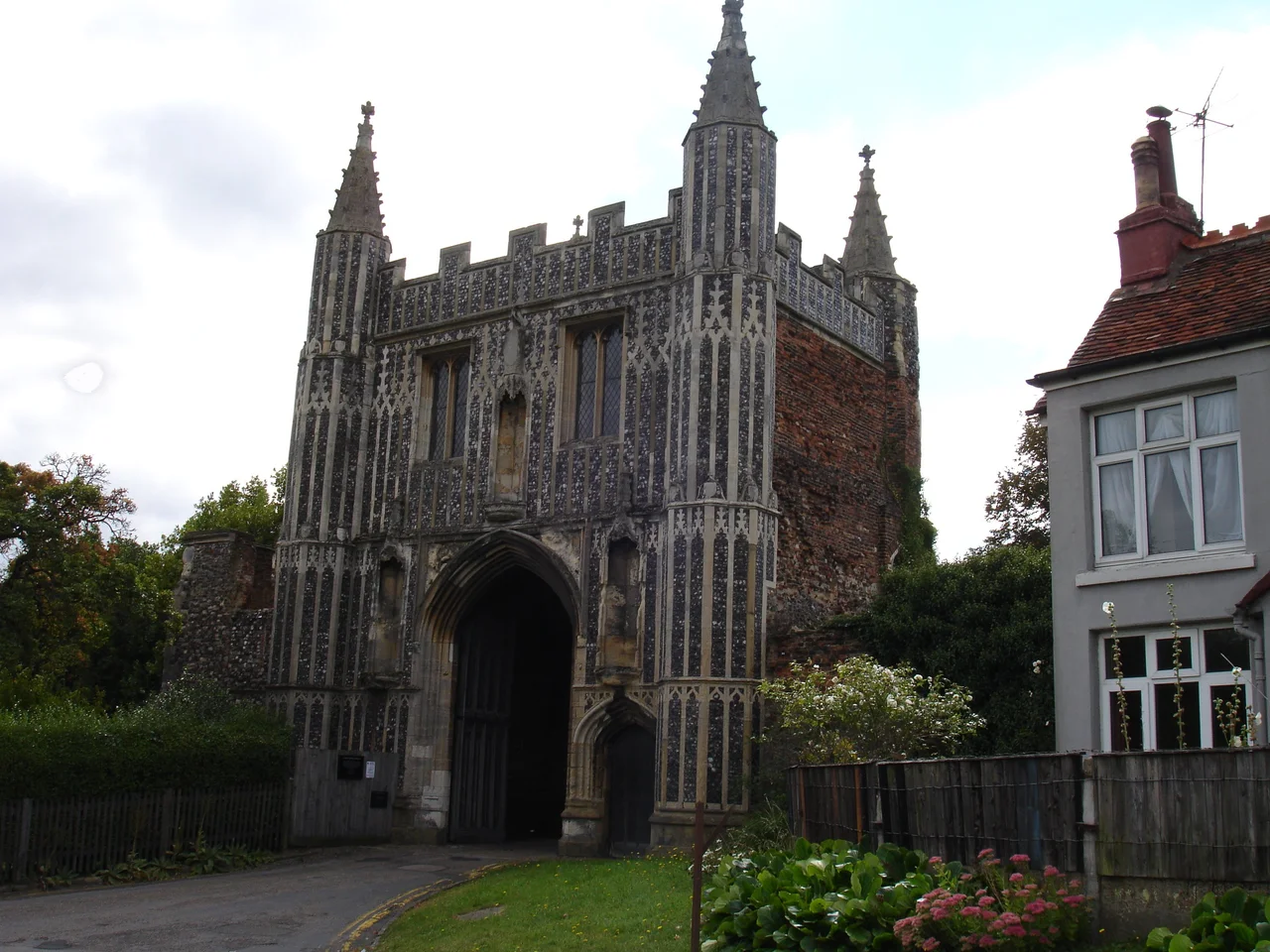

St John's Abbey, Colchester
Outside the southern wall of Colchester, on the road to Mersea, a single flint-and-stone gatehouse stands in a small park, looking as if it has been delivered from elsewhere. Its battlements are sharp, its flushwork panels still legible after six hundred years, its outline almost too elegant to be the entrance to a vanished thing. But it is. Pass underneath the gate and you walk into nothing - an empty lawn where a Benedictine abbey church once stretched ninety metres from west door to high altar, longer than its neighbour St Botolph's Priory and one of the largest monastic churches in the east of England. The abbey is gone. The gatehouse and the story of the last man to lead it are what remains.
A Sheriff Founds an Abbey
St John's Abbey was founded in 1095 by Eudo Dapifer, the Norman steward to William II and the same baron who had been entrusted with Colchester Castle. Eudo brought monks from the Benedictine house at Rochester and granted them generous lands; construction of the abbey church proceeded between 1096 and 1115. Royal favour followed quickly. A 1104 charter confirmed the abbey's possession of manors at Weeley and Pitsea, a four-day fair at the feast of St John, churches as far away as Leatherhead in Surrey and St Mary Woolchurch in the City of London, and the privilege of holding the same liberties as Westminster Abbey itself. Eudo was buried inside his foundation when he died in 1120. The list of abbots that survives - Hugh of York in 1104, Gilbert de Lungrill, William de Scuri - reads like a roll call of medieval English ecclesiastical politics, each name marking decades of land disputes, royal visits, and accumulated wealth.
Lands, Cells, and a Quarrel with a Leper Hospital
The abbey grew rich. By the high medieval period it controlled manors at Brightlingsea, Greenstead, Berechurch, Little Bardfield, Ardleigh, Boxted, East Donyland, Wickham Skeith in Suffolk, Walkern in Hertfordshire, Hamerton in Huntingdonshire, parish churches across Colchester, the watermill at Bourne, and dependent cells at Writtle and Snape. From 1399 the abbot was permitted to wear a mitre, giving him the same dignity as a bishop, and to sit in the House of Lords. The abbey's seal showed St John the Baptist holding the Agnus Dei in a canopied niche with Saints Peter and Paul beside him. Not all the wealth came peacefully. The abbots wanted control over St Mary Magdalene's, a small leper hospital on the road from Colchester to the Hythe port. The rector of the hospital was forced to petition Parliament after one Colchester abbot showed up demanding the hospital's charters and seal, and on being refused, physically threw the master Simon de la Naylonde and a colleague out of their own building. A later inquest acquitted the abbot. The leper hospital remained nominally under his thumb.
Cecily Neville and the Tudors
St John's connections went high. Cecily Neville - mother of Edward IV and Richard III, matriarch of the House of York - remembered the abbey in her will, leaving it a substantial bequest. The Yorkist sympathies of the house may have come from the involvement of local gentry in fifteenth-century court politics; whatever the cause, the abbey's prestige in the Tudor period was real. So was its wealth. At the dissolution the abbey's plate alone weighed more than 2,244 ounces of silver. None of which would protect it. By the 1530s Henry VIII was redirecting monastic England toward the royal treasury, and the larger houses - those with incomes above £200, like Colchester - came under the second wave of Suppression in 1539. The abbot at this moment was Thomas Marshall, who had also gone by the name John Beche, elected in 1533. He was a man with strong opinions and the misfortune to live in a moment when strong opinions about the church killed you.
The Last Abbot, Hanged
Beche refused to surrender. He had supported the executed Bishop John Fisher; he had been heard saying that Henry's first divorce was wrong; he had spoken openly against the dissolution. The Crown moved against him on grounds of treason. In late 1539 Thomas Marshall, abbot of Colchester, was tried for denying the royal supremacy and for spreading sedition. He was convicted, taken to the abbey he had led for six years, and hanged at the gates - the symbolic message unmistakable, that the king's writ now ran through the cloister. He was the last abbot. Colchester Abbey was dissolved in the same year, its buildings stripped of lead and roof timbers, its lands sold off to lay buyers. Marshall is one of a handful of abbots executed during the Dissolution; in Catholic memory he has since been beatified.
Gatehouse, Siege, Survival
The abbey church was demolished gradually over the sixteenth and seventeenth centuries, its stones reused in Colchester houses. The fifteenth-century gatehouse survived. In 1648 it was caught up in the Siege of Colchester - the Royalists fortified the abbey precinct, and Parliamentary forces took it in the storming of 14 July, after which the gatehouse was battered by cannon. The parish church of St Giles, which served the lay community attached to the abbey's north precinct, was heavily damaged in the same fighting; it was rebuilt and now serves as Colchester's Masonic centre. The gatehouse itself was patched up and continued as a private residence, then a folly within a private garden, before passing into public ownership. Today it is in the care of English Heritage, freestanding in a park beside the modern road. Excavations in the 1970s and 90s confirmed the abbey church was 90 metres long, larger than expected. The gatehouse is what you see; the rest is grass and the memory of a hanged abbot.
From the Air
St John's Abbey gatehouse sits at approximately 51.89 N, 0.90 E, immediately south of the line of Colchester's Roman wall, in a small park off St John's Green about 300 metres south of the town centre. Recommended viewing altitude is 1,500-2,500 ft AGL; from above, the gatehouse appears as a small isolated stone structure in a green rectangle - the abbey footprint - bordered by terraced housing. London Stansted (EGSS) is 28 nm west; Southend (EGMC) 24 nm south-west. Class G airspace below the Stansted TMA.
Nearby Stories
- Woolpit 2 km away
- Tilty Abbey 3.6 km away
- Saxmundham 5.6 km away
- RAF Bottisham 6.5 km away
- Kelvedon Hatch Secret Nuclear Bunker 6.6 km away
- Maunsell Forts 7.4 km away
- Battle of Assandun 15 km away
- Broadstairs 36 km away