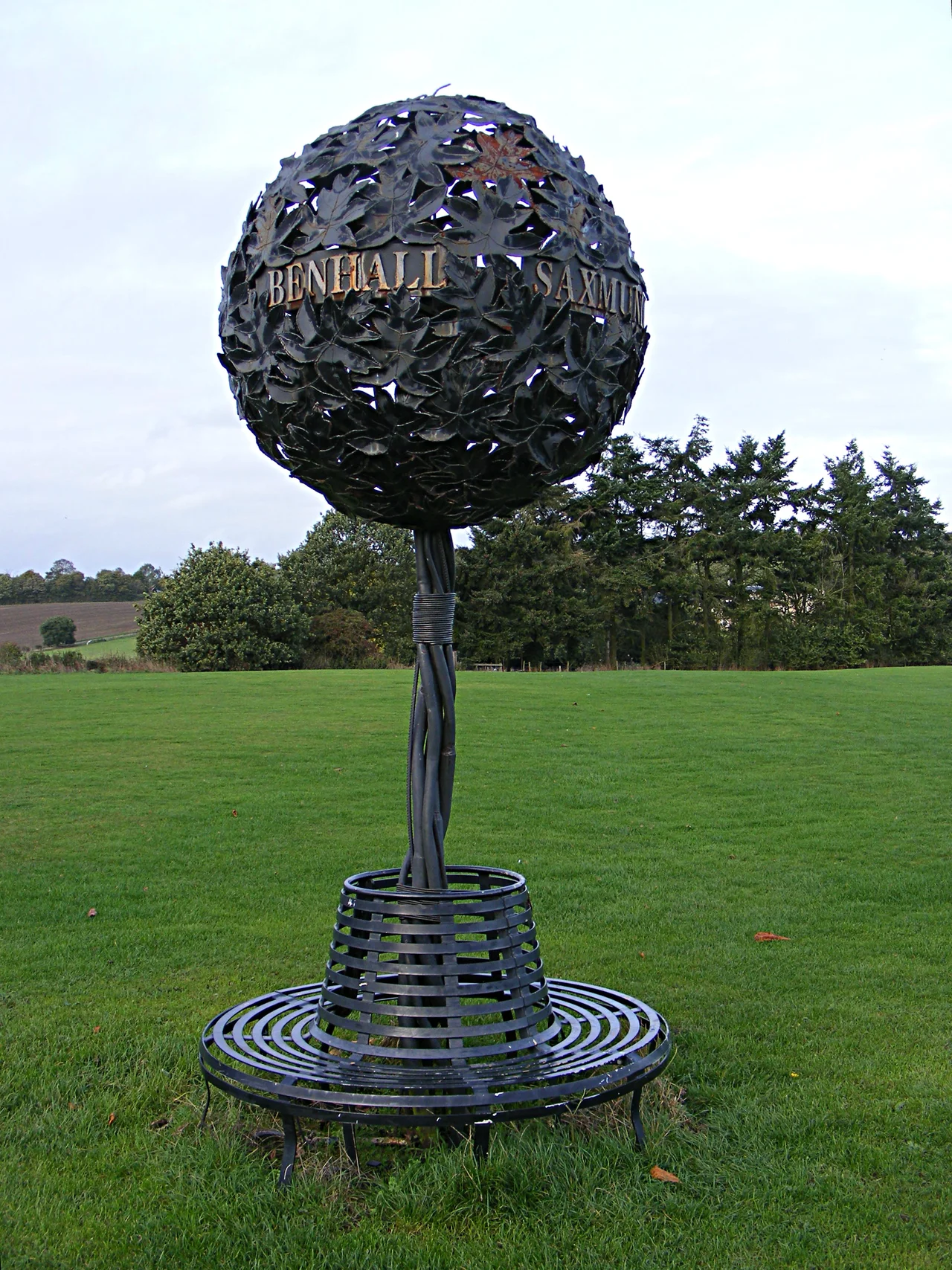

Saxmundham
Ray Allen, the NBA All-Star who would later sink the most important three-pointer in Game 6 of the 2013 Finals, spent some of his childhood years in Saxmundham. His father was stationed at a US Air Force base nearby, and the family lived in this quiet Suffolk market town in the valley of the River Fromus. It is a small detail in a basketball career that ended in the Hall of Fame and a small detail in the long history of a town first attested in the Domesday Book of 1086. Saxmundham collects small details like that.
Seaxmund's Village
The name is first recorded in the Domesday Book as Sasmunde(s)ham and appears as Saxmundham in the Feet of Fines of 1213. The meaning is straightforward Old English: Seaxmund's village or estate. The Parish Church of St John the Baptist dates back to the eleventh century, though most of what you see today owes its appearance to nineteenth-century rebuilding. The baptismal font from around 1400 carries a carving of an angel holding the three crowns of East Anglia, the heraldic symbol of the old Anglo-Saxon kingdom. The town has held a market charter since at least 1272, and a market still runs every Wednesday in the Market Place just off the High Street. The 2021 census counted 4,777 people in the parish, a town quietly going about its business in the valley between Ipswich, eighteen miles southwest, and the coast at Sizewell, five miles east.
A Cast of Quiet Lives
Saxmundham produces an unusual range of notable residents for a town its size. John Shipp, born here in 1784, was an army officer whose military memoirs were widely read across the nineteenth century. Henry Bright, born 1810, became a painter of the Norwich School. The sculptor Thomas Thurlow was born here in 1813. The county cricketer Bernard Collins, born 1880, played for Essex and also wrote a book on life after death titled Death is Not the End, published by Psychic Press in 1939. Buck Read, born the same year, would emigrate to America and coach basketball at Western Michigan University for thirty-one years. Herbert Heyner, the baritone, died here in 1954. The stamp designer Jennifer Toombs, born here in 1940, designed hundreds of stamps for British Commonwealth territories. The artist Maggi Hambling, born in 1945, has lived in a cottage near Saxmundham since the mid-1980s. Sam Miller, born 1962, became a television director. Ray Allen's childhood years here came in the 1980s. The list jumps centuries and disciplines but the centre of gravity stays the same.
Brother Eadulf and the Synod
Saxmundham's most internationally famous resident is fictional. Brother Eadulf, the Saxon monk who serves as companion and assistant to Sister Fidelma in Peter Tremayne's best-selling mystery series, is introduced in 1994's Absolution by Murder as originally the hereditary gerefa, or magistrate, of Seaxmund's Ham in the land of the South Folk. He attends the Synod of Whitby in AD 664 and joins Sister Fidelma in solving the murder of one of the delegates. The series has now reached thirty-one titles in roughly twenty languages. Peter Tremayne is the pseudonym of the Celtic scholar Peter Berresford Ellis, and he chose Saxmundham as Eadulf's place of origin because of local connections, the nearness of the town to an ancient royal burial site of the East Angles, and the historic East Anglian connections with Irish Christian missionaries. The International Sister Fidelma Society publishes a magazine three times a year and has been running for twenty years. Brother Eadulf has appeared in nearly every novel in the series. Only twice has the Saxmundham area actually been the setting, in The Haunted Abbot (2002) and in The Grave of the Lawgiver (2025).
On the East Suffolk Line
The A12 between London and Lowestoft bypasses Saxmundham to the east, and the East Suffolk Line between Ipswich and Lowestoft stops at Saxmundham railway station, where Greater Anglia trains pass through every couple of hours. The town became part of Plomesgate Rural District in 1894, became an urban district in its own right in 1900, was abolished in 1974 and folded into the Suffolk Coastal district, and in 2019 became part of the merged East Suffolk district. The eleven-councillor town council is led by a Town Clerk named Sharon Smith. There is bed-and-breakfast accommodation, a couple of campsites, and the Wednesday market with indoor and outdoor stalls. The town fits inside the valley as it always did, and the river Fromus runs through it on its way to join the Alde a few miles east. Nothing here is grand. Plenty is durable.
From the Air
Saxmundham sits at 52.215 N, 1.487 E in the valley of the River Fromus, about eighteen miles northeast of Ipswich and five miles inland from the coast at Sizewell. From 1,500-3,000 feet the town shows as a compact grid of streets along the A12 and the East Suffolk Line. The dome of Sizewell B is visible to the east on a clear day. Nearby airfields: Wattisham (EGUW) about 20 miles southwest, Norwich (EGSH) 35 miles north.
Nearby Stories
- Burgh Castle 5.7 km away
- East Bergholt 6.7 km away
- RAF Great Ashfield 8.7 km away
- Battle of the Gabbard 15 km away
- Four Days' Battle 34 km away
- Southern Bight 57 km away
- SS Elbe 90 km away