
East Bergholt
Walk into the churchyard of St Mary the Virgin at East Bergholt and you will hear something almost no other English church can produce. The bells do not ring from a tower, because there isn't one. They ring from a wooden cage at ground level, the heaviest five bells in regular use in England, swung by men and women standing beside them with their hands on the headstocks. The reason for this 500-year-old oddity is straightforward and slightly absurd: Cardinal Wolsey fell from grace in 1530 and the money for the tower stopped coming. The bells went into a temporary cage in the churchyard, and the temporary cage is still there.
Where Constable Was Born
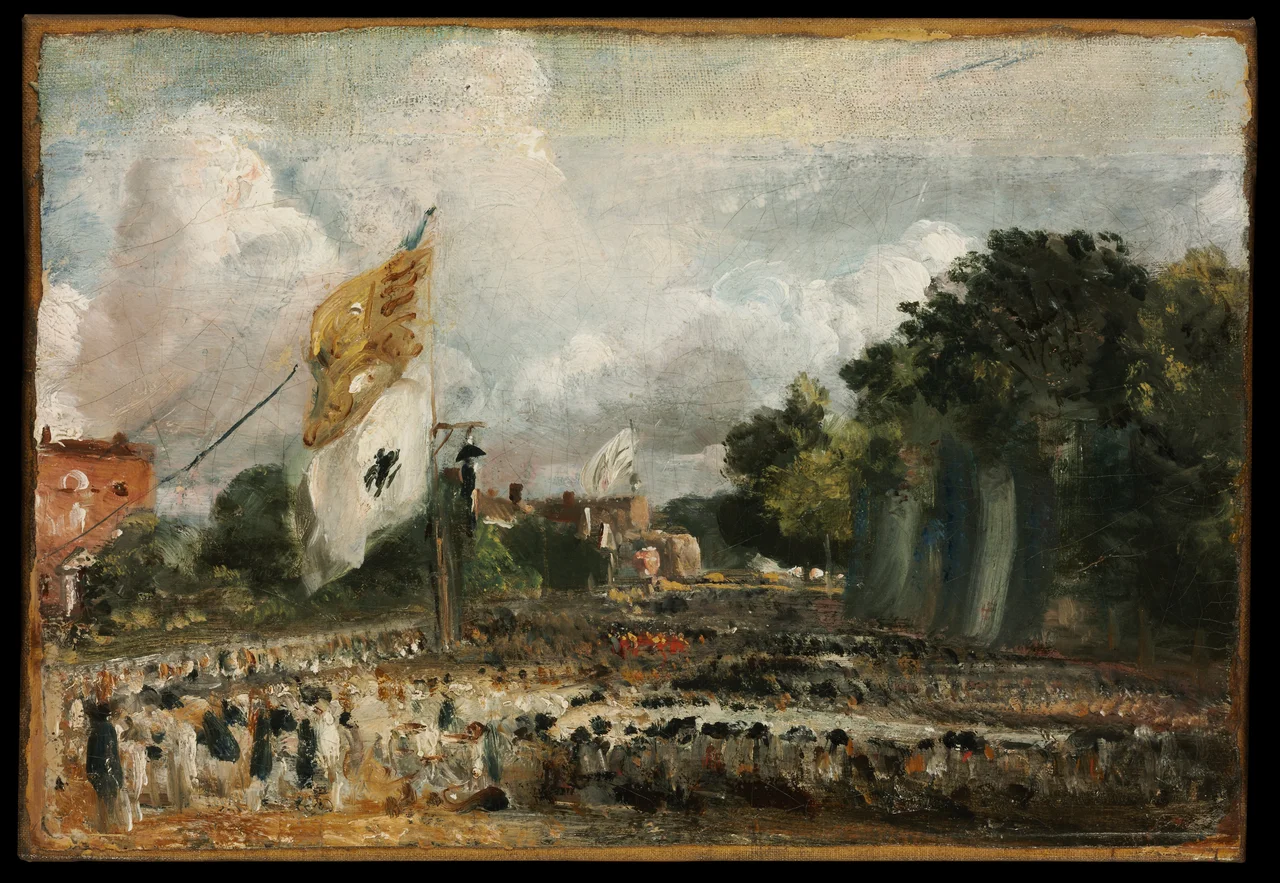
In 1776, in this same parish, a corn merchant named Golding Constable became the father of a son called John. The boy grew up around his father's mills and barges on the River Stour, walking the same lanes between East Bergholt, Flatford, and Dedham that he would later paint into the most famous landscapes in English art. The Hay Wain, painted from the front of Flatford Mill in 1821, set Willy Lott's cottage into the global imagination. East Bergholt is the source pool of that imagination. Constable's house no longer survives, but the rectory featured in his Landscape with Clouds still stands, and the village he sketched repeatedly across forty years has changed less than most of England.
The Bell Cage
Work on St Mary's tower began in 1525 with high ambitions. Wolsey, the most powerful churchman in England, was patron. When Henry VIII's break with Rome destroyed Wolsey's career in 1530, the tower stopped at its current truncated state. The parishioners built a wooden cage in the churchyard the following year to hold the bells "temporarily." The tenor weighs 1 ton 6 hundredweight - about 1,320 kilograms. The bells are tuned A, G, F♯, E, and D, and ringers manipulate the headstocks by hand rather than pulling ropes. Sometime in the 17th century, possibly because the occupant of Old Hall objected to the noise, the cage was reportedly moved. A 1731 map suggests it once stood east of the church. It still rings today, the temporary solution that outlasted its problem by half a millennium.
Protestant Radicals and Quiet Lanes
The village had a reputation for radicalism in the 16th century. Several inhabitants were burned as Protestant martyrs during Mary I's reign, and John Foxe recorded their stories in his Book of Martyrs. Robert Samuel, clergyman, died in 1555 - one of the names Foxe preserved. Centuries later the village remained a magnet for people who valued landscape and independence: Randolph Churchill, Winston's journalist son, lived at Stour House; the Wake-Walker family, including a naval officer buried in the cemetery, took East Bergholt Lodge; the Eley family of East Bergholt Place tended camellias that still bloom in their garden centre. Old Hall, once nunnery and army barracks, today houses about 60 people who farm organically and live cooperatively.
The Postcode Anomaly
East Bergholt sits on the Suffolk side of the river border. The Stour runs through the valley below, and Dedham, across the water, is in Essex. The nearest train station and the postal sorting office are both in Essex, so the village's address says "CO" for Colchester despite being firmly in Suffolk. When a 144-home housing development was approved in 2016 against fierce local opposition, some residents threatened to formally petition to switch counties altogether. The village is twinned with Barbizon, France - another small place whose painters changed how the world saw landscape. The kinship is intentional.
Constable's Country, Still
From above, East Bergholt is a green smudge on the Stour valley, a few minutes' flying south of Ipswich. The river is barely wider than a canal here, but it carried Golding Constable's grain barges down to Mistley and the sea. The vale below the village is now formally designated the Dedham Vale National Landscape, and the National Trust manages Flatford Mill, Willy Lott's Cottage, and Bridge Cottage just down the slope. Stand in the churchyard while the bells are ringing and you can hear what Constable heard - the same five notes, swung by hand in the same wooden frame, while the same clouds move over the same valley.
From the Air
East Bergholt lies at 51.98 N, 1.02 E in the Stour valley on the Suffolk-Essex border, about 8 miles south of Ipswich and 10 miles north of Colchester. From altitude, follow the silver thread of the River Stour east from Sudbury; East Bergholt sits on the north (Suffolk) bank with Flatford Mill directly below. Nearest airports are Stansted (EGSS) 50 miles southwest, Cambridge (EGSC) 60 miles west, RAF Wattisham (EGUW) 15 miles northwest, and Southend (EGMC) 35 miles south. Watch for the truncated tower of St Mary's church and the broad flatness of the Dedham Vale.
Nearby Stories
- Woolpit 2 km away
- Tilty Abbey 3.6 km away
- Saxmundham 5.6 km away
- RAF Bottisham 6.5 km away
- Kelvedon Hatch Secret Nuclear Bunker 6.6 km away
- Maunsell Forts 7.4 km away
- Battle of Assandun 15 km away
- Broadstairs 36 km away