.jpg)
Four Days' Battle
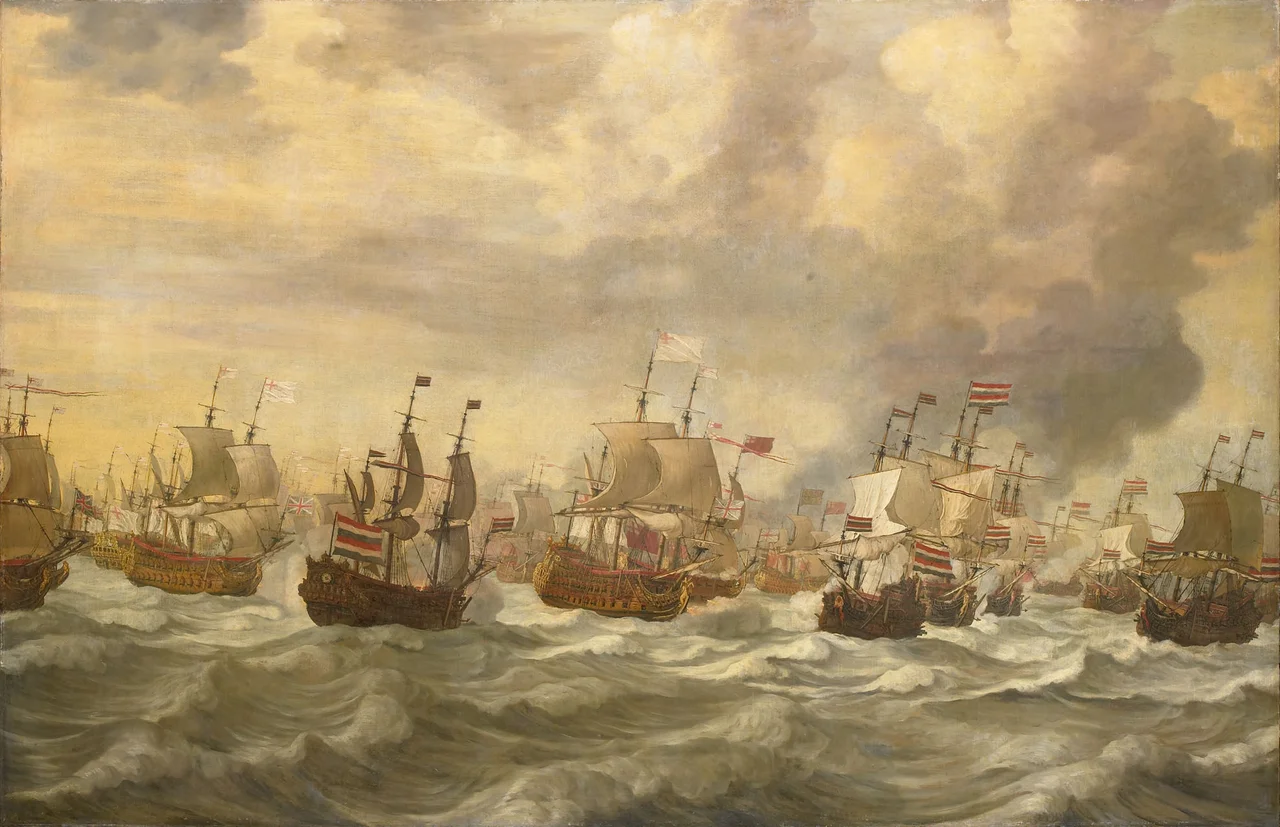
On the morning of 11 June 1666, Michiel de Ruyter's Dutch fleet caught the English at anchor with their topgallants struck, riding out a stiff southwesterly off the North Foreland. George Monck had just learned that a French squadron was supposedly bearing down on him from the west and had detached twenty of his best ships under Prince Rupert to deal with it. The signal was a mistake. Rupert was sailing the wrong way, and Monck was now outnumbered eighty-five to fifty-six. Rather than withdraw to safer water he cleared for action, swung his line south, and went straight at de Ruyter. What followed lasted four days and consumed more powder, men, and timber than any naval battle Europeans had ever fought.
The Largest Fleets of the Age of Sail
Numbers tell part of the story. The Dutch sortied roughly eighty-five sailing warships, including the brand-new 80-gun Zeven Provincien on which de Ruyter had hoisted his flag only weeks before. With Cornelis Tromp commanding the rear and Cornelis Evertsen the van, the fleet carried something like 21,000 men. The English put to sea with about seventy-nine ships before the detachment, and on the first day fought with fifty-six. Counting Rupert's returning squadron, the total of warships engaged across the four days came to roughly 140, with a combined crew of perhaps 35,000. No earlier battle had set so many ships of the line against each other in open water. None of the wars before, including the Spanish Armada campaigns of the previous century, had concentrated this much firepower in a single engagement.
Day One: Monck Bites First
Monck attacked downwind, his line of fifty-six heavy ships bearing into eighty-five Dutch from the windward side. Cornelis Evertsen the Elder of Zeeland was killed almost immediately. So was Sir William Berkeley, the English vice-admiral of the white, his ship taken after a savage boarding fight. The line broke into a brawl of squadron against squadron, with smoke so thick that captains could not see their own neighbours. By nightfall both fleets had taken serious damage but Monck's smaller force had refused to be encircled. He withdrew westward toward Rupert, slowed by his damaged ships, while de Ruyter pursued.
Day Two: The Long Retreat
On 12 June the wind shifted east, putting de Ruyter to windward. Monck fought a running battle westward, abandoning his most badly damaged vessels and burning what he could not tow. Cornelis Tromp tried to overrun the English rear in a pincer movement, the tactic he loved best. Monck wheeled his line and held him off. Vice-admiral Abraham van der Hulst was killed leading the Dutch attempt. The English lost more ships. By dusk the survivors were limping toward the Galloper Bank with the Dutch a few cables astern. The Royal Charles, Monck's flagship, was so battered her own gunports were jammed.
Day Three: Rupert Returns, the Prince Royal Burns
On 13 June, Prince Rupert's squadron reappeared from the west. The English now had something close to numerical parity. Then disaster: the 92-gun Prince Royal, flagship of Vice-admiral George Ayscue, struck the Galloper Bank in mid-action and went aground. Surrounded by Dutch warships and fireships, with no chance of being floated off, Ayscue surrendered. The Prince Royal was set ablaze where she lay. The loss of a first-rate flagship of the Royal Navy, and the capture of a vice-admiral, sent shockwaves through London when the news reached Whitehall.
Day Four: Verdict in Smoke
The final day was a confused, exhausted slugging match in poor visibility off the North Foreland. The combined English fleet under Monck and Rupert pushed back, but their losses had become too heavy. Sir Christopher Myngs, vice-admiral of the van, was shot in the cheek and shoulder by a Dutch marksman and carried below; he would die of his wounds days later in London. By dusk both fleets disengaged. The Dutch had won. The English casualty count over the four days exceeded 5,000, with more than a thousand killed including two vice-admirals, and nearly 2,000 taken prisoner. Around twenty Royal Navy ships were lost. The Dutch lost four ships outright to fire and counted over 2,000 dead and wounded, including Lieutenant-Admiral Cornelis Evertsen and Vice-Admiral Abraham van der Hulst. Tactically it was the worst defeat the Royal Navy had ever taken at sea, and one of the worst it ever would.
A Pyrrhic Sort of Victory
The Dutch could not finish what they had started. Less than two months later, on 25 July 1666, the refitted English fleet defeated the same Dutch admirals at the St. James's Day Battle. The next year de Ruyter raided up the Medway and towed the chained Royal Charles home as a trophy, a humiliation that brought Charles II to the negotiating table. But the Four Days' Battle remained the high-water mark of seventeenth-century naval combat. Pieter Cornelisz van Soest painted it. Samuel Pepys, who heard rumours of it from a tearful captain in his coach, wrote in his diary that the news was 'so bad as makes us all melancholy'. Three and a half centuries later, no battle fought under sail has ever matched its scale.
From the Air
Engagement coordinates roughly 52N 2E, between the North Foreland of Kent and the Flemish coast, drifting eastward over four days toward the Galloper Bank and Goodwin Sands. The battle was fought across the modern shipping lanes of the southern North Sea. Nearest airfields: Manston (EGMH) on the Kent coast, Lydd (EGMD) further south, Ostend-Bruges (EBOS) on the Belgian side. From altitude in clear weather the Goodwin Sands are visible at low tide.
Nearby Stories
- Margate Lifeboat Station 3.2 km away
- White Cliffs of Dover 3.9 km away
- HMS Hermes (1898) 8.4 km away
- De Panne 11 km away
- HMS Wakeful (H88) 19 km away
- Clacton Pier 21 km away
- Battle of the Gabbard 33 km away
- Southern Bight 51 km away