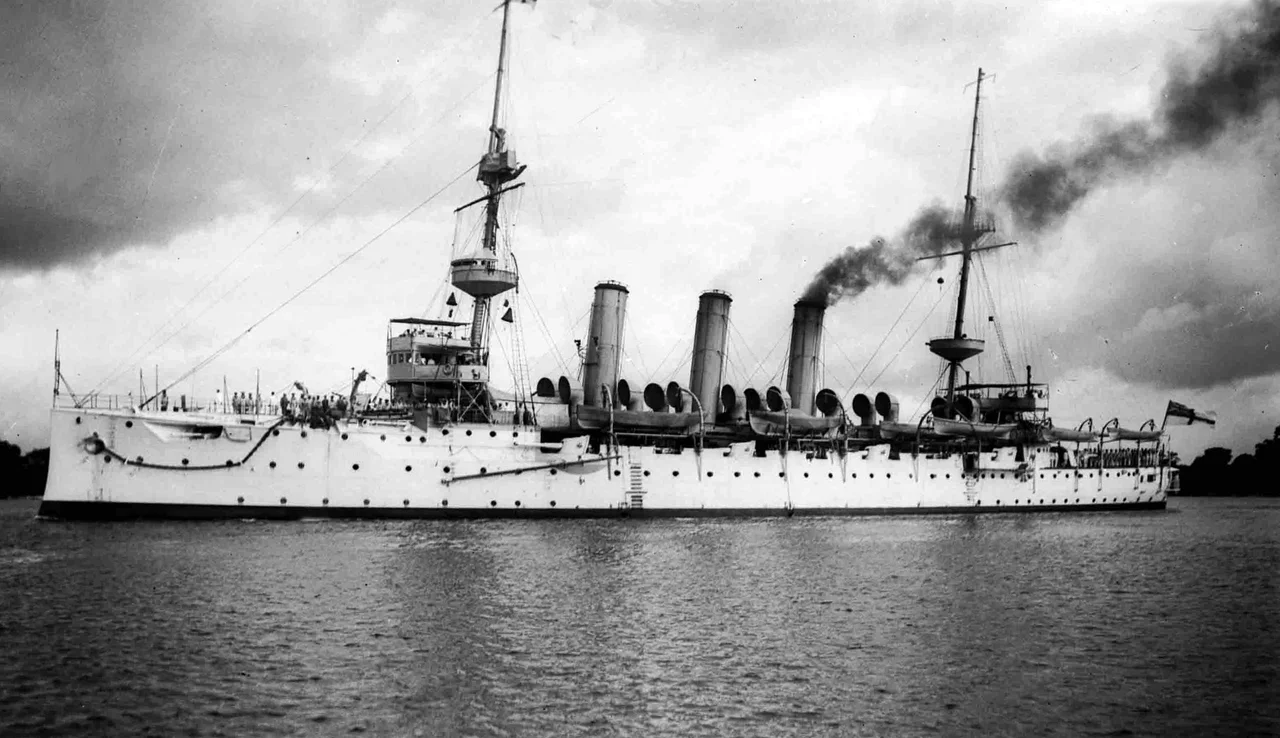

HMS Hermes (1898)
Look down through thirty metres of grey-green Channel water near Ruylingen Bank and you will find her upside-down, a 372-foot protected cruiser flipped onto her back like a beetle. Eleven months before her last morning, HMS Hermes had been the most modern thing the Royal Navy possessed: a Victorian warship with a wooden rail-and-canvas flight deck bolted over her forecastle, lifting wood-and-wire seaplanes off the North Sea to look for enemy ships. She was the navy's first answer to a question nobody quite knew how to ask yet. On 31 October 1914, a German U-boat answered it for her.
An old hull, a strange experiment
Hermes was already an antique by 1913. Built at Fairfield's Govan yard, launched in 1898 by Lady Kelvin, she had served as flagship on the West Indies, East Indies, and Cape of Good Hope stations - the kind of imperial cruising the Edwardian navy liked. She had eleven six-inch guns, eighteen finicky Belleville boilers eventually swapped out at Belfast, and a top speed of 20 knots from 10,000 horsepower. By the time she came home to the Nore Reserve in March 1913, she was a relic. Then somebody in the Admiralty looked at the bare forecastle, at the open quarterdeck, and decided she would do.
The forecastle becomes a flight deck
In April 1913, workmen at Portsmouth pulled out the forward six-inch gun and laid a tracked launching platform over the bow. A canvas hangar went up aft of the rails. A derrick was rigged from the foremast to lift seaplanes back out of the water. Two thousand imperial gallons of petrol went into tins in lockers below. By 7 May she was recommissioned as the Royal Navy's first experimental seaplane carrier, with room for three machines: a Borel Bo.11 monoplane, a Short Folder with its hinged wings, and later a Caudron G.2 amphibian after a storm wrecked the Borel. On 28 July a Caudron lifted off her deck while she was under way - one of the earliest successful launches from a moving British warship.
Pretending to be a Zeppelin
In the 1913 fleet manoeuvres, Vice-Admiral John Jellicoe's Red Fleet needed a Zeppelin to scout against, and Hermes was told to pretend. The Short Folder, weighted to its limit, could only carry a tiny wireless transmitter, so it would fly off, spot ships, and signal back to Hermes - which would relay the report on her bigger wireless. About thirty flights went up before 6 October. The conclusions, written down in clipped Admiralty prose, are obvious now and were not obvious then: aircraft needed proper radios to be useful as scouts, sustained naval flying was possible at sea, and converted landplanes were not the answer. Every aircraft carrier that ever launched a strike traces back to those weeks. Hermes was paid off again in December, the experiment over.
The last morning
When the war began in August 1914 she was hurriedly recommissioned, this time as an aircraft ferry and depot ship for the Royal Naval Air Service. On 30 October she crossed to Dunkirk with a deck-load of seaplanes for the squadrons defending the Channel ports. The next morning she put back to sea for home. Somewhere out in the Straits of Dover a wireless signal warned her of a submarine in the area, and her captain ordered her recalled. She was zigzagging at 13 knots when U-27, commanded by Bernd Wegener, fired from 300 yards. The torpedo found her amidships. She rolled and went down off Ruylingen Bank in shallow water with the loss of 21 of her crew.
The wreck and the law
She is a war grave now, protected under the Protection of Military Remains Act 1986. In January 2017 two English divers were charged with failing to declare items they had brought up from her hull - a reminder that she is still down there in roughly thirty metres of water, upside down, the canvas hangar long gone but the hull intact enough for trespassers to fancy a souvenir. Her name passed on: the next HMS Hermes was a real aircraft carrier, and the one after that fought in the Falklands. The lineage starts here, in the strait, with an old cruiser and a wooden flight deck and a torpedo on a clear cold morning.
From the Air
Wreck site at 51.11N, 1.84E, in the Dover Strait roughly 7 nautical miles east-northeast of Dover. Lies upside down in about 30 m of water. Nearest airfields: Lydd (EGMD) and Manston (EGMH) on the English side; Calais-Dunkerque (LFAC) on the French side. Heavy ferry, container and tanker traffic through the Strait of Dover TSS - look for the unbroken procession of ships rounding South Foreland from cruising altitude. Frequent low cloud and visibility under 5 km on cold mornings.
Nearby Stories
- Ramsgate 1.8 km away
- Battle of Cassel (1328) 1.8 km away
- 1382 Dover Straits Earthquake 4.8 km away
- Admiralty Pier Turret 8 km away
- Plopsaland Belgium 9.7 km away
- Boulonnais 15 km away
- HMS Wakeful (H88) 19 km away
- Royal Sovereign Lighthouse 69 km away