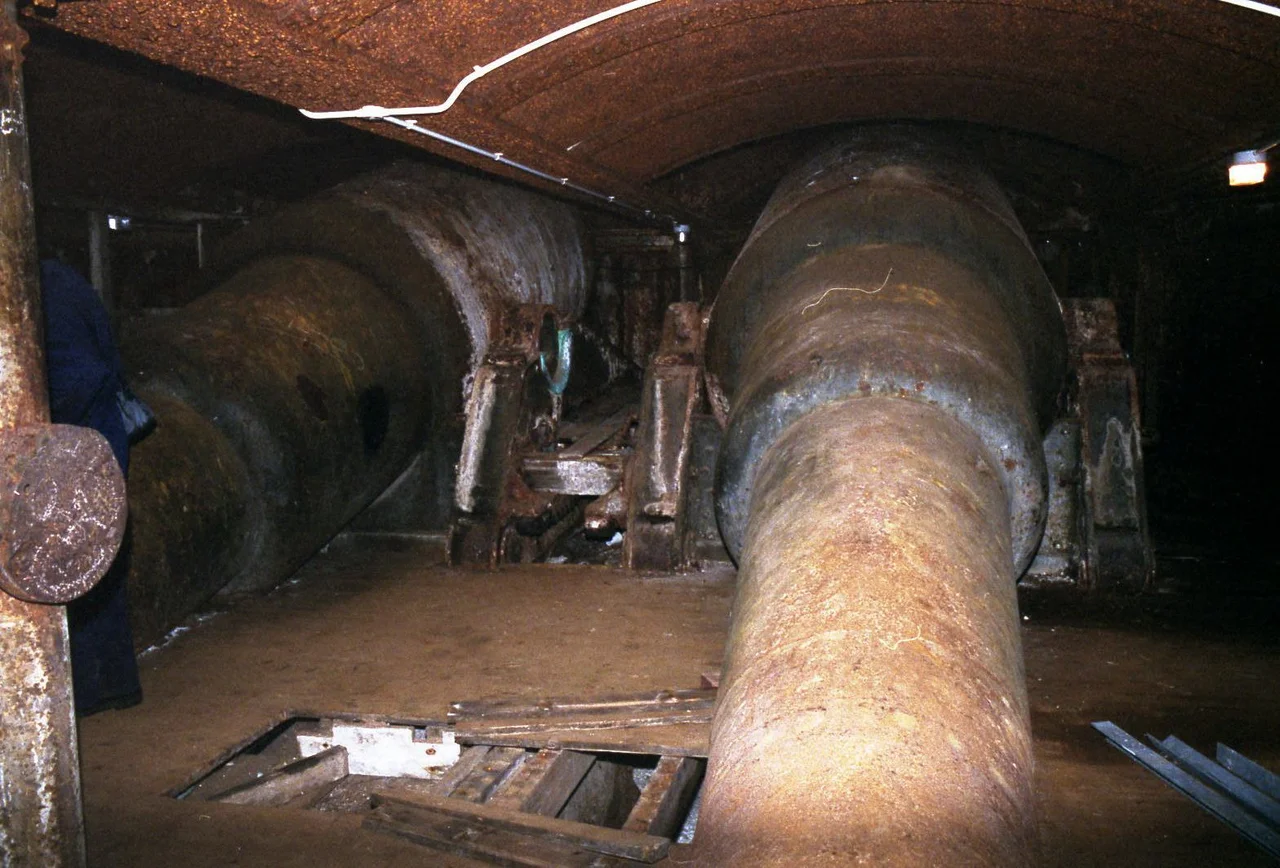

Admiralty Pier Turret
Two guns weighing 80 tons each, the biggest installed anywhere in the United Kingdom, sit silently inside a revolving armoured turret on the Dover breakwater. They have sat there since 1882. They were declared obsolete in 1902 - twenty years of service - and neither of them was ever fired at an enemy. The Admiralty Pier Turret, locally known as the Dover Turret, is one of the more peculiar pieces of Victorian military engineering still in place: 895 tons of wrought iron and steel revolving on 32 rollers, run by four steam engines, designed to penetrate 20 inches of iron at 1,000 yards range, made obsolete almost immediately by the rapid rise of breech-loading naval guns and faster ships. The guns are still in there.
A Fort at the End of the Pier
Dover's Admiralty Pier was already a major piece of Victorian engineering when, in 1872, work began on a small fort at its far end. The engineer in charge, Edward Druce, reported in January 1872 that diving bells had begun preparing the underwater foundations; in January 1874 he confirmed that the substructure was complete at a cost of £19,718 4 shillings 0 pence - a precise enough figure for a war ministry pleased with its own bookkeeping. The fort was originally intended for two 12-inch muzzle-loading rifled guns of 25 tons each, those being the most powerful guns then available. But by 1877, the Defence Committee had noticed that the Royal Gun Factory was building something altogether more impressive: an 80-ton gun capable of penetrating 20 inches of wrought-iron armour at 1,000 yards. They recommended scrapping the 25-ton plan and fitting the new monsters instead. The fort, not yet finished, would need a turret to swing them.
Thames Ironworks Builds the Turret
The turret was built by the Thames Ironworks and Shipbuilding Company at Blackwall, the same yard that had constructed HMS Warrior twenty years earlier. The structure was a wrought-iron frame clad with three layers of seven-inch armour separated by two-inch layers of iron and wood - effectively a battleship's main turret bolted onto a stone fort. With both guns aboard the turret weighed 895 tons and revolved on 32 rollers. Inside were four steam engines: the loading engine, which ran the guns back after firing and lifted ammunition up from the magazines; the main engine for rotating the turret; an auxiliary engine that could substitute for either of the first two; and a donkey engine that supplied water to the two boilers. The first gun was ready by September 1875 after eighteen months of manufacture, tested at the Royal Arsenal Woolwich, then hauled onto the barge Magog and taken to Shoeburyness for proof firings.
Moving Forty Tons of Iron Across a Harbour
Getting two 80-ton guns onto the breakwater was, by 1881 standards, a major engineering puzzle. Rail was considered first - then dismissed because the special carriage required would have no other use afterwards. Barging the guns out was settled on instead, using special sheers and holdfast anchors to lift them across to the turret. The Board of Trade granted permission for manpower-driven capstans to be used instead of machinery, on condition that everything be removed as soon as the guns were landed. An overhead traveller carried the guns from sheers to the turret top. The sheers themselves weighed 100 tons; the traveller weighed 22. The first gun arrived on 4 December 1881 and was in place by 6 January 1882. The second followed on 12 May 1882. By July 1883 the turret machinery was ready for proof testing: 250-pound powder charge, then 337 pounds, then three full battering charges of 450 pounds. The cliffs did not fall down as some nervous locals had predicted. The fort did not collapse. A couple of windows broke in the nearby lighthouse, which seemed an acceptable cost.
Obsolete Almost Immediately
The handover to the Royal Artillery in 1886 came after a final four-round demonstration firing. The Pier Turret was, on paper, formidable - though it had a problem. The magazine was too exposed, and by 1887 a consultative committee was already proposing a new shell store below the waterline and a concrete reinforcement of the turret foundation. Strengthening works went on into the 1890s. But naval technology was racing ahead. The big muzzle-loading guns of the 1870s were already being made redundant by faster-loading breech-loaders, by quick-firing artillery, and by ships that could simply move faster than the Pier Turret could traverse its enormous weight to track them. In 1902 the Admiralty officially declared the 80-ton guns obsolete. They were not removed. In April 1909 two 6-inch BL Mk VII guns were added on the pier roof either side of the turret, with the obsolete turret's magazines repurposed to store ammunition for the new battery. This was named the Pier Turret Battery. A battery command post went up on top of the old lighthouse, which had itself become obsolete after a new lighthouse was built at the end of the extended pier.
Caretaker's Family, Storm, Silence
Between the two World Wars, the Admiralty Pier Fort was turned into a home for the battery caretaker, who lived there with his wife and family - a domestic life conducted inside a coastal fortification with two 80-ton guns dozing in their turret next door. The Pier Turret Battery was reduced to care and maintenance in 1920, used periodically for Territorial Army drill. In April 1944 it became a Home Guard battery. The guns were finally withdrawn to Woolwich in August 1947, after 65 years in their turret. In 1958 the battery buildings were demolished and the 6-inch emplacements tidied; one was turned into a shelter, the other into a viewing platform. The fort and the turret were left. A severe storm in 1987 closed the pier walkway and the turret became inaccessible to the public. Most of the internal machinery has since been removed. But the two enormous Fraser RML 16-inch 80-ton guns and their carriages remain in place - the biggest guns ever installed in the United Kingdom, still pointing out toward a sea that never quite gave them anything to shoot at. The turret remains under the control of the Dover Harbour Board. There are no plans to restore it. It can be viewed for free, from the adjacent Prince of Wales Pier, in daylight hours.
From the Air
The Admiralty Pier Turret is at 51.1116 degrees North, 1.3189 degrees East, on the western breakwater of Dover Harbour in Kent. Best viewed at 1,500 to 3,000 feet AGL - the long Admiralty Pier extends seawards from the western side of the historic harbour, with the white chalk cliffs of Dover and Dover Castle visible to the east, and the cross-Channel ferry terminals immediately inland. France is clearly visible across the Channel on clear days. Nearest airfield: Manston (EGMH) about 12 nautical miles north. Watch for the heavy Channel ferry traffic, the busy controlled airspace, and the helicopter routes to and from the Coastguard station.
Nearby Stories
- HMS Hermes (1898) 7.3 km away
- Herne Bay Museum and Gallery 8.5 km away
- Benenden School 9.2 km away
- Boulonnais 9.4 km away
- Priestfield Stadium 12 km away
- 1382 Dover Straits Earthquake 17 km away
- Royal Sovereign Lighthouse 21 km away
- Battle of Boulogne 28 km away