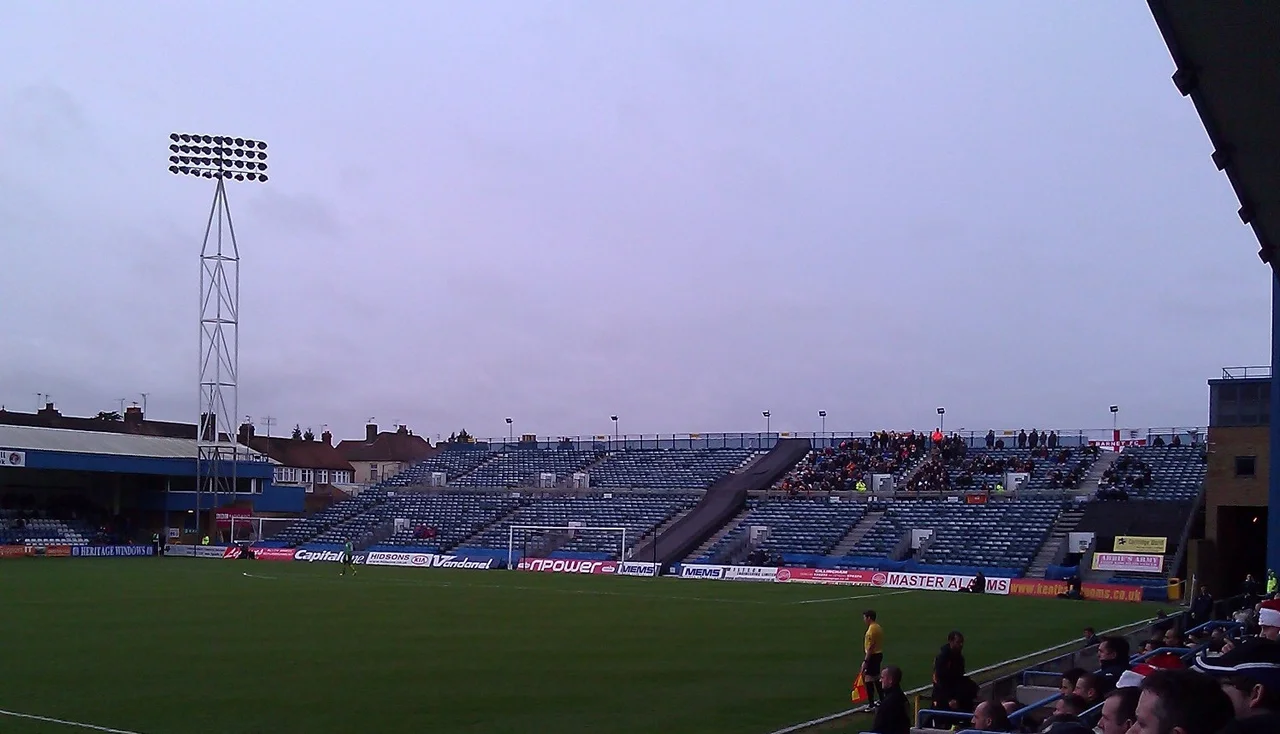

Priestfield Stadium
In 1899, dock workers from the Chatham yards built a second stand at Priestfield in their off-hours, in exchange for beer and cigarettes. This is a real and verifiable line in the history of Gillingham Football Club's home ground. It is also a fair summary of how Priestfield Stadium came together over a hundred and thirty years - in fragments, by improvisation, paid for in shares and supporters' fundraisers and, when nothing else worked, in barter. Today the stadium seats just under twelve thousand, holds four stands all built since 1997, and is still scheduled for replacement by an owner who first promised a move two decades ago.
Sheep on the Pitch
New Brompton Football Club, the founding name of the Gillingham side, formed in June 1893 by issuing fifteen hundred one-pound shares to buy land in Gillingham. The ground was initially called the Athletic Ground, then Priestfield Road after a nearby road, and finally just Priestfield from 1947. The first match was played on 2 September 1893, when New Brompton's reserves faced Grays, followed immediately by the senior team taking on Woolwich Arsenal's reserves. Admission was threepence. Most fans stood on banked earth or along the pitch perimeter. Between match-days sheep grazed the grass - a common arrangement at Victorian football grounds, where keeping the pitch trimmed was a daily problem and a flock was cheaper than a groundsman.
Storms, Sondes, and Steady Growth
By 1908 the ground had eight hundred seats and terracing at the Rainham end. In 1912 the club renamed itself Gillingham, formed its first Supporters' Association, and used a bank loan of 1,570 pounds to put up a proper grandstand. A month after the stand opened, a storm tore the roof off and twisted the ironwork - the club sued the contractor, and it took three more months to repair. The attendance record kept rising despite all this. A 1924 FA Cup match against Cardiff City drew 19,472 spectators; a 1948 cup tie against Queens Park Rangers drew 23,002, with hundreds more turned away outside. In 1955 a major redevelopment levelled the once-sloping pitch, replaced the Gordon Road terracing, and added the Stanley Stand. In 1963 floodlights went up at a cost of more than fourteen thousand pounds. In 1987 the club installed the Lord Sondes Clock, named for the Earl of Sondes who sat on its board. Then, for thirty years, almost nothing changed.
Scally's Renovation
When Paul Scally bought the club in 1995, the ground was famously run-down. Over the next decade he rebuilt nearly all of it. A new Gordon Road Stand opened in 1997 at a cost of two million pounds - supporters initially voted to call it the Paul Scally Stand, and Scally turned the offer down, saying he was 'uncomfortable and embarrassed' by it. The Rainham End went all-seater in 1999. The Main Stand was demolished the same year to make way for the Medway Stand, but the project ran late, and supporters spent most of the 1999-2000 season looking at an empty hole on one side of the ground, then at construction scaffolding, before finally being allowed into a not-quite-finished stand. The Medway Stand has twenty executive boxes, the changing rooms, the club shop, the offices, and (built into it) a banqueting suite with a view of the pitch. Much of its fixtures and fittings were bought second-hand from the closing-down sale of the Millennium Dome.
The Brian Moore Stand and the Sloping Terrace
The fourth and final side was the Town End, demolished in 2003. A temporary stand was raised in its place, named after the late Brian Moore - the football commentator who had been a lifelong Gillingham supporter. It is still a temporary stand. The old Town End had a feature few grounds matched: it sloped sideways, with one end of the terracing visibly higher than the other. When the pitch had been levelled in 1955 the gradient of the Town End behind it was simply left alone. For decades, anyone walking along the Town End walked uphill at one end and downhill at the other. The Brian Moore Stand replaced it but the slope of memory persists in the seating arrangement of visiting supporters. The drainage was finally fixed at the same time, after a notorious FA Cup tie against Leeds United when the pitch had to be heavily sanded because it 'resembled a ploughed field'.
Tenants and Footnotes
Priestfield has hosted clubs other than its own. In 1895, Woolwich Arsenal played a Second Division home game here against Burton Swifts because the Football League had closed Arsenal's own Manor Ground for five weeks after crowd trouble. A century later Brighton and Hove Albion played their home matches at Priestfield for two seasons after losing the Goldstone Ground - their fans, exiled to Gillingham, drove round-trips of three hundred miles or more for every home game, and the two clubs ended up in a dispute over charges that was settled out of court in 2001. In April 2006 England's women's team played a World Cup qualifier against Austria at Priestfield in front of 8,068 spectators - higher than Gillingham's own average home gate that season. From 1927 a flapping greyhound track ran around the outside of the pitch, independent of the National Greyhound Racing Club. The ground has been MEMS Priestfield Stadium for sponsorship purposes since 2011, interrupted briefly by KRBS Priestfield from 2007 to 2010, but in Gillingham nobody calls it anything except Priestfield.
The Move That Hasn't Come
Paul Scally announced in September 2003 that 'there is no future for the club at the Priestfield'. The club outlined plans for a new ground at Cuxton in 2004, abandoned them, and then in 2017 Scally identified Mill Hill, east of the A289 Yokosuka Way, as his preferred site. Each announcement has come and gone. In 2007 the shareholders sold Priestfield itself to a company wholly owned by Scally for 9.8 million pounds as part of a debt restructuring, and the club then bought the stadium back in 2011 for around a tenth of that price. Priestfield's current capacity is 11,582 - down from a peak of nearly 20,000 in the terraced era - and the club's plans for a Premier League future still depend on a new ground that has not yet been built. Meanwhile, on Saturday afternoons, the Lord Sondes Clock is gone and the sheep are gone, but the Gills still take the field on a piece of land bought in 1893 with fifteen hundred one-pound shares.
From the Air
Coordinates 51.3842 N, 0.5608 E, in Gillingham, Kent, in the urban grid south of the Medway and the Chatham Dockyard. The stadium sits about half a mile south of Gillingham railway station on the Chatham Main Line. From the air, identify it by the rectangular footprint of the four stands surrounding a pitch in dense terraced housing, between Priestfield Road and Gordon Road. Recommended viewing altitude 1,500-3,000 feet. Nearest airports: Rochester (EGTO) 4 nm west, Lydd (EGMD) 30 nm south, London Southend (EGMC) 16 nm north across the Thames.
Nearby Stories
- Waltham Abbey Royal Gunpowder Mills 1.6 km away
- Bethlem Royal Hospital 4.4 km away
- Sissinghurst Castle Garden 5.6 km away
- Chelmsford 6.5 km away
- Herne Bay Pier 6.7 km away
- Operation Stack 7.1 km away
- St Osyth's Priory 13 km away
- Plymouth Brethren 24 km away