
Waltham Abbey Royal Gunpowder Mills
The herons fish where the gunpowder used to flow. For more than three centuries, this riverside ground beside the River Lea was where Britain manufactured the means to blow things up - first black powder for the muskets at Waterloo, later cordite for two world wars, and finally RDX, the white crystalline core of the bouncing bombs that breached the Ruhr dams in 1943. Most of the timber-framed mills are still here, threaded by a quiet web of canals built to move barrels of explosive without sparking them. Almost nothing else like it exists. The Ballincollig and Faversham mills, the other two Royal Gunpowder works in the United Kingdom, were demolished or built over. Waltham Abbey is the only one that survived virtually intact.
How the Crown Got Into Explosives
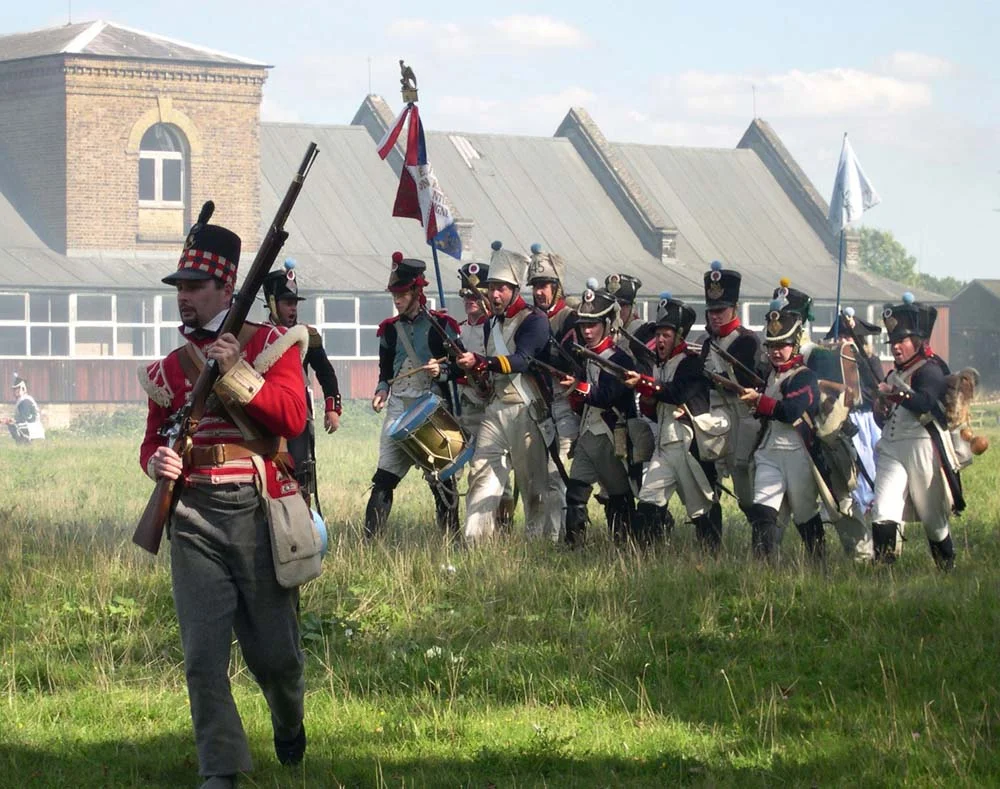
Gunpowder was a private trade until the late eighteenth century. The Crown bought what it needed from the same Faversham and Surrey families who had been mixing saltpetre, charcoal and sulphur since Tudor times - and worried, every year, about whether the quality would hold up in a French war. In 1787, on the advice of Sir William Congreve, then deputy comptroller of the Royal Laboratory at Woolwich, the government took the matter in hand. It bought the existing Waltham Abbey works and put them under direct state control. Congreve - whose son would later invent the war rocket that scorched Baltimore harbour in 1814 and earned a line in the American anthem - wanted gunpowder Britain could trust. Within a generation, Waltham Abbey was setting the global benchmark for purity and consistency, and its black powder was packed into the cartridges that Wellington's gunners fired at Waterloo.
Canals That Could Not Spark
Walk the site now and the layout still makes its own argument. Long, low buildings sit far apart from each other, separated by tree-screened earth banks. Between them runs the canal network - narrow, slow water in which every barrel of finished powder, every barrel of half-mixed ingredients, every wet cake waiting to be pressed and dried, travelled by horse-drawn punt. The reasoning was brutally simple: iron-shod cartwheels on cobbles can spark. Wet wood on wet water cannot. Each blast mound around each building was sized so that if one shed exploded, the next one would not. It mostly worked. There were still terrible accidents - one in 1940, during the Second World War, killed five men and remains one of the worst home-front industrial losses of the war. But the system, designed in the eighteenth century, contained disasters that elsewhere would have flattened whole districts.
Smokeless and Strange
From the mid-1850s onwards, the mills shifted away from black powder toward something stranger and more powerful. Chemists across Europe had figured out how to nitrate cotton, glycerine and other organic compounds to make explosives with five times the punch of gunpowder and without the choking white smoke that gave away every artilleryman's position. Waltham Abbey became the proving ground for British versions: guncotton, cordite, eventually RDX. During the first two years of the Second World War, the site was the United Kingdom's sole producer of RDX. That mattered. RDX is one of the two components, with TNT, of torpex - the dense, water-resistant explosive Barnes Wallis specified for his bouncing bombs in Operation Chastise in May 1943. The cylindrical charges that skipped across Lake Eder and Mohne and tore the dams open had been mixed, in part, on this stretch of Essex water. After the war, RDX production was dispersed to ROF Bridgwater and the mills' cordite work to new sites in Bishopton, Wrexham and Ranskill. The Royal Gunpowder Mills as a manufacturing concern closed on 28 July 1945.
Rocket Motors and Skylarks
Closure was not the end. The site reopened almost immediately as the Explosives Research and Development Establishment, a hush-hush government laboratory that in 1977 took the longer title Propellants, Explosives and Rocket Motor Establishment - PERME for short. The rocket work was real. ERDE and PERME scientists developed propellants for the Skylark sounding rocket, the workhorse of British high-altitude research from the 1950s into the 1990s, and for solid-fuel motors used in everything from missiles to the Black Knight launcher. The South site became part of Royal Ordnance plc just before that company was privatised in 1984. The North site stayed under the Ministry of Defence, eventually folded into the Royal Armament Research and Development Establishment, and was finally closed in 1991. After 204 years, the state had no further need of the place.
The Wilderness That Came Back
When the chemists left, the wildlife returned. A large area of the north site is now a Site of Special Scientific Interest - the canals and ponds and decades of restricted access turned out to be unintentional nature reserve. Another section is a scheduled ancient monument. The cordite mills themselves came under threat in 2016 when a children's activity centre proposed demolishing them for dormitories, but Epping Forest District Council, after national press exposure, refused permission. The South site has become Gunpowder Park - 255 acres of regenerated parkland inside the Lee Valley Park, opened in 2004 and now dedicated to arts, science and wildlife. You can tour the surviving mills by land train, see the Napoleonic-era press houses, walk the Cordite Mills lane where workers in soft-soled slippers once carried trays of damp explosive. H. G. Wells, who set chapter 17 of *The War of the Worlds* here, imagined Martians destroying the place. Reality preferred a quieter ending: the herons, the canals, and 300 years of carefully-contained energy at rest.
From the Air
Coordinates 51.693 N, 0.009 W, on the western bank of the River Lea near the town of Waltham Abbey in Essex, immediately north of the M25 motorway. Nearest airports: London Stansted (EGSS) 12 nautical miles northeast and London City (EGLC) 12 nautical miles south. Recommended viewing altitude 1,500 to 3,000 feet AGL - look for the gridded pattern of long, low buildings inside dark wooded earth banks, threaded by the parallel lines of the gunpowder canals just east of the main River Lea. The Lee Valley reservoirs sit immediately south.
Nearby Stories
- The Albert Memorial: A Nation's Grief Cast in Gold 0.2 km away
- Milton Keynes 4.4 km away
- Pleshey Castle 5.9 km away
- Chequers 6.1 km away
- Gravesend Blockhouse 6.8 km away
- Catharine Macaulay 8.9 km away
- Clare Priory 17 km away
- Fowlmere Airfield 17 km away