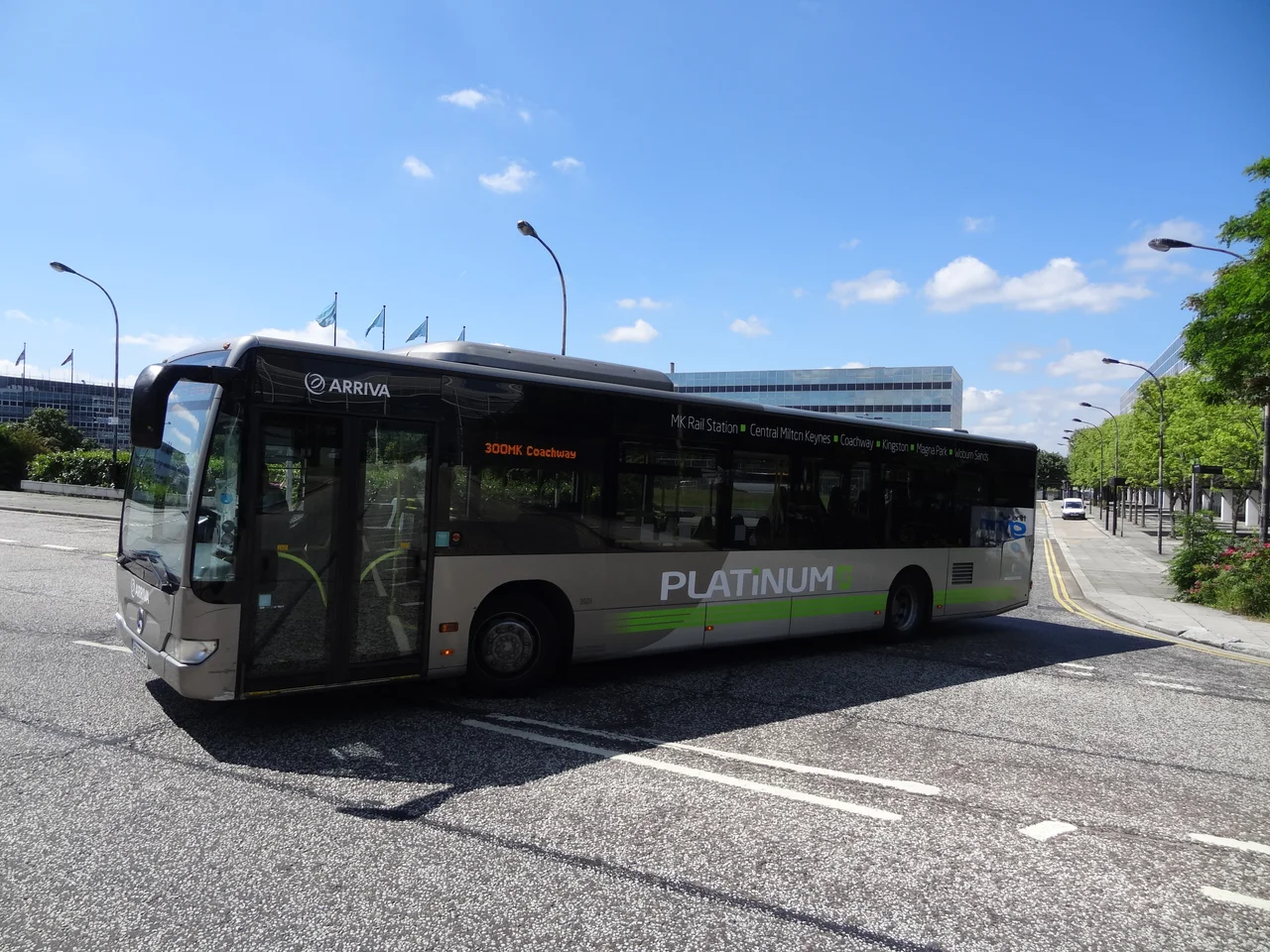

Milton Keynes
Most people in Britain have an opinion about Milton Keynes, and most have never been there. The standard line is 'soulless new town with the concrete cows,' delivered without any visit to back it up. The visitor who actually pulls off the M1 at Junction 14 and explores discovers something the slogans miss: a city with twenty-two million trees, two Sites of Special Scientific Interest, a high street made of red tarmac cycle paths instead of cars, and the kitchen-table site where the Second World War was won. Yes, the concrete cows exist. They are also delightful. Bring a map.
Getting Lost on Purpose
The main roads of Milton Keynes are laid out as a grid - numbered H roads running horizontally and V roads running vertically - with roundabouts at every junction and tree-lined corridors deliberately designed to muffle traffic noise. The visual effect is that all the main roads look more or less the same. New drivers regularly drift through three roundabouts before realizing they have gone the wrong direction since the second one. Locals know this. The trick is to keep a map handy and trust that you will end up somewhere interesting. Pedestrians and cyclists have a parallel network called the redways - paths of red-coloured tarmac that follow the grid but cross every main road by bridge or underpass, never at grade. The redways are a marvel and a way to see the city that no driver ever does. They are also poorly signposted, so the rule for the redways is the same as for the roads: bring a map.
Bletchley Park
On the southern edge of the city stands a Victorian mansion that is the actual reason hundreds of thousands of people visit Milton Keynes each year. Bletchley Park was the wartime home of the British codebreaking operation that read the German Enigma cipher. It is now a museum, and a deeply moving one. The huts where mathematicians and linguists - many of them women, working twelve-hour shifts in unheated wooden buildings - decrypted intercepted messages have been restored. Alan Turing's office is preserved. Next door, the National Museum of Computing operates a working rebuild of Colossus, the world's first programmable electronic digital computer, originally built here in 1943 to crack the Lorenz cipher used by the German High Command. Visitors stand in the same room where Colossus was operated and watch the rebuilt machine chatter through a sample decryption. Bletchley is the kind of museum where you arrive expecting an hour and leave four hours later, having missed lunch.
Concrete Cows, Real Cows, Old Towns
Liz Leyh's Concrete Cows have been parked in a field by Bancroft since 1978 - a piece of public sculpture that the locals adopted and the national press never let them forget. They are smaller than expected, somewhat awkward, and completely charming. The originals are now at the Milton Keynes Museum; weatherproof replicas continue to graze in the field. The city sits on twenty-two thousand acres, much of which is parkland or original villages absorbed into the planned area. Stony Stratford is the highlight: a high street of quirky independent shops and proper British pubs, with river walks immediately behind it. Local legend says the phrase 'a cock and bull story' was coined here, from the names of two coaching inns, The Cock and The Bull, where travellers between London and Birmingham swapped increasingly improbable yarns. Newport Pagnell has its own collection of pubs and a more village feel. Both reward an afternoon's wandering.
Lakes, Snow Slopes and Skydiving Indoors
Willen Lake is a balancing lake - a piece of urban flood engineering - that doubles as one of the city's main recreation hubs. The south basin has a wakeboarding tow-rope system, watersports, and a path around the water that lets you do a circuit on foot or by bike. The north basin is a bird sanctuary. Next to the lake sit Gulliver's Land, a theme park aimed at younger children, and Eco Park. In Central Milton Keynes itself, the Xscape building houses an indoor real-snow ski slope, a climbing wall, and an indoor vertical wind tunnel for skydiving practice. None of these things are what visitors expect to find in an English city. All of them are surprisingly good. For something more peaceful, the city is unusually rich in formal gardens - Campbell Park is described in the Pevsner architectural guide as the most imaginative park laid out in Britain in the twentieth century, which is a remarkable thing to say about an entirely planned landscape.
Eating, Drinking, Staying
The Centre: MK is the main shopping centre - over two hundred and thirty stores, all under cover, all with good disabled access. The central restaurant cluster sits around the theatre district, Xscape and The Hub. For something with more character, the outlying villages absorbed into Milton Keynes - Stony Stratford, Wolverton, Fenny Stratford - have most of the independent restaurants and the proper pubs. Treat yourself to a full English fry-up at Kay's Kitchen in Stony Stratford. Try The Plough in Simpson or Ye Olde Swan in Woughton on the Green for pub food and decent beer. The Old Beams in Shenley Lodge is good. For nightlife, the theatre district and Xscape area run hot on weekend nights; a CAMRA member should head to Stony Stratford instead. The hotels are mostly chains - Holiday Inn, Hilton, Travelodge, Jurys Inn - with some bookable in the bustling centre and others in quieter spots near Willen Lake.
From the Air
Milton Keynes is at 52.033°N, 0.767°W, about fifty miles northwest of London. From altitude, the city is unmistakable: a rigid grid of main roads cutting through gentle Oxford clay countryside, with the linear parks of the River Ouzel and Great Ouse threading the urban area in green. London Luton (EGGW) is the nearest major airport at twenty-five miles south; Cranfield (EGTC) sits ten miles east. London Heathrow (EGLL) is fifty-five miles south via the M1 and M25. The Grand Union Canal traces the eastern edge of the urban area - look for the Iron Trunk aqueduct over the Great Ouse at Wolverton.
Nearby Stories
- Coombe Abbey 3.5 km away
- Waddesdon Manor 3.7 km away
- Battle of Edgehill 5.8 km away
- Battle of Naseby 8.7 km away
- Hertfordshire 9.9 km away
- Connington South Rail Crash 11 km away
- St Neots 13 km away
- Cotswolds 35 km away