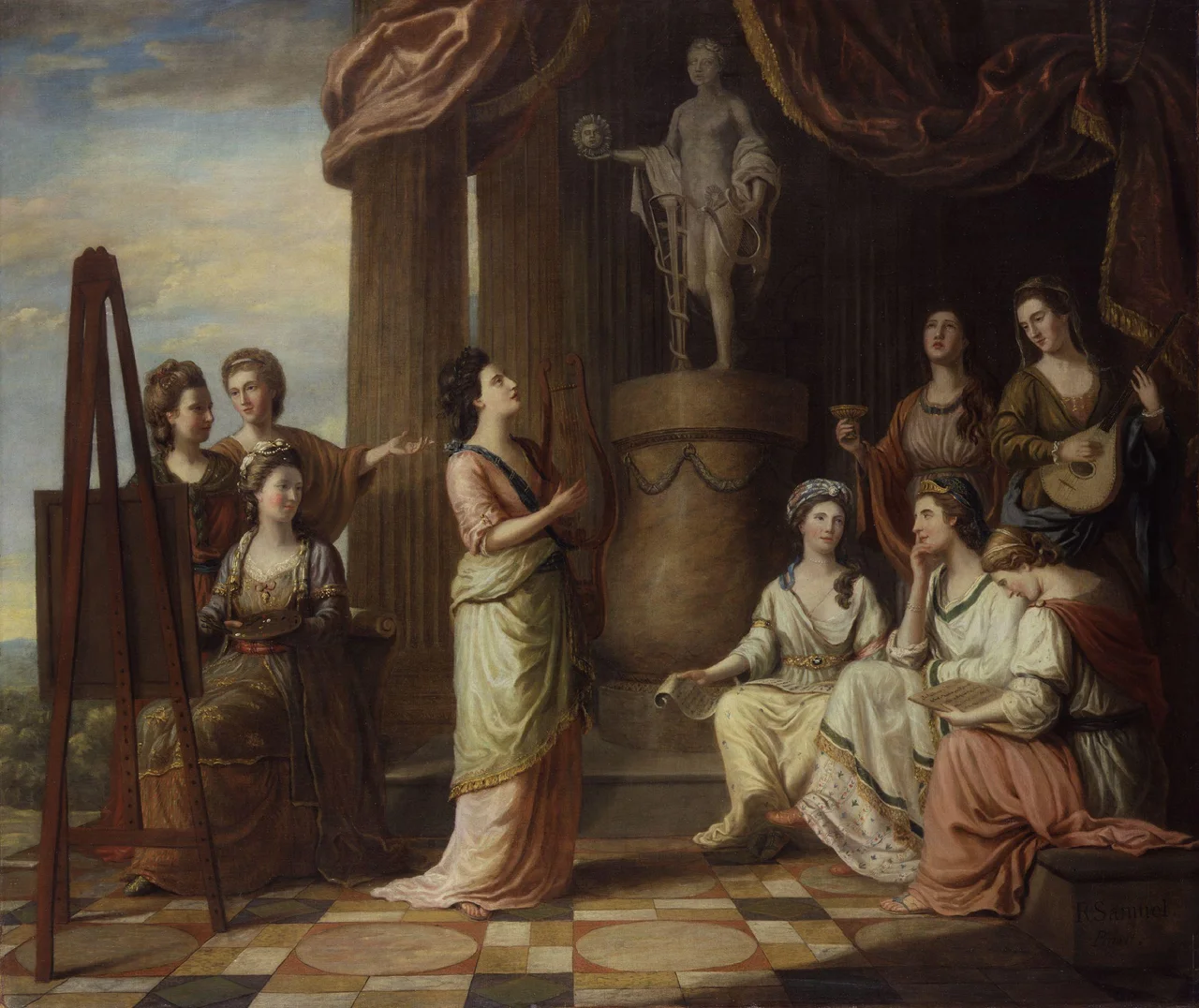

Catharine Macaulay
In June 1785, after a year touring the new United States, an English historian stayed for ten days at Mount Vernon as the personal guest of George and Martha Washington. Catharine Macaulay was the most famous female intellectual in the English-speaking world. She had written six volumes of a still-unfinished History of England, argued in print that the people had the right to overthrow tyrannical monarchs, corresponded with John Adams and Benjamin Franklin, and been welcomed in revolutionary Paris by Mirabeau and Condorcet. Washington wrote afterward that her principles were so much and so justly admired by the friends of liberty and mankind. Six years later, she died in obscurity in the Berkshire village of Binfield. Her name was being deliberately forgotten.
Olantigh and the Reader
Catharine Sawbridge was born on 23 March 1731 at Olantigh in Wye, Kent, the daughter of a landed proprietor whose ancestors had been Warwickshire yeomanry. Her mother died when Catharine was two. A governess provided some of her education; the rest she gave herself, with a stubbornness that became characteristic. She would later tell Benjamin Rush that she had been a thoughtless girl until she was twenty, when she picked up an odd volume of history left in a window of her father's house and was transformed. Whether or not the story is exact, the intellectual hunger was real. She read herself into the Greek and Roman republics. Liberty, she wrote in her own History, became from childhood the object of a secondary worship. In 1760 she married George Macaulay, a Scottish physician, and moved to St James's Place in London. With his encouragement she began to write. The first volume of The History of England from the Accession of James I to that of the Brunswick Line was published in 1763 and made her, almost overnight, the Celebrated Mrs Macaulay.
Against David Hume
The History was conceived as the Whig reply to David Hume's enormously successful Tory History of England. Where Hume saw Parliament's seventeenth-century revolutionaries as troublesome enthusiasts, Macaulay saw them as the patriots who had attacked, at the hazard and even the loss of their lives, the formidable pretensions of the Stuart family. She believed the Anglo-Saxons had possessed freedom and representative institutions, and that the Norman Conquest had imposed a yoke that English history was essentially the story of throwing off. She approved of the execution of Charles I. She called the Commonwealth of England the brightest age that ever adorned the page of history. She denounced Oliver Cromwell, however, as the vain-glorious usurper who had ended that brightness for purely personal ambition. William Pitt the Elder praised her work in the House of Commons. Joseph Priestley and John Wilkes admired it. Horace Walpole's friends carried foreign visitors to her drawing room because she was one of the sights of London.
The Scandal of 1778
Catharine Macaulay had been widowed in 1766. She raised her daughter Catharine Sophia and continued her writing. In 1774 she moved to Bath, where the radical Reverend Thomas Wilson installed her in a house and erected a statue of her as the goddess of history in his church. The arrangement was ostentatious and her enemies whispered. Then in November 1778, at the age of forty-seven, she married William Graham, a twenty-one-year-old surgeon's mate she had met through her younger brother. The scandal was instant and lasting. Friends abandoned her. Her London circle dropped her. The Whigs who had loved her now found her impossible. Samuel Johnson, who had always disliked her politics, was at his most cutting. She remained productive in her marriage. The first volume of her second history, covering the period from the Glorious Revolution forward, appeared the same year as her wedding. But her place in English public life was gone. She and William Graham travelled to revolutionary America from July 1784 to July 1785, the first English radical to visit after independence.
America, and Wollstonecraft
Macaulay's American journey was an act of intellectual pilgrimage. She stayed with John and Mercy Otis Warren and influenced Mercy's own work as a historian of the Revolution. She met Richard Henry Lee in New York. She corresponded with John and Abigail Adams. At Mount Vernon she pressed Washington for materials toward a history of the Revolution that her failing health would prevent her from writing. Back in England she returned to Binfield in Berkshire, the village where she would die. Her 1790 work Letters on Education argued that the apparent weakness of women was the result of their miseducation, and that men and women shared the same natural rights and should receive the same kind of education. Two years later Mary Wollstonecraft published A Vindication of the Rights of Woman. Wollstonecraft wrote to Macaulay directly: you are the only female writer who I coincide in opinion with respecting the rank our sex ought to endeavour to attain in the world. I respect Mrs Macaulay Graham because she contends for laurels while most of her sex only seek for flowers.
The Reply to Burke
In 1790 Edmund Burke published Reflections on the Revolution in France, the great conservative answer to the French upheaval. Macaulay replied immediately with her Observations on the Reflections of the Rt. Hon. Edmund Burke. Where Burke mourned the passing of the age of chivalry, Macaulay called chivalry methodized sentimental barbarism. Where Burke argued that English rights were the inherited gift of kings, she replied that any right given by a monarch could be taken away by a monarch. Only natural rights, claimed by all human beings, could be secured. The boasted birthright of an Englishman she had always thought of as an arrogant pretension, because it implied a kind of exclusion to the rest of mankind from the same privileges. Mary Wollstonecraft's own Vindication of the Rights of Men, also a reply to Burke and a precursor to her Rights of Woman, was deeply indebted to Macaulay. Catharine Macaulay died at Binfield on 22 June 1791. She was sixty. Her great History had reached the year 1689 and was unfinished.
Recovered
For most of the nineteenth century she was forgotten. Her remarriage embarrassed the male historians who controlled the literary canon. Her radicalism embarrassed everyone. By the time Thomas Babington Macaulay, no relation, produced his own Whig History of England in the 1840s and 1850s, the original Mrs Macaulay was a footnote. The recovery began slowly in the twentieth century with feminist historians and accelerated after 2000. Karen Green's Catharine Macaulay's Republican Enlightenment in 2020 placed her firmly in the canon of Anglo-American republican thought. Wollstonecraft's debt is now standard scholarship. The French Ministry of the Interior had, in 1798, recommended the History to French schools as suitable prize material; the recognition that took her own country two centuries longer to give. The statue Reverend Wilson erected of her as the goddess of history was removed long ago. The history of England has at last caught up with her.
From the Air
Binfield, where Catharine Macaulay lived in her final years and died, sits at approximately 51.44°N, 0.79°W in the modern Bracknell Forest unitary authority area of east Berkshire. The village is two miles north-west of Bracknell town centre and ten miles south-east of Reading. Visual landmarks at altitude include the Swinley Forest woodland to the south, Bracknell town centre to the south-east, Ascot Racecourse five miles east, and the M4 motorway four miles north. The area sits under the London TMA at moderate altitudes; Heathrow CTR is twelve nautical miles east. Nearest GA airfields are EGLF Farnborough 6 nautical miles south, EGTB Booker 12 nautical miles north, and EGTF Fairoaks 9 nautical miles east.
Nearby Stories
- Hampton Court Palace: Henry's Obsession, William's Ambition 1.7 km away
- Hungerford Massacre 7.4 km away
- Chequers 9.7 km away
- Hatfield rail crash 12 km away
- Mottisfont Abbey 15 km away
- Queen Victoria Hospital 25 km away
- Hampshire 32 km away
- Cotswolds 34 km away