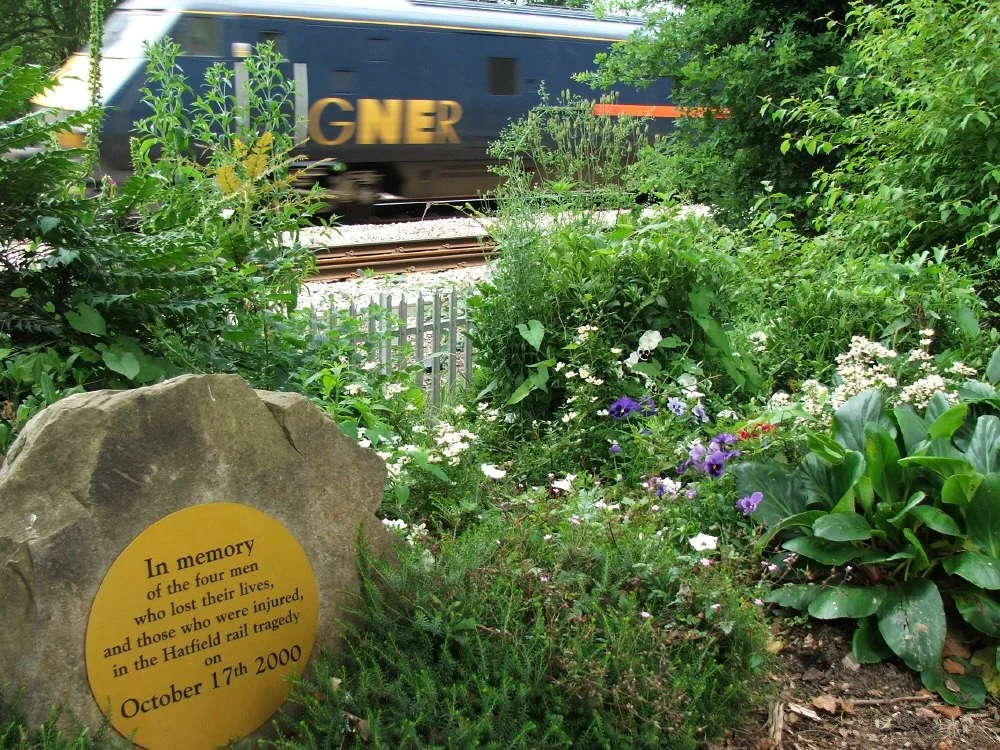

Hatfield rail crash
Four people boarded the 12:10 from King's Cross to Leeds on 17 October 2000 and never came home. Robert Alcorn was a 37-year-old pilot from Auckland, on his way to a job interview. Steve Arthur, 46, lived in Pease Pottage in West Sussex. Leslie Gray, 43, came from Tuxford in Nottinghamshire. Peter Monkhouse, 50, an advertising executive from Leeds, was also travelling in the restaurant coach. At 12:23, somewhere south of Hatfield station on the East Coast Main Line, a length of rail under their carriage shattered. It had been cracked for months. The replacement rails were sitting in a yard, in the wrong place. The train was doing 115 mph.
How a Rail Breaks Quietly
Railway engineers call it rolling contact fatigue. Every time a wheel passes over a rail head at speed, the steel where the wheel touches it is squeezed against itself with enormous force. Do that ten thousand times, a hundred thousand times, a million, and microscopic cracks begin to grow under the running surface. They are invisible to a passing inspector. They spread sideways through the steel until the surface above them spalls off in flakes - five millimetres deep, a hundred millimetres long at Hatfield - and then the rail simply falls apart under the next train. Railtrack knew this. A company letter in December 1999, ten months before the crash, warned that its own specification was inadequate to guard against the problem. Replacement rails for the Hatfield section had been ordered and made. They had just never been delivered to the right place.
Twelve Twenty-Three
The Great North Eastern Railway InterCity 225 set was sleek, modern, capable of 140 mph. The Class 91 locomotive at the front, its driver and the first two coaches stayed upright on the rails after the failure. Everything behind them did not. The carriages buckled into three sections across more than 1,000 yards of track. The Mark 4 stock - British Rail's last great passenger design - held its shape almost everywhere. The exception was the restaurant car, where the four who died were eating. Thirty-three other passengers were injured, three of them seriously. The locomotive, oddly, would survive Hatfield, get repaired, then be the lead unit at the Selby rail crash four months later, get repaired again, and run for another twenty years before being scrapped in Nottingham in 2021. Drivers and crew nicknamed it Lucky.
The Manager Who Did Not Know
The investigation that followed turned over more uncomfortable stones than anyone had expected. Since the privatisation of British Rail in the mid-1990s, Railtrack had outsourced almost all of its engineering expertise to contractors. The maintenance procedures still existed on paper, and those procedures, properly followed, would probably have caught the cracked rail. They were not being followed. In an interview that became famous afterwards, a Zone Quality Standards Manager admitted, on the record, 'I do not have knowledge of railway engineering nor railway safety' - a sentence directly contradicting his job description. The Head of Track had warned in May 1999 that insufficiently skilled work was breaking more rails than the network could keep up with. Because nobody knew which other stretches of track were quietly cracking, Railtrack imposed more than 1,800 emergency speed restrictions across the network. The country's railways ground to a crawl for months. Freight operator EWS was cancelling up to 400 trains a week. The cost to the British economy was estimated at six million pounds a day.
What Hatfield Changed
Railtrack never recovered. The disruption, the costs, the loss of public confidence: by October 2001, Transport Secretary Stephen Byers pushed the company into administration. His successor, Alistair Darling, replaced it in 2002 with Network Rail, a not-for-dividend successor that brought infrastructure back under something closer to public stewardship. The Institute of Rail Welding was founded the same year, an attempt to rebuild the craft knowledge Railtrack had let drain away. In 2003, charges of manslaughter were brought against five managers and the two corporate defendants - Network Rail and Balfour Beatty's track maintenance arm. By the time the trial began in January 2005, the manslaughter case had been weakened; on 14 July, Mr Justice Mackay instructed the jury to acquit on all manslaughter charges. The health and safety case stood. Balfour Beatty changed its plea to guilty and was fined ten million pounds. Network Rail, found guilty in September, was fined three and a half million. Steve Arthur's widow received one million pounds in damages in 2004; the other three families settled out of court.
A Bend in the Line
Today the East Coast Main Line runs through Hatfield much as it always did - faster now, smoother, the trains quieter. There is no monument at the spot. The exact stretch of track was lifted and replaced within weeks. But the changes that rippled out from those few seconds in October 2000 reshaped British railways in ways still felt. Track inspection regimes were rewritten. Ultrasonic testing trains now sweep the network looking for the invisible cracks that killed at Hatfield. On the fifteenth anniversary in 2015, the RMT union warned that Network Rail's newest maintenance system was confusing and the lessons risked being unlearned. Rail safety, like aviation safety, is built on accidents nobody is supposed to repeat - and the names Robert Alcorn, Steve Arthur, Leslie Gray and Peter Monkhouse remain attached to a stretch of Hertfordshire countryside that travellers cross daily without knowing it.
From the Air
Coordinates 51.7539 N, 0.2217 W, immediately south of Hatfield railway station on the East Coast Main Line in Hertfordshire. The site lies 19 miles north of central London. Nearest airports: London Luton (EGGW) 8 nautical miles north-northwest, London Stansted (EGSS) 16 nautical miles northeast, and London Heathrow (EGLL) 21 nautical miles south. Recommended viewing altitude 2,500 to 4,000 feet AGL - the four-track main line is clearly visible threading between Hatfield town centre and the green wedge of Hatfield House parkland just east. Watch for the high-speed trains on the line itself.
Nearby Stories
- The Albert Memorial: A Nation's Grief Cast in Gold 0.2 km away
- Milton Keynes 4.4 km away
- Pleshey Castle 5.9 km away
- Chequers 6.1 km away
- Gravesend Blockhouse 6.8 km away
- Catharine Macaulay 8.9 km away
- Clare Priory 17 km away
- Fowlmere Airfield 17 km away